Key messages
The data presented provide an overview of institutional road safety management in the Americas. The existence of road safety management coordinating bodies indicates a strong commitment to safeguarding road safety. National strategies and the funding thereof also highlight the seriousness with which the challenge of road safety is being addressed, with a direct impact on reducing serious road traffic injuries and deaths.
In summary, this report highlights the Region’s commitment to improving road safety and preserving health in the Americas:
- Thirty out of 32 countries have a road safety coordinating body.
- Fourteen coordinating bodies perform essential functions recommended by global good practice.
- Twenty-one countries reported having a national road safety strategy, five of which have received full funding to implement it.
- Twenty-nine countries reported having a road traffic crash information system.
- Thirty-one countries reported having a national vehicle registry.
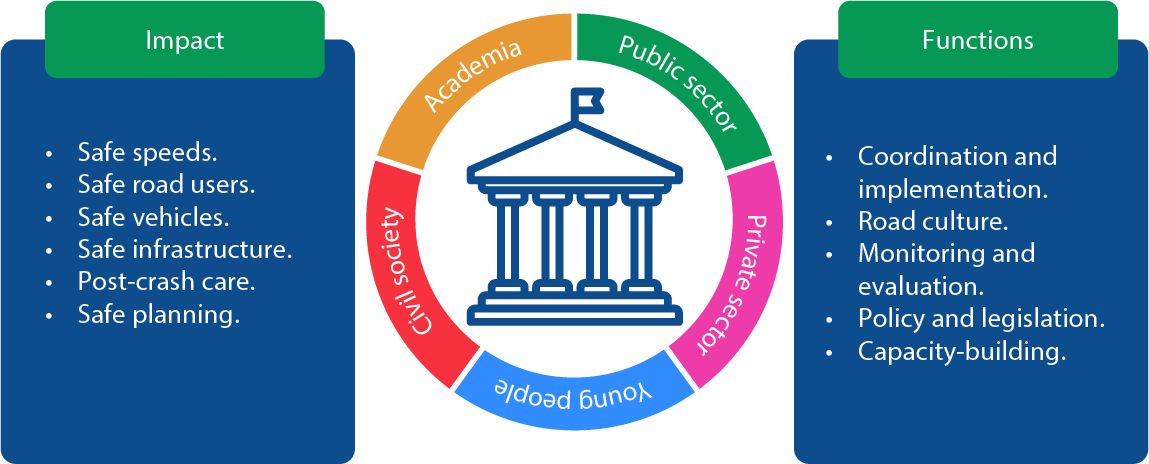
A comprehensive safe systems approach ensures that road users can safely exercise their right to mobility. This approach requires adequate road safety management, which can only be achieved by integrating ongoing actions led by decision-makers and government entities. Road safety management must include a coordinating body or advisory committee fostering the coordination and implementation of road safety actions, involving all sectors of society: the public, academic, and private sectors, civil society organizations, and young people, as shown in Figure 24 (4).
Figure 24. Road safety management using the comprehensive safe systems approach
Regularly monitoring and assessing road safety management measures makes it possible to determine whether all the elements and information needed to quantify progress towards the target of reducing serious road traffic injuries and deaths by 50% are available (3). It is therefore important to know the current implementation status of evidence-based interventions and countries’ progress in terms of coordinating bodies, developing national road safety strategies, and data system availability (8).
Of the 32 countries in the Region of the Americas that participated in the 2023 global road safety survey, 30 (94%) reported having a road safety coordinating body. This is a significant improvement from 2009, when only 42% of countries had a coordinating body (13 out of 31 in 2009, compared to 30 out of 32 in 2023). Despite the progress made in 2023, only 14 countries have bodies that perform essential functions recommended by global good practice, and 11 receive funding for road safety management. Boxes 4 and 5 present national and regional initiatives aimed at improving road safety and sustainable mobility through institutional road safety management.
There has been significant progress in the development of national road safety strategies. In 2009, only 15 out of 31 countries had a national road safety strategy; in 2018, this figure had increased to 22 out of 30 countries. In 2023, however, it decreased to 20 out of 32. More than 20 countries have introduced strategies aimed at reducing the number of road traffic deaths, preventing drink driving, promoting seat belt use, and promoting motorcycle helmet use.
Of the 21 countries that reported having a national strategy, eight reported receiving partial funding, eight received no funding, and five received full funding. 21 Unlike the progress shown in other indicators, funding for national strategies has decreased since 2009. That year, 9 out of 31 countries reported that their road safety strategies were fully funded; in 2023, this figure had dropped to 5 out of 32 countries.
Table 1 shows the progress of coordinating bodies, national strategies, and funding indicators from 2009 to 2023. With regard to global good practice, it shows that countries have enough regional coordinating bodies, a moderate amount of national strategies, and that these are critically underfunded. This could hinder progress towards achieving the targets of reducing the number of road traffic deaths and serious injuries.
Table 1. Regional diagnosis for the period 2009-2023
Note: The colors represent level of compliance with global good practice in road safety management (green indicates compliance, yellow partial compliance, and red non-compliance).
Data systems were divided into health information systems and mobility information systems. As regards health information systems, 29 countries reported having a system that records road traffic crashes (with and without victims). Only 12 countries have a death registration system with universal coverage (eight of these have an unlimited time frame and four set a limit of up to one year after the injury). Seventeen countries amend records up to 30 days after the crash (victims dying up to 24 hours, 7 days, and 30 days later). Meanwhile, 19 countries document information on individuals with serious injuries, and 15 record trauma due to road traffic crashes.
In terms of risk factors, 12 countries (38%) estimate deaths caused by speeding, and 15 (47%) estimate those resulting from drink driving. Twenty-one countries (66%) also reported having a drink-driving information system, and 11 countries (34%) had an information system for other drugs.
In terms of mobility information systems, only 1 of the 32 countries does not have a national vehicle registry. Only 16% (five countries) record frequency and total distribution, and 28% (nine countries) partially record trips by mode of transport. Between six and nine countries (19% and 28%, respectively) reported having transport statistics for walking, cycling, two- or three-wheeled motor vehicles, four-wheeled light motor vehicles, publicly managed roads (e.g., minibuses and public buses, etc.) and trains, planes, and boats. Only one country provided statistics on other personal devices (e.g., scooters). Between 10 and 21 countries (31% to 66%) reported having information systems for speeding, use of seat belts, child restraint systems, and motorcycle helmets, and for distracted driving.
Improving road safety management indicators aids compliance with good practice proposed in global initiatives. This is based on the First and Second Decade of Action for Road Safety (2011-2020 and 2021-2030, respectively), and the proposals of the 2030 Agenda for Sustainable Development, mainly related to Goals 3.6 and 11.2 (4). PAHO offers digital resources to support monitoring of SDG 3 target indicators at the regional, subregional, national, and subnational levels.22
Twelve targets and a series of indicators (34 in total) were proposed to assess progress towards the targets of the Global Plan 2021-2030. There has been slow progress meeting road safety management indicators related to information systems. More than 50% of countries in the Region have achieved Target 1, which involves establishing a multisectoral and comprehensive national action plan by 2030. However, this achievement is not equally distributed across income levels and subregions. Annex 1 outlines the report’s methodology and provides specific details and indicators on road safety management.
Country-specific data allow for assessment of each participating country’s national road safety management strategy. Of the 32 countries, only one (Chile, with 82%) adequately complies with global good practice in road safety management. Eleven countries partially comply (the Dominican Republic and Nicaragua have the lowest compliance percentage, both with 61%, and Ecuador and the United States have the highest percentage, with 72%). Twenty are non-compliant, with the Bahamas and Barbados having the lowest indicators (10% and 11%, respectively). Figure 25 shows countries’ level of compliance with global good practice in road safety management. While the Region has made progress, more than half of countries (a total of 20) do not comply with global good practice.23
Figure 25. Compliance with global good practice in road safety management in the Region of the Americas, 2023
Note: A breakdown of the indicators used to analyze Chapter 2: Institutional road safety management can be found in Annex 1, which describes all the country estimates in detail. The methodological note shows compliance with global practice in road safety management. The British Virgin Islands are not shown on this map.
Source: Prepared by the authors, based on World Health Organization materials. Global status report on road safety 2023. Geneva: WHO; 2023.
The methodology describes all the country estimates in detail, highlighting the fact that 32 countries responded to the survey. However, questions related to road safety management remain unanswered or the information is unknown.
Conclusions
These results may be seen as alarming for the Region of the Americas. It is important to thoroughly analyze each member country’s needs as, although general evidence-based guidelines establish practical and effective measures that all countries are theoretically able to implement, their sociopolitical contexts differ. It is thus important to consider that these results are derived from a quantitative analysis. Qualitative or mixed research could clarify how certain actions have more impact than others, depending on each country’s situation.
Box 4. Regional improvements in data management and exchanging good practice: the Ibero-American Road Safety Observatory
The Ibero-American Road Safety Observatory stems from multiple meetings and discussion forums held by professionals from various countries. These professionals identified the need to address road safety and establish a regional organization and crash database for the countries involved in the Ibero-American Road Safety Program. These countries met at the 26th Ibero-American Summit of Heads of State and Government in 2018. Their aim was to promote safe travel for road users and help reduce injuries, disabilities, and deaths from road traffic crashes.
The efforts made to create this entity have led to regular meetings between road safety officials from the Ibero-American countries. This has enabled discussions on data management, new policy implementation, and the exchange of experiences, technical support, and recommendations for implementing global good practice.
The observatory has implemented six primary objectives to effectively impact public road safety policies and provide advice to key stakeholders in its member countries; however, two of its objectives are essential to road safety management: i) the first focuses on generating and managing standardized information that supports decision-making, with a systematic process that allows for country comparisons; ii) the second focuses on supporting the design and implementation of comprehensive and inclusive mobility and road safety policies, as well as creating or consolidating national bodies that promote forums for regional dialogue and the implementation of road safety practices, with the support of a regional network of experts. The latter could help identify the reasons why not all countries have achieved the same level of progress, and redirect strategies according to each country’s situation. Countries would be expected to encourage the continued efforts of participating individuals and organizations in promoting national and regional programs and projects to improve road safety policies.
The countries and entities that are currently part of this collaboration program are: Costa Rica (presidency), the Dominican Republic (first vice-presidency), Chile (second vice-presidency), Spain (technical unit), Andorra, Argentina, Colombia, the Dominican Republic, Guatemala, Panama, Paraguay, and Uruguay.
Source: Prepared by the authors, based on data from the Ibero-American Social Security Observatory.Box 5. Paving the way for safe and sustainable mobility in Honduras
On 28, 29, and 30 March 2023, the Pan American Health Organization (PAHO) “Workshop to accelerate the impact on road safety and sustainable mobility in the Region of the Americas” was held in Tegucigalpa. Nine priority countries attended the workshop to implement the acceleration strategy: Belize, Bolivia (Plurinational State of), the Dominican Republic, El Salvador, Guatemala, Haiti, Honduras, Jamaica, and Paraguay. Its objectives were: i) to increase awareness of evidence-based intervention strategies to accelerate the impact on road safety and sustainable mobility; ii) to incorporate the impact cycle methodology (delivery) into the approach to road safety policies by all relevant actors (PAHO, governments, civil society, private sector); iii) to design the first version of a roadmap or delivery plan for at least one priority road safety component (identifying key interventions, institutions, actors responsible for their implementation, and the resources required for this); iv) and to introduce mechanisms and routines to accelerate implementation, monitoring, and accountability with all relevant actors.
On 28, 29, and 30 March 2023, Honduras held the Second Road Safety Symposium “Building Alternatives for Safe and Sustainable Mobility”, in Tela. This event was organized by the Honduran National Police, with PAHO providing technical support and funding. The event was led by General Juan López Rochez and featured foreign speakers, representatives from Chile, Costa Rica, El Salvador, Guatemala, Mexico, Nicaragua, and Panama, and officials from PAHO, the National Road Safety Council, and the Honduran National Police. The symposium was designed to be an inter-institutional and international meeting, aiming to promote public policymaking and strategies to facilitate vehicular traffic management and achieve safe and sustainable road mobility in the country. The participants ultimately reached agreements containing solutions to the problems raised and possible strategies. Police Education Directorate officials also gathered information generated at the roundtables to prepare the final report. International experts were acknowledged and the various event participants were thanked.
The Minister of Security and the PAHO Representative Office in Honduras held a strategic conversation. In it, they discussed the needs and demands that the Ministry of Security needs to address, along with the joint technical cooperation that can be provided. Representatives from the Ministry of Security, the National Directorate of Roads and Transportation, and the PAHO team held subsequent meetings to create an initial approach and develop a technical support proposal.
At the Ministry of Health’s request, implementing the Emergency and Critical Care Systems Assessment (ECCSA) tool was also discussed as a means of technical support in pre-hospital care, specifically in the context of road traffic crash emergencies.
In this regard, as part of the 2024-2025 Biennium Plan, the PAHO Representative Office in Honduras is developing a road safety project proposal that includes the needs raised by its counterpart. This includes:
- Technical support to develop the national road safety plan, with broad multisectoral participation and integrated, comprehensive education initiatives to save lives.
- Designing promotional and prevention campaigns related to risk factors, targeting the adolescent population, aimed at changing behaviors to save lives.
- Carrying out an assessment and formulating a strategic plan for organized and integrated pre-hospital emergency care for road traffic crashes and injuries, within primary care and in the community.
- Reviewing and developing policies and the regulatory framework to accelerate action through the national inter-institutional and multisectoral commission on harmful alcohol use, and other public health issues.
Source: Prepared by the authors, based on information provided by Ana Cristina Lozano from the PAHO Representative Office in Honduras.
Footnotes
21 Honduras reported that a road safety strategy would be fully funded, although it does not have a national or subnational strategy.
22 More information can be found at: Pan American Health Organization. Monitoring and analysis of the indicators of the SDG-3 targets and their social inequalities at the regional, subregional, national, and subnational levels. Washington, D.C.: PAHO; [no date]. Available from: https://opendata.paho.org/en/sdg3/monitoring-and-analysis/monitoring-of-targets-and-their-inequalities.
23 Evidence-based interventions recommended by WHO and PAHO can be found at: https://www.who.int/health-topics/road-safety#tab=tab_1.