
Preventing violence against health workers in the Region of the Americas
|
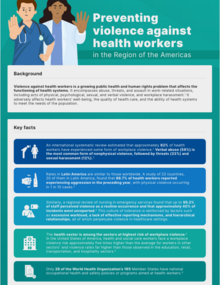
This factsheet presents evidence on the magnitude and characteristics of violence against health workers in the Region of the Americas. It describes the main forms of violence, including aggression perpetrated by patients and their families, violence among colleagues and supervisors, sexual harassment, and violence associated with insecurity and organized crime. It also highlights the disproportionate impact of these forms of violence on certain groups, particularly nursing personnel, women, and those working in frontline and high-demand health services. The publication also examines the consequences of violence for health workers, health facilities, and health systems as a whole, and summarizes evidence-based interventions and measures to prevent and respond to it. These include actions related to public policies, institutional strengthening, workforce training, reporting mechanisms, psychosocial support, and the promotion of safe and healthy working environments. Intended for policymakers, health managers, health professionals, and other stakeholders, this factsheet seeks to raise awareness of the issue and promote comprehensive responses to protect health workers and strengthen the resilience of health systems. |