
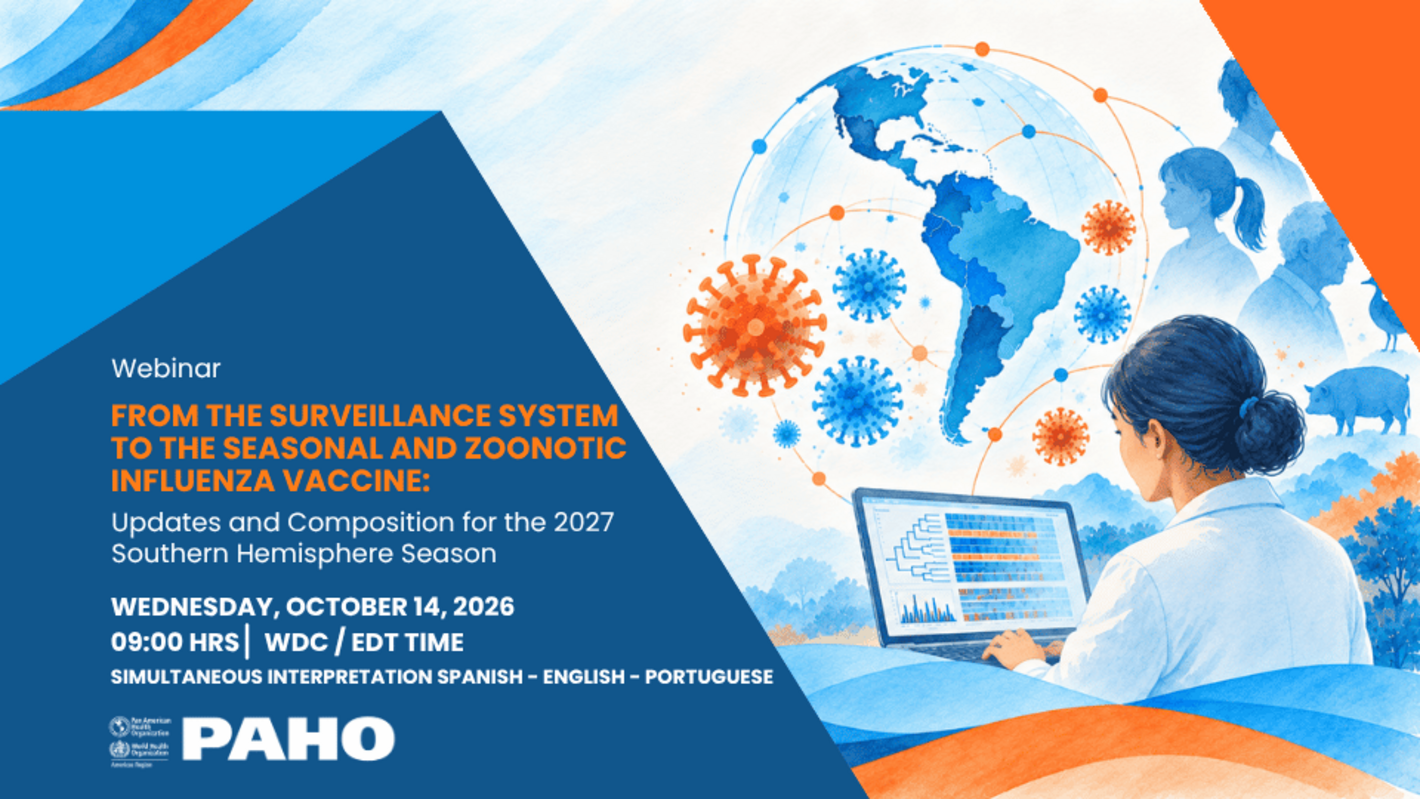
Washington, D.C., October 14, 2026 (PAHO) – The Pan American Health Organization (PAHO) organized a regional virtual seminar on the composition of influenza vaccines for the 2027 Southern Hemisphere season, which connected some 130 participants with experts from the Global Influenza Surveillance and Response System (GISRS) and World Health Organization (WHO) collaborating centers. Among the findings presented was the Region’s contribution to global pandemic preparedness: a virus detected in Brazil was proposed, during the WHO’s September consultation, as a new candidate for a zoonotic vaccine.
The session complemented the previous week’s virtual seminar, “Analysis of the 2026 Respiratory Virus Circulation Season in the Southern Hemisphere of the Region of the Americas,” and focused on the path a sample takes, from the sentinel site to the vaccine decision. Dmitry Pereyaslov, coordinator of the GISRS at the WHO, set the stage: a network created in 1952 that today brings together more than 160 institutions in 139 countries, areas, and territories, and analyzes some 12 million respiratory samples each year. From these, a handful of representative viruses are selected and sent to the WHO for consultations, held in February for the Northern Hemisphere and in September for the Southern Hemisphere.
Rebecca Kondor, director of the WHO Collaborating Center at the U.S. Centers for Disease Control and Prevention (CDC), detailed the recommendations for the 2027 season. The components for influenza A(H3N2) feature viruses from subclade K and influenza B/Victoria featuring viruses from subclade C.3.1 re being updated, while A(H1N1)pdm09 remains unchanged. Data from the Region played a key role in this analysis: since February, 25 countries have shared more than 400 sequences of A(H1N1)pdm09, more than 4,000 of A(H3N2), and more than 2,000 of B/Victoria.
Regarding zoonotic viruses those that spread from animals to humans Thomas Fabrizio of St. Jude Children’s Research Hospital demonstrated how the analysis led to the proposal of two new candidate vaccine viruses: an A(H1N1)v from clade 1C.2.2, associated with a case in Spain, and an A(H3N2)v from clade 1990.5.1, detected in Brazil, for which none of the existing candidates provided adequate coverage.
That second virus is of Brazilian origin, and its history traces back to the country’s surveillance network: three national influenza centers, 310 sentinel sites, and since 2024 a One Health technical committee, created by decree, that brings together seven ministries. This was explained by Fernando Motta of the Oswaldo Cruz Foundation (Fiocruz), who emphasized that the discovery was the result of collaboration between human and animal health sectors. Fiocruz sent the virus to the CDC, where its characterization revealed that no existing vaccine candidate provided adequate coverage a process involving international shipment that requires multiple administrative steps while simultaneously protecting biodiversity and building trust among partners.
This case illustrates the significance of each shipment: a sample arriving at a national influenza center can become evidence for regional and global decision-making. From PAHO, Juliana Leite noted that national centers are committed to making at least two shipments per year, and that timeliness is key to tracking viral evolution.
“The inclusion of this H3 variant among the potential candidates for a zoonotic vaccine is a major achievement for our region and reflects the strengthening of surveillance and laboratory capacity,” stated Andrea Vicari, head of PAHO’s Infectious Threats Management Unit.
Experts noted that the influenza season in the Northern Hemisphere has already begun, and that collaborating centers remain available to support laboratories. Inquiries can be directed to laboratoryresponse@paho.org . PAHO continues to support countries in the laboratory surveillance of respiratory viruses and in the timely exchange of samples and data, which form the basis for vaccine decisions and pandemic preparedness.