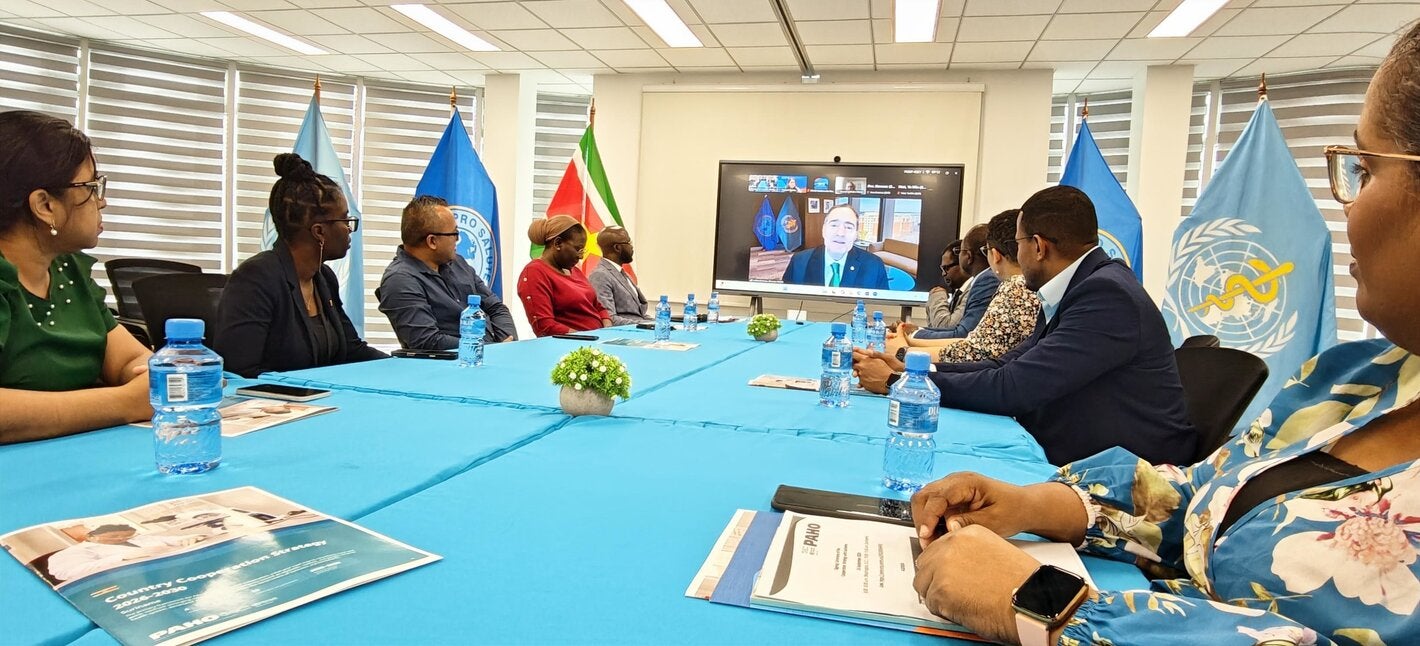
Paramaribo, Suriname, 16 September 2026 - The Government of Suriname and the Pan American Health Organization (PAHO) today signed the Country Cooperation Strategy (CCS) 2026-2030, a shared roadmap to strengthen the country’s health system and improve the health and well-being of all people in Suriname. The Strategy was signed at a virtual ceremony by Drs. André Misiekaba, Minister of Health, Welfare and Labour, and Dr. Jarbas Barbosa da Silva, Director of PAHO.
“This is more than the signing of a document. It is a renewal of our commitment to health as a fundamental right,” said Minister Misiekaba. “But a Strategy has meaning only if it is implemented, and the Government of Suriname accepts its responsibility to translate these commitments into action.”
Dr. Barbosa da Silva stated: “The next step is to translate the shared priorities into concrete action and measurable results. The Strategy provides a clear framework for doing so, while further advancing the collaboration between Suriname and PAHO and focusing our efforts on making a tangible difference for the people of Suriname.”
The new Strategy builds on significant progress. In June 2025, Suriname became the first country in the Amazon region to be certified malaria-free by the World Health Organization (WHO). Important challenges remain, however. Noncommunicable diseases continue to cause premature deaths, and HIV and tuberculosis require sustained attention. Mental health and suicide remain serious concerns, and access to quality care is still uneven, particularly for remote and underserved communities.
Developed through a nationally led consultation and aligned with Suriname's national health priorities, the Strategy focuses on four areas:
- Strengthening leadership, governance and health systems to advance universal health, including health financing, the health workforce, access to medicines and health technologies, digital transformation and people-centered primary health care.
- Enhancing health promotion, immunization, and the prevention and control of communicable and noncommunicable diseases, while advancing the elimination of priority diseases.
- Improving health and well-being across the life course, with a focus on populations in situations of vulnerability.
- Strengthening capacity to prevent, prepare for and respond to emergencies, outbreaks and disasters, and building resilience to climate-related and other emerging threats.
Progress will be reviewed at midterm in 2028 and at the end of the cycle in 2030.
“Everything committed to today must ultimately reach the nurse opening a clinic along a river in the interior, and the family that walks through her door,” said Yafflo Ouattara, PAHO/WHO Representative in Suriname. “That is the real test of a Country Cooperation Strategy: not the ceremony, but the difference it makes in people’s lives.”