
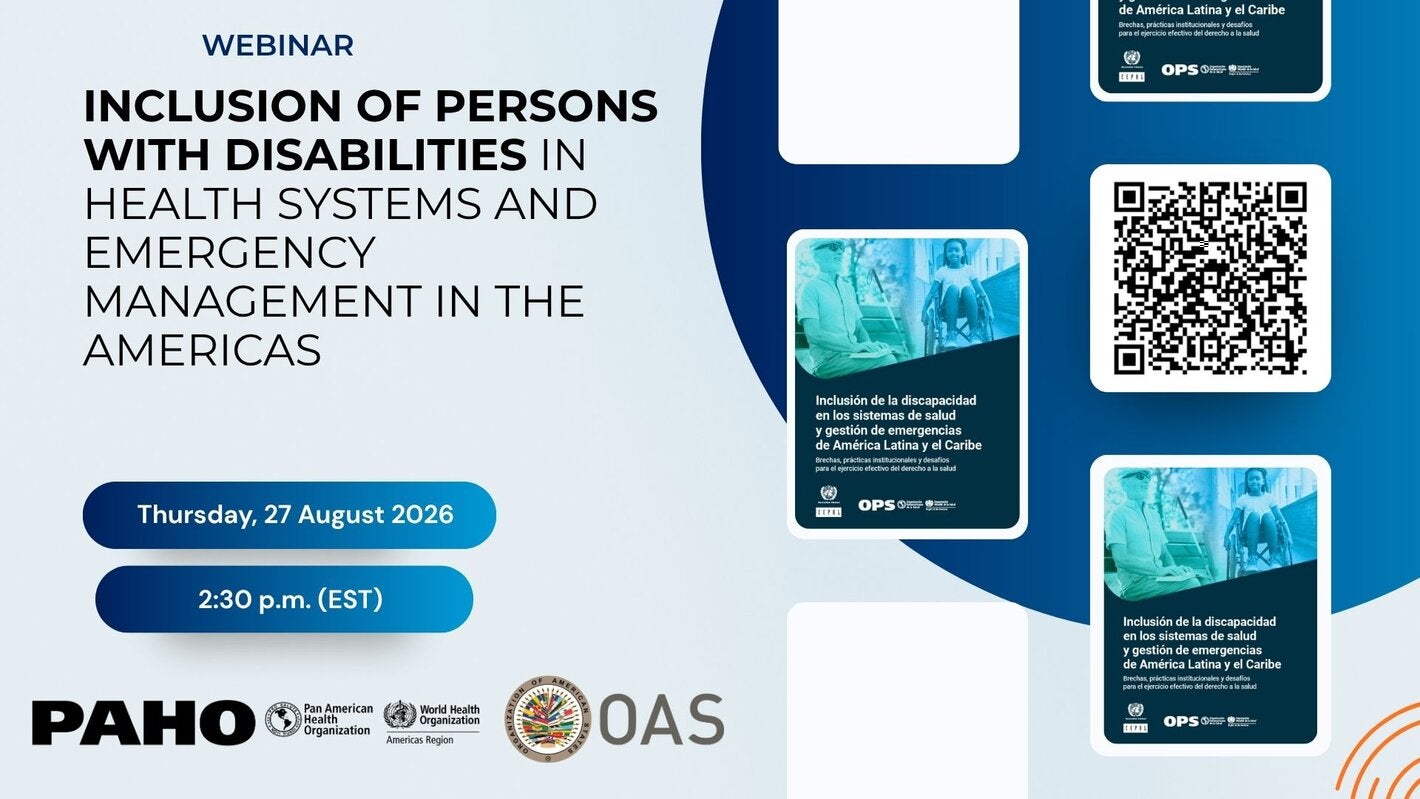
Join us on Thursday, August 27, at 2:30 p.m. (Washington, D.C. time/EST) for the webinar "Inclusion of Persons with Disabilities in Health Systems and Emergency Management in the Americas." This event, organized in collaboration with the Organization of American States (OAS), aims to foster dialogue on three priority dimensions of inclusion:
- accessibility,
- training for health personnel, and
- inclusive emergency management.
The meeting addresses the need to strengthen inter-institutional and regional cooperation and to move toward systems that are more inclusive, resilient, and person-centered.
Webinar Objectives
- Examine key challenges and regional best practices regarding accessibility in health services and emergency response.
- Identify priorities for strengthening the initial and continuing education of health personnel regarding disability, accessibility, reasonable accommodations, and person-centered care.
- Analyze mechanisms to mainstream disability considerations into emergency preparedness, response, and recovery plans.
- Facilitate exchange among the OAS, PAHO, RIADIS, CEDDIS, national disability institutions, and organizations of persons with disabilities to generate multisectoral approaches and perspectives.
- Generate inputs to guide future actions regarding regional cooperation, intersectoral coordination, and institutional strengthening in this area.
RECORDING
How to participate
- DATE: Thursday, August 27, 2026
- TIME: 2:30 p.m. (Washington, D.C. time / EST) [See the bottom of the page for times in other cities]
- LANGUAGES: English and Spanish, with simultaneous interpretation in both languages.
- REGISTER: https://us06web.zoom.us/meeting/register/8L0s1oV-QG25BXxzWys72g#/registration
Agenda
- 2:30 Event presentation and moderation: Silvana Luciani, Unit Chief, Noncommunicable Diseases, PAHO
- 2:35 Opening remarks: Claudia González, Director, Department of Access to Rights, OAS
- 2:45 Expert panel:
- CEDDIS: Antonia Irazábal
- RIADIS: Juan Ángel de Gouveia
- Joint Group-PAD/OAS: Gabriela Martínez
- Special Olympics: Claudia Echeverry
- PAHO: Gustavo Pérez
- 3:45 Questions from participants
- 4:00 Closing remarks: Anselm Hennis, Director, Department of Noncommunicable Diseases and Mental Health, PAHO
Context
The inclusion of persons with disabilities in health systems and emergency management is essential to guaranteeing the effective exercise of the right to health on an equal basis. A recent regional report—produced by the Pan American Health Organization (PAHO), the Economic Commission for Latin America and the Caribbean (ECLAC), and the Latin American Network of Organizations of Persons with Disabilities and their Families (RIADIS) and published in 2026—highlights that, despite regulatory and institutional progress in Latin America and the Caribbean, structural gaps persist regarding access to health services, quality of care, information accessibility, continuity of care, and emergency preparedness. Furthermore, the study emphasizes that disability must be addressed through a human rights-based approach and the social model of disability, ensuring that physical, communication, organizational, and attitudinal barriers are systematically recognized and removed.
Meanwhile, the Comparative Study of National Reports—submitted under the Fourth Monitoring Cycle on the implementation of the Inter-American Convention on the Elimination of All Forms of Discrimination against Persons with Disabilities (CIADDIS) and published by the OAS in 2026—provides valuable evidence on the need to strengthen data collection processes regarding universal access to health services, effective coverage, and the active participation of persons with disabilities in the design of programs and guidelines on sexual and reproductive health.
It also gathers indicators concerning specific protocols for addressing emergency situations and the need to strengthen response mechanisms for persons with disabilities.
The aforementioned reports offer a solid framework for fostering a space for political and technical dialogue among States, regional bodies, organizations of persons with disabilities, and other key stakeholders.
Time in other cities
- 11:30 a.m. – Los Angeles, Vancouver.
- 12:30 p.m. – Belmopan, Guatemala City, Managua, Mexico City, San Salvador, San Jose (Costa Rica), Tegucigalpa.
- 1:30 p.m. – Bogota, Kingston, Lima, Panama City, Quito.
- 2:30 p.m. – Bridgetown, Caracas, Georgetown, Havana, La Paz, Nassau, Ottawa, Port-au-Prince, Port of Spain, San Juan, Santo Domingo, Saint George's, Saint John's (Antigua), Santiago, Washington D.C.
- 3:30 p.m. – Asunción, Buenos Aires, Brasilia, Montevideo, Paramaribo.
- 8:30 p.m. – Geneva, Madrid.
- For other cities, please check local times at the following link.