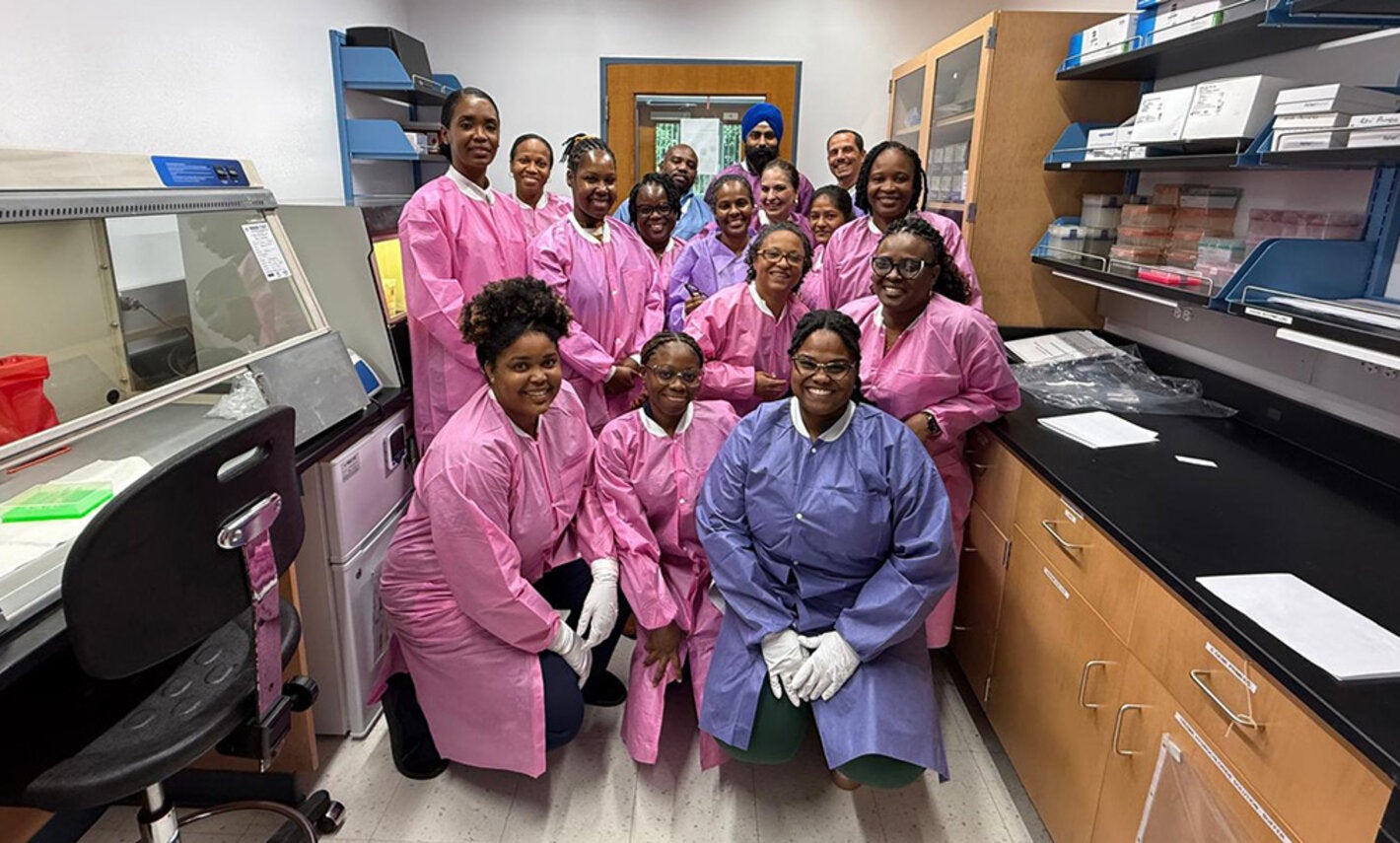
Bridgetown, Barbados, 4 July 2025 (PAHO) - Laboratory staff from across 13 Caribbean nations received extensive training at Barbados’ Best-dos Santos Public Health Laboratory’s National Influenza Centre (NIC), as part of PAHO’s ongoing mission to prepare Caribbean laboratories to effectively manage viruses with epidemic and pandemic potential.
Developed to strengthen the diagnostic and surveillance capacity of human and animal health laboratories in the Caribbean subregion, the workshop ‘Caribbean Workshop on Molecular Diagnosis of Seasonal and Zoonotic Influenza Viruses and Other Viruses with Epidemic and Pandemic Potential’ trained staff as part of the Severe Acute Respiratory Infections Network (SARInet plus) and Arbovirus Diagnosis Laboratory Network of the Americas (RELDA, accronym in Spanish). The training included diagnosis of dengue fever and other viruses, and finding solutions.
The five-day workshop was attended by national reference laboratory staff from the following countries: Antigua and Barbuda, Bahamas, Belize, British Virgin Islands, Cayman Islands, Dominica, Grenada, Guyana, Saint Kitts and Nevis, Saint Lucia, Saint Vincent and the Grenadines, Suriname, and Trinidad and Tobago.
Barbados’ Chief Medical Officer, The Most Honorable Dr. Kenneth George, and PAHO/WHO Representative for Barbados and the Eastern Caribbean Countries (ECC), Dr. Amalia Del Riego, addressed workshop participants.
Dr. George cited the recent detection of human infections caused by avian influenza A(H5) in Ecuador, Chile, Mexico and the detection of avian influenza A(H7) viruses in poultry populations most recently in several USA states, as a reminder of the need to be prepared. “Although there is pandemic potential, the transfer of viruses from animal to humans has been so far very inconsistent at best; however, we must be equipped with the tools and expertise for early detection and diagnosis. I have been informed that the Ministry of Agriculture and Food Security is looking to sample for latent infections in migratory birds in Barbados and this approach is highly supported.”
Dr. Del Riego highlighted how laboratory training benefits populations. “Understanding the true prevalence and spread of a virus, is essential for resource planning, such as hospital bed capacity and stockpiles; informing decisions for targeted interventions; and measuring the effectiveness of implemented public health measures and vaccination campaigns.”
The workshop, funded by the Centers for Disease Prevention and Control of the United States of America and The Pandemic Fund project for Eastern Caribbean Countries being supported by PAHO/WHO, The World Bank and The Food and Agriculture Organization of the United Nations (FAO), and in collaboration with the Organisation of Eastern Caribbean States (OECS), achieved several objectives, including:
- Laboratory professionals were updated on the current regional and global situations concerning zoonotic influenza and other viruses with epidemic and pandemic potential.
- They reviewed the fundamentals of molecular diagnostics, applied to surveillance and emergency response. Their competencies were strengthened in molecular diagnostics for the detection and subtyping of influenza A viruses, including seasonal (H1, H3) and zoonotic (H5, H7) subtypes; and for Oropouche and Mayaro viruses.
In addition, collaboration between public health and veterinary laboratories was further promoted within a One Health framework to detect and respond effectively to zoonotic threats; country teams received support to identify specific needs, challenges, and opportunities for improving molecular diagnostic capacity; and teams of laboratory professionals were encouraged to continue networking and exchanging knowledge to ensure the long-term sustainability of laboratory preparedness efforts in the Caribbean region.