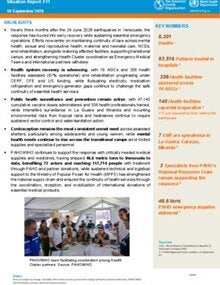
Nearly three months after the 24 June 2026 earthquakes in Venezuela, the response has moved into early recovery while sustaining essential emergency operations. Efforts now center on maintaining continuity of care across mental health, sexual and reproductive health, maternal and neonatal care, NCDs, and rehabilitation, alongside restoring affected facilities, supporting transitional camps, and strengthening Health Cluster coordination as Emergency Medical Teams and international partners withdraw.
Health system recovery is advancing, with 16 ASICs and 356 health facilities assessed (61% operational) and rehabilitation progressing under CERF, CFE and US funding, while fluctuating electricity, medication refrigeration and emergency-generator gaps continue to challenge the safe continuity of essential health services.
Public health surveillance and prevention remain active, with 47,145 cumulative vaccine doses administered and 556 health professionals trained, while intensified surveillance in La Guaira and Miranda and mounting environmental risks from tropical rains and heatwaves continue to require sustained vector-control and water/sanitation action.
Contraception remains the most consistent unmet need across assessed shelters, particularly among adolescents and young women, while mental health needs continue to rise across the transitional camps amid limited supplies and specialized personnel.
PAHO/WHO continues to support the response with critically needed medical supplies and medicines, having shipped 46.6 metric tons to Venezuela to date, benefiting 72 actors and reaching 117,714 people with treatment through PAHO and partner donations, while sustained technical and logistical support to the Ministry of Popular Power for Health (MPPS) has strengthened the national supply chain and ensured the continuity of health services through the coordination, reception, and mobilization of international donations of essential medical products. |