
Situation Report No.8: Earthquakes in Venezuela 2026 (M7.2 and M7.5)
|
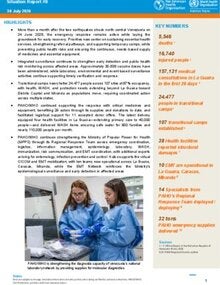
More than a month after the two earthquakes struck north-central Venezuela on 24 June 2026, the emergency response remains active while laying the groundwork for early recovery. Priorities now center on sustaining essential health services, strengthening referral pathways, and supporting temporary camps, while preventing public health risks and ensuring the continuous, needs-based supply of medicines and essential equipment. • Integrated surveillance continues to strengthen early detection and public health risk monitoring across affected areas. Approximately 30,638 vaccine doses have been administered, while laboratory, environmental and event-based surveillance activities continue supporting timely verification and response. • Transitional camps now shelter 24,477 people across 107 sites at 87% occupancy, with health, WASH, and protection needs extending beyond La Guaira toward Distrito Capital and Miranda as populations move, requiring coordinated action across multiple states. • PAHO/WHO continued supporting the response with critical medicines and equipment, benefiting 29 actors through its supplies and donations to date, and facilitated logistical support for 11 accepted donor offers. The latest delivery equipped four health facilities in La Guaira—extending primary care to 40,000 people—and delivered WASH items ensuring safe water for 800 families and nearly 110,000 people per month. • PAHO/WHO continues strengthening the Ministry of Popular Power for Health (MPPS) through its Regional Response Team across emergency coordination, logistics, information management, epidemiology, laboratory, WASH, immunization, risk communication, and EMT coordination, with additional experts arriving for entomology, infection prevention and control. It also supports the virtual CICOM and EMT mobilization, with ten teams now operational across La Guaira, Caracas, Miranda, while the EMT Network reinforces the |