
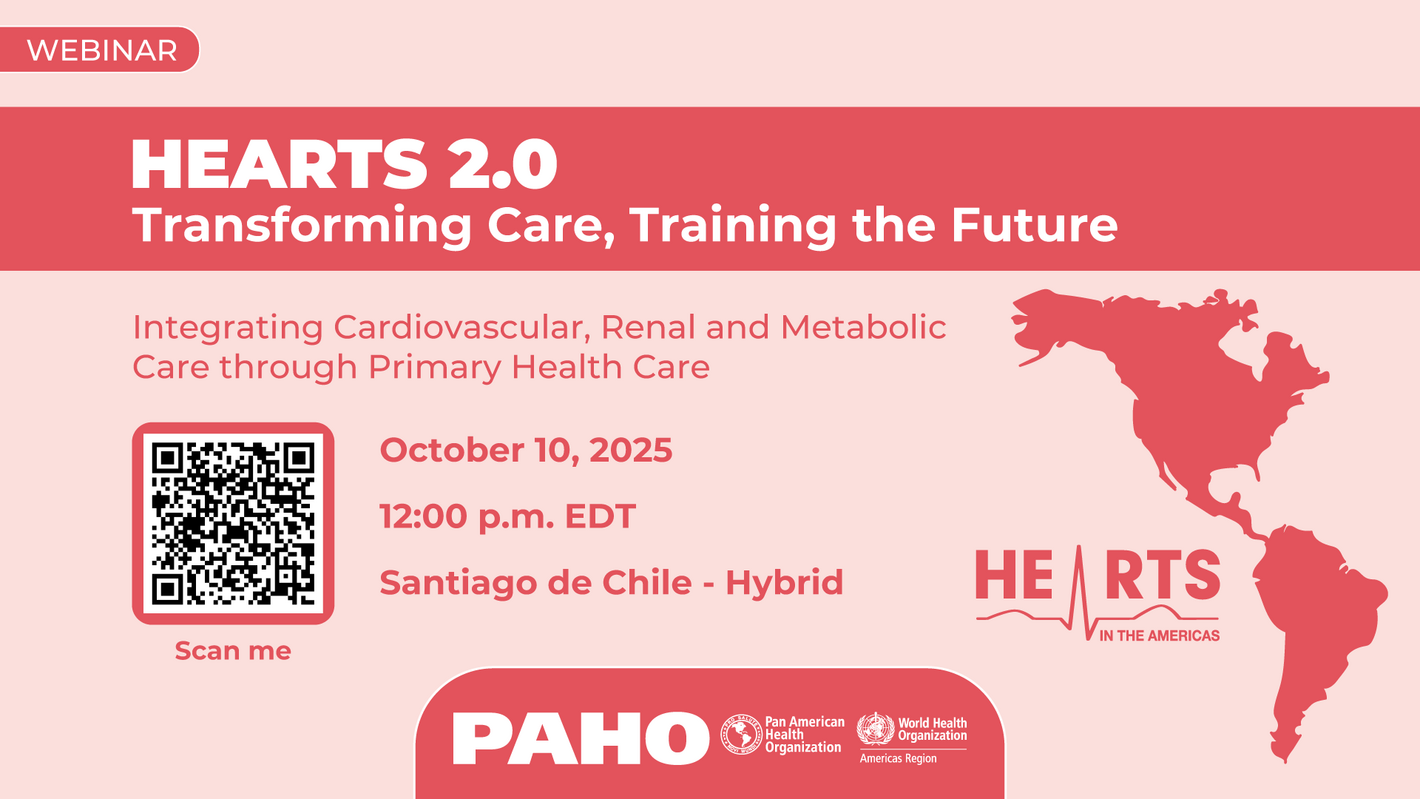
Join us on Friday, October 10, at 12:00 pm (Washington, DC time or EDT) on the webinar "HEARTS 2.0: Transforming Care, Training the Future. Integrating Cardiovascular, Renal and Metabolic Care through Primary Health Care". This webinar invites students, faculty, and primary healthcare professionals to join in the transformation of care for cardiovascular, kidney, and metabolic diseases, centering care on the person and overcoming the fragmentation of clinical management and the healthcare system. The webinar is organized by PAHO as part of the activities organized for World Heart Day, and will be a hybrid session from Santiago de Chile.
RECORDING
Objectives of the webinar
- Promote an integrated approach to cardiovascular, renal, and metabolic care, and disseminate the process toward the HEARTS 2.0 clinical pathway.
- Disseminate the HEARTS quality strategy in the Americas and share successful experiences, with special reference to the Chilean program.
- Encourage universities to integrate HEARTS into their academic curricula as part of a new training model to strengthen the preparation of future healthcare professionals.
How to participate
- DATE: Friday, October 10, 2025
- TIME: 12:00 p.m. (Washington, DC time or EDT) / 1:00 pm (Santiago de Chile time) [Check at the end of the page the time in other cities]
- LANGUAGES: Spanish and English, with simultaneous interpretation in those languages
- REGISTER: https://paho-org.zoom.us/webinar/register/WN_1jX9GMTbRfuAOnQ5xsDYZw
Agenda
Moderators: Pedro Orduñez and Carolina Neira - Welcome and introduction
Part 1. HEARTS 2.0 Pathophysiological basis of Cardio-Renal-Metabolic Syndrome
- Dr. Donald DiPette. Distinguished Professor of Medicine, University of South Carolina, United States
Guidelines, protocols, and the clinical pathway: Making it simple to make it possible
- Dr. Daniel Piñeiro. Professor of Medicine, University of Buenos Aires. Past President of the World Heart Federation.
HEARTS 2.0. Goodbye to fragmentation and greater priority for primary care
- Dr. Andrés Rosende. HEARTS in the Americas. Questions and Answers
Part 2. Panel. HEARTS as a quality improvement strategy to advance the implementation of HEARTS 2.0.
- Dr. Esteban Londoño (HEARTS in the Americas)
- Dr. Vhania Batista (PAHO, Dominican Republic)
- Dr. Marcela Rivera (Ministry of Health of Chile)
- Dr. Matias Villatoro (Ministry of Health of El Salvador)
Questions and Answers
Part 3. HEARTS in the Americas. Educational and Training Resources
- Dr. Mariana Rodríguez, HEARTS in the Americas.
- Virtual Courses.
- Technical Documents
- Open Access
- Bibliographic Repository
Closing Activity: Launch of the Special Issue – HEARTS in the Americas, Pan American Journal of Public Health
- Dr. Pedro Orduñez, PAHO. HEARTS in the Americas
Context
Cardiovascular, kidney, and metabolic diseases are the leading cause of disease burden and premature death in the Americas and require integrated, innovative, and collaborative responses. Tools are needed to standardize and operationalize care, raise quality standards, and ensure universal access. The HEARTS 2.0 clinical pathway represents this commitment to effectively integrating cardiovascular, kidney, and metabolic care in PHC.
HEARTS in the Americas, a WHO and PAHO strategy, has established itself as the benchmark initiative for transforming cardiovascular care in the Region, with Chile as a leading proponent of implementation and a source of successful experiences. The recent visit and continuous quality improvement workshop in Chile culminated in this meeting of universities, which seeks to make the education and training of future health professionals a central strategy for addressing this major public health challenge.
Click on the image to open HEARTS in the Americas

Time in other cities
- 9:00 a.m. – Los Angeles, Vancouver
- 10:00 a.m. – Belmopan, Guatemala City, Managua, Mexico City, San José (CR), San Salvador, Tegucigalpa
- 11:00 a.m. – Bogotá, Panamá City, Kingston, Lima, Quito
- 12:00 p.m. – Bridgetown, Caracas, Georgetown, Havana, La Paz, Nassau, Ottawa, Port of Spain, Port-au-Prince, San Juan, Santo Domingo, Washington D.C.
- 1:00 p.m. – Asunción, Buenos Aires, Brasilia, Montevideo, Paramaribo, Santiago
- 6:00 p.m. – Geneva, Madrid
For other cities, check the local times in the following link.