
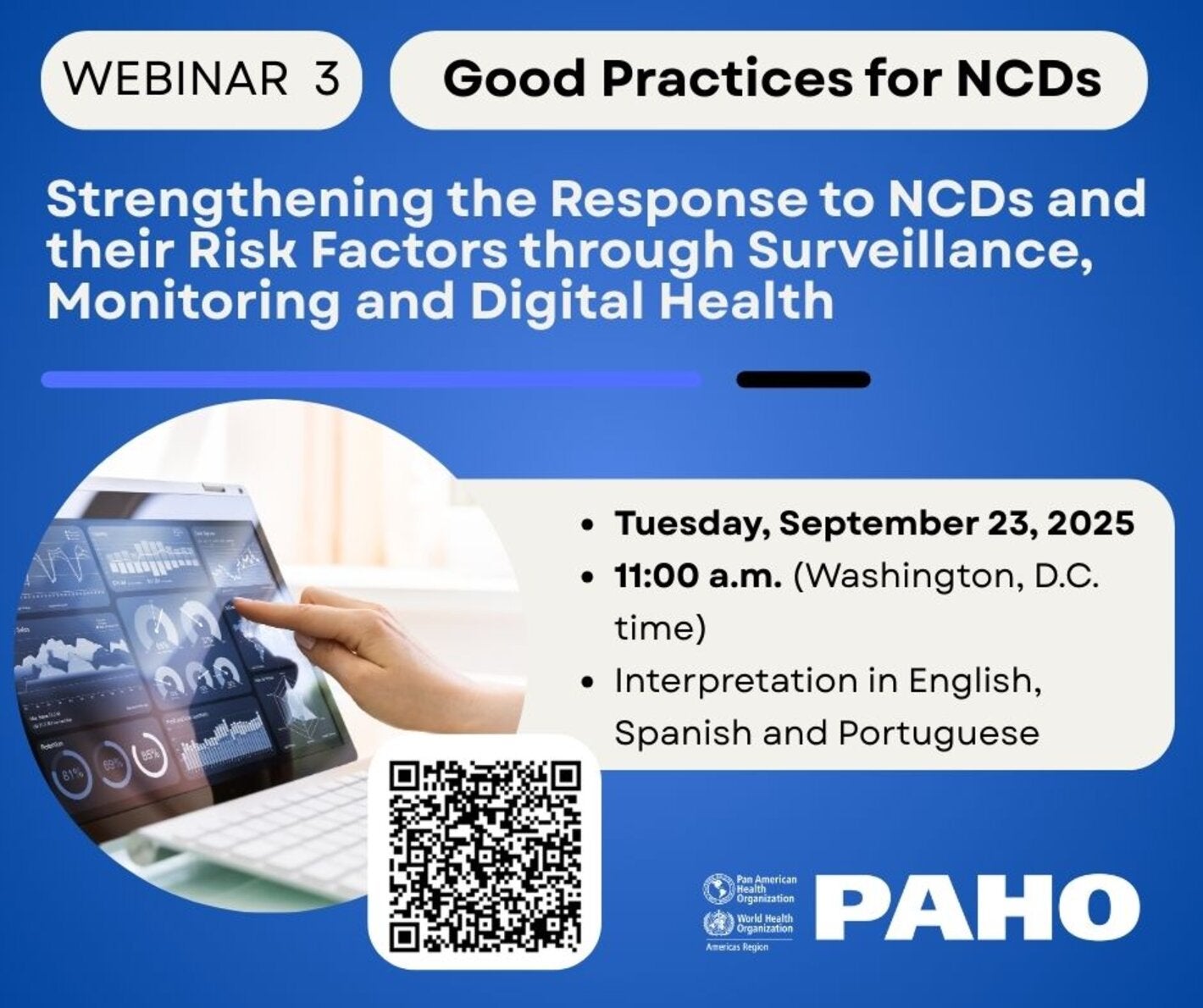
Join us on Tuesday, September 23, 2025, at 11:00 am (EDT) on the webinar of Best Practices for NCDs: Strengthening the Response to NCDs and their Risk Factors through Surveillance, Monitoring and Digital Health, the third webinar of the regional series “Best Practices for NCDs,” led by PAHO to highlight effective experiences in the response to NCDs and their risk factors through surveillance, monitoring and digital health in the Region of the Americas.
RECORDING
Objectives of the webinar
- To make visible and recognize good practices aimed at strengthening the surveillance and monitoring of NCDs and their risk factors.
- Promote the use of data for the planning, management, and evaluation of public health policies.
- Facilitate the exchange of experiences between countries in the region, promoting horizontal learning and technical cooperation.
- Encourage the use of the Good Practices Portal as a tool for the dissemination of evidence, the scaling up of successful interventions, and informed decision-making.
- To make visible experiences in digital health that strengthen the prevention and care of NCDs, improve the continuity of care, and expand access in underserved populations, in alignment with PAHO's regional digital transformation frameworks.
Visit the NCD Good Practices website
Discover innovative and effective experiences in the prevention, control, and surveillance of noncommunicable diseases (NCDs) in the Region of the Americas. Through the PAHO Public Health Good Practices Portal, you will find validated cases that have demonstrated positive results and can be adapted to different contexts. We invite you to explore these initiatives, learn from other countries, and participate in our webinars, available at the following link: PAHO NCD Good Practices.
How to participate
- DAY: Tuesday, September 23, 2025
- TIME: 11:00 a.m. (Washington, DC time or EDT) [See the bottom of this page for times in other cities]
- LANGUAGES: English, Spanish, and Portuguese with simultaneous interpretation in those languages
- REGISTRATION: https://paho-org.zoom.us/webinar/register/WN_AJuxW3kWRqiPWZNeZOqpFQ#/registration
Agenda
11:00 a.m. Opening remarks
- Anselm Hennis, Director, Department of Noncommunicable Diseases and Mental Health, PAHO
11:10 a.m. Presentation: Public Health Surveillance to Strengthen the Comprehensive Response to NCDs and their Risk Factors
- Dr. Roberta Caixeta, Advisor, Surveillance, Prevention and Control of NCDs, PAHO
11:15 a.m. Argentina: Cardiovascular Emergency Network Program
- Dr. Eduardo Esteban LLempen Ibáñez, Cardiologist of the Ministry of Health of the Province of Tucumán, Government of Argentina
11:30 a.m. Brazil: Innovation in Digital Health – Telehealth and telediagnosis centers in remote areas
- Dr. João Pedro Braga, technical consultant, Secretariat of Information and Digital Health (SEIDIGI)/ Department of Digital Health and Innovation (DESD), Ministry of Health of Brazil
- Dr. Rodrigo Silva Amaral, technical consultant, Secretariat of Information and Digital Health (SEIDIGI)/ Department of Digital Health and Innovation (DESD), Ministry of Health of Brazil
11:45 a.m. Chile: Use of Artificial Intelligence (AI) to Optimize Diabetic Retinopathy Screening in Primary Health Care in Chile
- Dr. Marcela Rivera, Ministry of Health of Chile
- Dr. Fernando Barría, Director of the Ophthalmology Unit at Hospital Digital and leader in the use of AI for diabetic retinopathy screening.
12:00 p.m. Guatemala: "KANOXïK" data intelligence health tool for the early detection of occult kidney disease in Guatemala
- Dr. Santiago Torales, Chief of Renal Function Replacement Therapies - AMEDIGSS, UNOPS Guatemala
12:15 p.m. Questions and answers from participants
12:25 p.m. Closure
- Dr. Silvana Luciani, Unit Chief of Noncommunicable Diseases, Violence Prevention and Injuries, PAHO
Background
Noncommunicable diseases (NCDs) – such as cardiovascular diseases, diabetes, cancer and chronic respiratory diseases – represent the leading cause of morbidity and mortality in the Region of the Americas. Their growing burden poses significant challenges for health systems, especially in contexts of inequity and limited access to quality services.
Against this backdrop, the Pan American Health Organization (PAHO) promotes the strengthening of Primary Health Care (PHC) as a fundamental axis for early detection, timely treatment, and comprehensive monitoring of these conditions.
Within the framework of the "Better Care for NCDs" initiative, PAHO has identified and validated various good practices implemented in countries of the region, which have proven to be effective in strengthening the diagnosis, treatment, and comprehensive management of NCDs, especially from the first level of care. These actions are aligned with the commitments adopted by Member States at the United Nations General Assembly (UNGA) high-level meetings on NCDs, and seek to accelerate progress towards more resilient, equitable, and people-centered health systems.
This third virtual seminar—part of a regional series organized by PAHO—will present successful experiences validated by the Organization, available on the Portal of Good Practices in Public Health. The highlighted initiatives have succeeded in improving surveillance, NCD monitoring, and digital health, as well as generating useful evidence for decision-making.
You can check the agenda and recording of the first session of this series at the following link, and the recording and agenda of the second webinar, here.
Time in other cities
- 8:00 a.m. – Los Angeles, Vancouver
- 9:00 a.m. – Belmopan, Guatemala City, Managua, Mexico City, San José (CR), San Salvador, Tegucigalpa
- 10:00 a.m. – Bogotá, Panama City, Kingston, Lima, Quito
- 11:00 a.m. – Bridgetown, Caracas, Georgetown, Havana, La Paz, Port of Spain, Port-au-Prince, Nassau, Ottawa, San Juan, Santo Domingo, Washington D.C.,
- 12:00 p.m. – Asunción, Buenos Aires, Brasilia, Montevideo, Paramaribo, Santiago
- 5:00 p.m. – Geneva, Madrid
For other cities, please check the local time on this link.