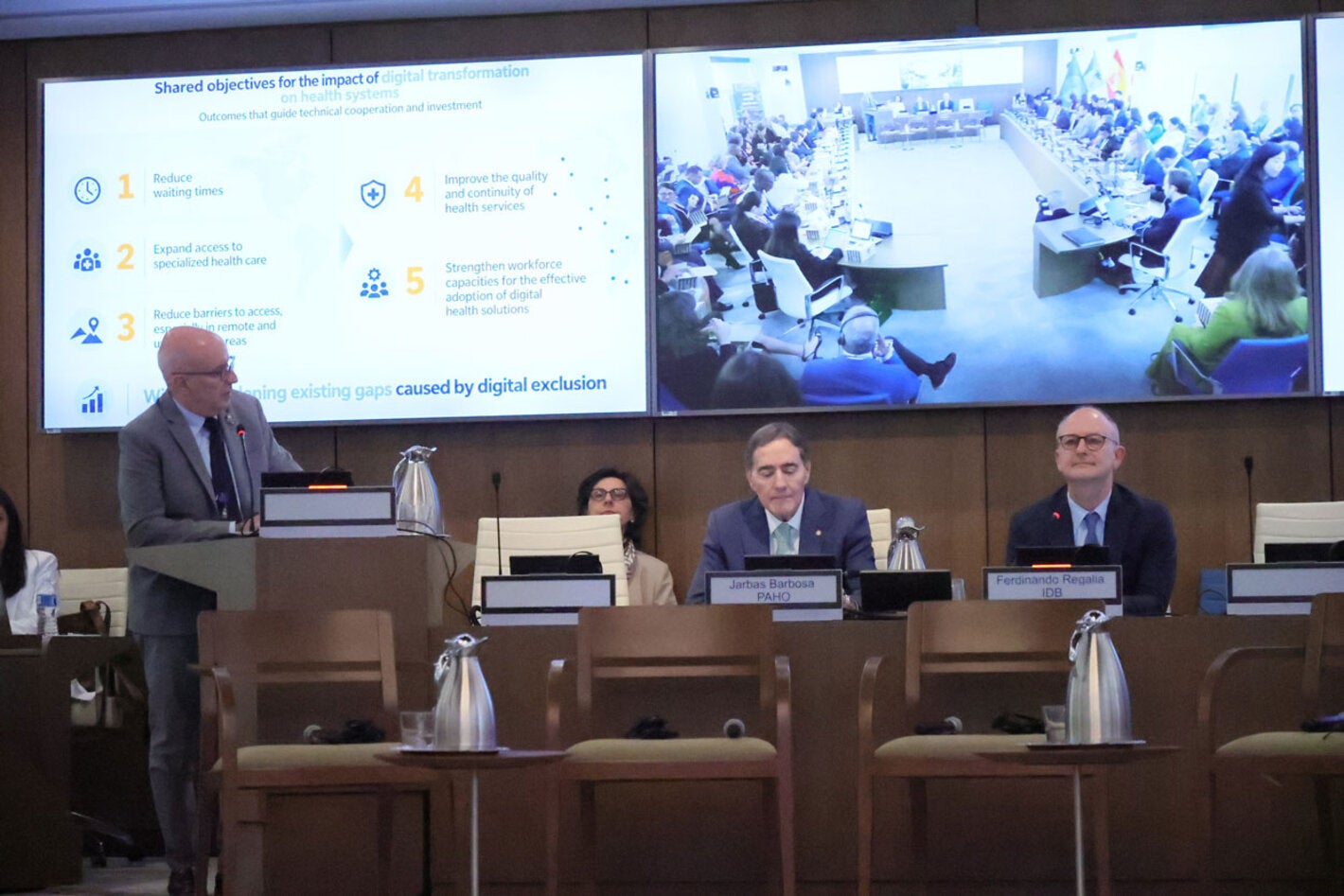
PAHO Directing Council briefing highlights regional progress toward a trusted digital health ecosystem where secure information can accompany people across services and borders.
Washington, D.C., 29 September 2026 (PAHO) – Countries of the Americas are advancing toward a future in which essential health information can travel securely with people, within and across countries. The next challenge is to ensure that these investments can work together, enabling trusted and secure exchange of health information when and where it is needed, health authorities and experts said today during a briefing session held as part of the 63rd Directing Council of the Pan American Health Organization (PAHO).
The session, Advancing and Accelerating Digital Transformation in the Americas: The Case of the Pan-American Highway for Digital Health, brought together health ministers, regional organizations, and international partners to examine national progress and discuss how greater regional cooperation can help countries connect their digital health systems.
“Digital transformation helps health systems serve people better,” PAHO Director Dr. Jarbas Barbosa said. “Ultimately, our measure of success will be the difference this transformation makes in people’s lives.”
Countries have increasingly invested in electronic health records, telehealth, digital prescriptions, and other technologies. Yet many of these systems were developed independently and cannot easily communicate with one another, creating information silos and limiting their potential. Digital transformation delivers its greatest value when it is connected to concrete health priorities. Interoperable systems can help reduce waiting times, expand access to specialists and specialized care, strengthen continuity of care, support surveillance and improve health system management.
During the first panel, the Ministers of Health of Chile, El Salvador, and Trinidad and Tobago shared their countries’ experiences. Chile has expanded its Digital Hospital and electronic prescriptions and is advancing the interoperability of clinical records. El Salvador has expanded connectivity and developed digital health services, while Trinidad and Tobago has advanced electronic prescriptions, digital medical imaging and vaccination records, alongside investments in cybersecurity and disaster recovery.
“It’s not about buying more technology; it’s about connecting, securing and sustaining what we already have,” Trinidad and Tobago’s Minister of Health, Dr. Lackram Bodoe, said.
From digital investments to regional interoperability
The Pan-American Highway for Digital Health (PH4H), a joint PAHO and Inter-American Development Bank (IDB) initiative, seeks to support this next phase by enabling secure and interoperable exchange of health information within and across countries, while respecting national legislation, data governance, sovereignty, and priorities.
The initiative builds on years of regional cooperation on digital health and information systems for health. A practical example is the development of interoperable digital yellow fever vaccination certificates, which can allow health information to be securely verified across borders.
A second panel examined the regional implications of greater interoperability. Alison Drayton, CARICOM Assistant Secretary-General for Human and Social Development, highlighted the importance of interoperability for the Caribbean, where people frequently move between countries and smaller states may not have access to every type of specialized health service.
“As citizens move, their care must move with them,” she said, noting that access to essential health information can improve continuity of care, referrals and access to specialized services across borders.
Representatives from the Republic of Korea and the IDB also emphasized that technology alone is not enough. Common data standards, governance, cybersecurity, data protection and a skilled health workforce are essential to building trust and enabling systems to work together.
Participants emphasized that the Region now has an opportunity to move from planning to implementation through practical use cases that demonstrate the value of interoperability. The PH4H can help countries at different levels of digital maturity advance together, learn from one another, and build a trusted regional ecosystem for better health outcomes.