
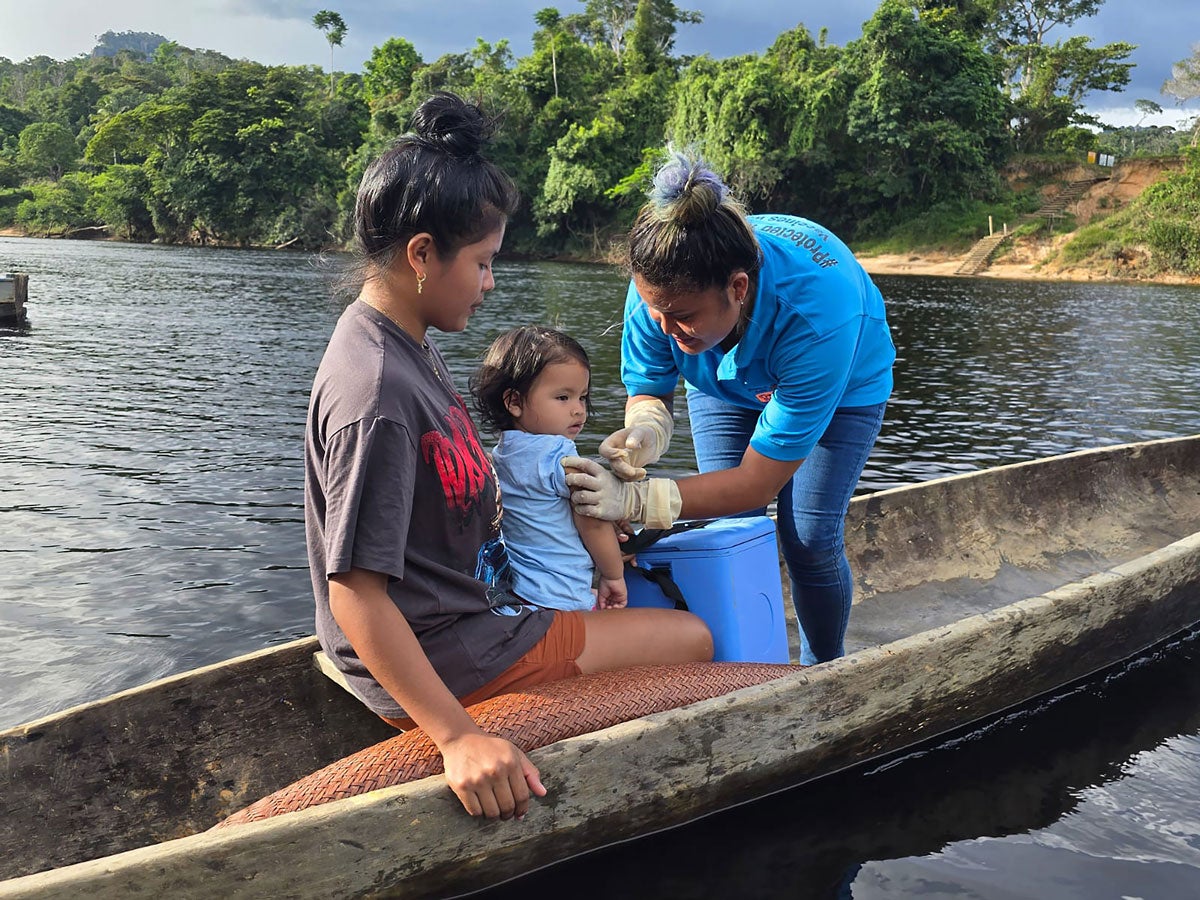
Photograph: © Ministry of Health, Guyana
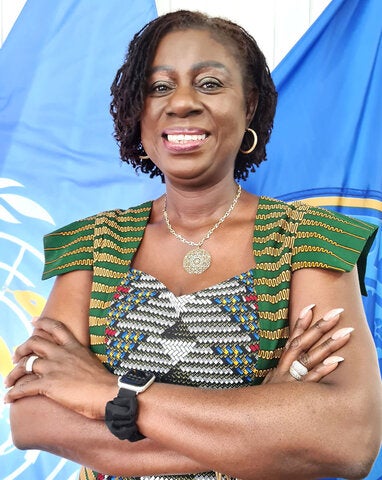
Message from the PAHO/WHO Representative in Guyana
I am pleased to present the 2025 Annual Report of the PAHO/WHO country office for Guyana.
In 2025, our team emerged reinvigorated and reenergized, bringing fresh perspectives and revitalized efforts to support the advancement of key health priorities for Guyana. With enhanced collaboration and a focus on improving systems, it set the tone for continued progress throughout the year.
We worked together with the Ministry of Health and made significant contributions to the country’s priority areas, tackling communicable and noncommunicable diseases, improving mental health services, bolstering maternal, newborn, child, and adolescent health, advancing health systems resilience, and boosting our preparedness to respond effectively to emergencies.
Through technical cooperation, PAHO assisted the Ministry of Health in several key ways: boosting skills and workforce development, providing vital medicines and supplies, improving service delivery through evidence-based practices, facilitating community outreach, and enhancing governance and strategic planning.
As we look ahead, we are committed to working with the Government of Guyana to improve the health and development of the population. Continued collaboration will be essential to drive sustainable progress, improve health equity, and ensure no one is left behind.
Kim Eva Dickson
PAHO/WHO Representative in Guyana
JUN

JUL

SET

OCT
NOV
TECHNICAL SUPPORT FOR COMMISSIONING REGIONAL HOSPITALS
Six new regional hospitals were commissioned to boost decentralized care and expand equitable access, advancing toward universal health coverage.
LAUNCH OF NATIONAL SUICIDE SURVEILLANCE SYSTEM
The national suicide and attempted suicide surveillance system was launched with over 100 health workers trained in WHO-aligned self-harm data collection and analysis.
STRENGTHENING TOBACCO CONTROL THROUGH THE GLOBAL YOUTH TOBACCO SURVEY
The Global Youth Tobacco Survey reached 1761 adolescents in 25 schools, generating essential baseline data for tobacco control.
CAPACITY-BUILDING IN EMERGENCY OBSTETRIC CARE AND POSTPARTUM HEMORRHAGE
To lower maternal mortality, 33 doctors, residents, and nurses in all regions were trained in emergency obstetric care and postpartum hemorrhage management.
FOSTERING RESILIENCE AND REINFORCING HEALTH EMERGENCY PREPAREDNESS AND RESPONSE
The One Health approach bolstered national resilience to address human, animal, and environmental health threats and boosted emergency preparedness.
Achievements in Guyana
Health systems and services
PAHO supported the commissioning of six new regional hospitals to boost decentralized care and expand equitable access, advancing the Ministry of Health’s goal of achieving universal health coverage. PAHO and the University of São Paulo also completed a three-year hybrid nursing curriculum to address Guyana’s shortage of registered nurses through flexible, high-quality training. In addition, PAHO provided technical support for the development of the National Health Strategic Plan (2026–2031), which outlines national priorities and aligns Guyana’s agenda with global health frameworks to strengthen system resilience and responsiveness.
Health and well-being throughout the life course
Guyana’s Expanded Program on Immunization boosted national immunization with the human papillomavirus (HPV) 9-valent vaccine in July. PAHO supported the HPV plan of action and communication strategy, which targeted persons aged 9–35 years, with 15 000 doses administered in six months. PAHO also backed the development of guidelines for new influenza vaccines and communication materials for the seasonal vaccines program. Added to the national schedule in October, the seasonal influenza vaccine delivered 3655 doses to high-risk groups. Guyana is on track to meet the Sustainable Development Goal target for maternal mortality, with United Nations estimates showing a midpoint of 74 per 100 000. To further reduce maternal mortality, PAHO supported the training of 33 doctors, residents, and nurses across all regions in emergency obstetric care and postpartum hemorrhage management. Health workers trained in obstetric care at the lower level will help improve the quality of care at the primary health care level. Maternal and neonatal health was further improved through training for 52 health workers from hinterland regions and private hospitals in the Perinatal Information System, and through PAHO’s support for updating the maternal health manual for community health volunteers and traditional birth. Thus, there is now a standardized, electronic system for reporting maternal and neonatal information. Moreover, data analysis at the national level has improved. Additionally, eight hospitals across five regions achieved Baby-Friendly Hospital Initiative certification, with 884 clinical and 934 nonclinical staff trained to meet WHO breastfeeding standards.

Noncommunicable diseases and mental health
Guyana advanced Better Care for NCDs through strengthened surveillance, prevention, and treatment. PAHO supported the launch of the national suicide and attempted suicide surveillance system, and trained over 100 health workers in WHO-aligned self-harm data collection and analysis. Bolstering national suicide surveillance enhanced analytical skills and the availability of timely, reliable data, enabling health authorities to better understand self-harm patterns and ultimately inform targeted prevention and response strategies. In September, the Global Youth Tobacco Survey reached 1761 adolescents in 25 schools, generating essential baseline data for tobacco control. The results will generate critical data to inform tobacco control policies and prevention strategies. Tobacco cessation capacity expanded through a PAHO training of trainers workshop for 27 professionals, the establishment of cessation clinics nationwide, and the training of over 80 health workers in addiction science. Adolescent mental health services also improved through the training of 58 health workers at eight health centers. This capacity-building facilitated the integration of mental health services into primary care in four regions, boosting access to care where it is most needed.
Communicable diseases
Guyana advanced its national Disease Elimination Initiative with support from PAHO. For lymphatic filariasis elimination, PAHO assisted with training 639 pill distributors and supervisors for the mass drug administration campaign, aiming to deliver preventive treatment to at least 213 000 residents. PAHO also supported the finalization of guidelines for the elimination of mother-to-child transmission of HIV, including syphilis management. A national elimination plan and road maps for priority diseases were developed, accompanied by updated guidelines, strengthened surveillance, expanded diagnostic services, enhanced quality assurance, and donation of rapid diagnostic tests and test kits.
Health emergencies
Guyana bolstered national resilience using the One Health approach to address human, animal, and environmental health threats. With PAHO support, the Ministry of Health improved laboratory capacity, emergency preparedness, surveillance, infection prevention and control, and antimicrobial resistance initiatives. A milestone was the certification of the National Public Health Reference Laboratory as a WHO-recognized National Influenza Centre, enabling weekly influenza reporting to PAHO and reinforcing regional surveillance capacity. PAHO also supported the development of the Health National Adaptation Plan for climate and health, and facilitated a multisectoral air quality sensitization workshop. Such efforts are vital to holistically strengthen International Health Regulations capacities, and improve national readiness for health emergencies and climate-related hazards.
Stories from the field
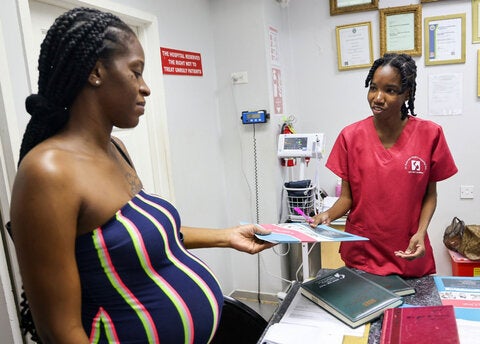
Promoting safe motherhood through the use of SIP Plus
For years, maternal health care in Guyana depended on paper charts – bulky files that traveled from desk to desk, sometimes missing pages, sometimes arriving too late. For clinicians, this meant long hours piecing together a mother’s journey through pregnancy. For patients, it meant their stories were scattered across folders instead of held in one trusted place.
Today, that reality is changing.
Each morning in Georgetown, long before the rush of the city begins, Dr. Padmini Singh – obstetrician and gynecologist at the Georgetown Public Hospital Corporation (GPHC) – starts her day in the 7 a.m. handover meeting. Her team gathers to review the night’s most urgent cases, a ritual that once depended entirely on handwritten notes.
“In recent years, with the introduction of SIP Plus, something has changed in how these meetings unfold,” said Dr. Singh. “Before, we worked entirely on paper. It was functional, but some information could be missed or misplaced,” she recalls. “Now, everything is centralized, updated in real time, and accessible from the moment a patient walks through the door.”
Introduced in 2022 at the GPHC and the Dr. Balwant Singh’s Hospital through the Improved Health of Women and Adolescent Girls in Situations of Vulnerability project, and implemented by PAHO with support from the Government of Canada, SIP Plus has reshaped how maternal care is delivered.
From the first prenatal visit to delivery and postpartum, the digital system follows each woman’s story with accuracy that paper simply could not offer. At the GPHC – where more than 10 000 maternal patients pass through each year – SIP Plus brings continuity to a system that once struggled to keep pace.
For Dr. Singh and her team, the change is more than technological. It is personal. It means every mother’s journey is clearer, safer, and finally, fully seen.
Healing begins in the classroom: The human story behind a mental health training revolution
Guyana’s rich cultural mix – Amerindian, Afro‑Guyanese, Indo‑Guyanese, Chinese, Portuguese, and others – deeply shapes how people understand mental health. In many communities, emotional pain is still misunderstood or linked to spiritual beliefs, leaving those who struggle unsure of where to turn.
For Dr. Esther Ward, lecturer at the Cyril Potter College of Education, culture is central to understanding how Guyanese children express distress. “Culture is the total of one’s experience,” she explains. “Professionals who have not been exposed to certain traditions may fail to recognize red flags or know how to respond. Our training promotes culturally aware and responsive teachers – people who understand that a student’s background shapes how they communicate and cope.”
Dr. Ward has spent years working with teachers, counselors, and administrators across the country, especially in rural areas where cultural norms and distance often limit access to mental health support. Her goal is simple but transformative: ensuring every child is seen, heard, and understood within their own cultural reality. “We’ve achieved something important – getting others to understand that mental health is not just about ‘my people,’ but for all people,” she says.
Guyana continues to confront high suicide rates that reflect social, economic, and cultural challenges. In response, the National Mental Health Action Plan and National Suicide Prevention Plan (2024–2030) call for stronger community‑based and school‑centered programs. PAHO is working alongside Guyana to expand training, counseling services, and early identification of depression and anxiety among young people – helping ensure that no child’s silent struggle goes unnoticed.
- Canada. Continued support to improve the health of women and adolescent girls in vulnerable situations, while also strengthening maternal and child health services and expanding vaccine access.
- The END Fund. Funded the 2025 lymphatic filariasis mass drug administration campaign.
- European Commission. Funding supported technical cooperation for the commissioning of six regional hospitals and the completion of the Health National Adaptation Plan.
- Pandemic Influenza Preparedness Partnership Contribution. Allocated funding for pandemic influenza preparedness capacity-building, and response activities at the time of a pandemic.
- Resolve to Save Lives. Funding to support the HEARTS assessment in seven regions.
- Ribeirão Preto School of Nursing, Brazil. Partnered to complete the revision and update of the new three-year hybrid nursing curriculum for registered nurses.
- Task Force for Global Health. Funding to support the introduction of the seasonal influenza vaccine in Guyana.
- UNICEF. Contributed to strengthening adolescent mental health services in primary care, capacity-building for adolescent community stakeholders, and the improvement of self-harm surveillance systems.
- US Centers for Disease Control and Prevention. Supported the Global Youth Tobacco Survey.

Making health
a commitment for all
2025 Country Annual Reports
of the Pan American Health Organization