

Photograph: © iStock/digitalskillet
PAHO: CATALYST FOR HEALTH IN THE AMERICAS
120 years of history
PAHO was the first multilateral health agency. Established in 1902, its founding objective was to respond to disease threats associated with increasing trade among countries in the Americas.
Preferred partner
PAHO’s position as a respected technical authority, along with its strong, long-standing relationships with Ministries of Health, makes it a highly valued partner in the Region.
Honest broker for health
We strive to build consensus around issues that are common to countries in the Region to prioritize health in a politically heterogenous and epidemiologically complex context.
Technical excellence
World-class technical expertise, data aggregation, and analytical capacity make PAHO a highly respected technical authority and information source for countries and partners.
Country focus
With the most extensive country presence of any WHO Region, we are committed to country-centered technical cooperation, tailored to unique needs and contexts.
Effective implementation
PAHO has an impressive track record of successes in disease elimination, healthcare coverage and emergency response that demonstrate its capacity to implement efficiently and effectively.
120 years of history
PAHO was the first multilateral health agency. Established in 1902, its founding objective was to respond to disease threats associated with increasing trade among countries in the Americas.
Technical excellence
World-class technical expertise, data aggregation, and analytical capacity make PAHO a highly respected technical authority and information source for countries and partners.
Preferred partner
PAHO’s position as a respected technical authority, along with its strong, long-standing relationships with Ministries of Health, makes it a highly valued partner in the Region.
Country focus
With the most extensive country presence of any WHO Region, we are committed to country-centered technical cooperation, tailored to unique needs and contexts.
Honest broker for health
We strive to build consensus around issues that are common to countries in the Region to prioritize health in a politically heterogenous and epidemiologically complex context.
Effective implementation
PAHO has an impressive track record of successes in disease elimination, healthcare coverage and emergency response that demonstrate its capacity to implement efficiently and effectively.
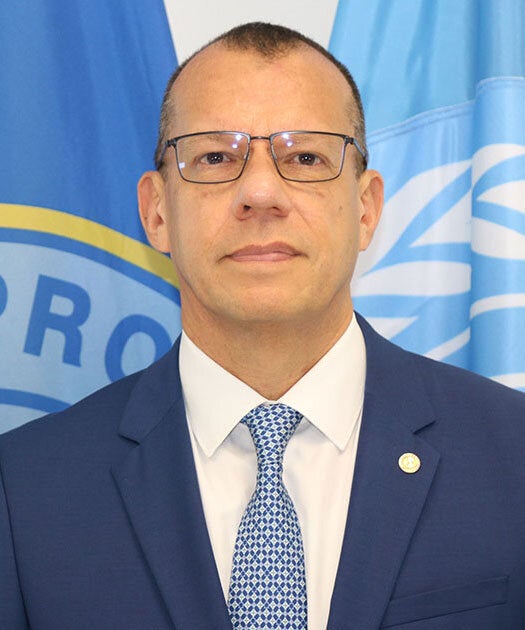
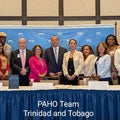
Message from the PAHO/WHO Representative in Trinidad and Tobago, Aruba, Curaçao, Sint Maarten, Bonaire, Saba, and Sint Eustatius
We are proud to highlight the significant achievements of the PAHO country office in Trinidad and Tobago through our collaborative efforts with the Ministry of Health and other partners.
Despite rising mortality and morbidity rates from noncommunicable diseases (NCDs), progress was made in promoting exclusive breastfeeding, with two more hospitals certified as Baby Friendly. Support was also provided to improve the quality of HEARTS implementation. A national STEPS survey on NCDs will guide future policymaking to reduce the NCD burden.
PAHO helped improve health security by developing sentinel surveillance systems for respiratory diseases. PAHO’s collaboration with the Environmental Management Authority and Ministry of Health has improved air quality and public health through the Healthy Municipalities, Cities and Communities Movement.
Finally, PAHO actively supported acceleration of the digital transformation of the health sector.
The Country Cooperation Strategy 2025–2030 will guide PAHO’s support for disease prevention, health promotion, and sustainable health systems development.
We look forward to continuing our efforts to advance health and well-being in Trinidad and Tobago.
Dr. Gabriel Vivas Francesconi
PAHO/WHO Representative in
Trinidad and Tobago, Aruba, Curaçao, Sint Maarten, Bonaire, Saba,
and Sint Eustatius
Highlights in 2024
JUN

AUG

OCT
NOV

NOV
DEC
BABY-FRIENDLY HOSPITAL
Scarborough General and Port Fortin Hospitals certified Baby Friendly.
HEALTH SERVICES AND DISINFECTING ROBOTS
Bringing High and Low Technologies (HALT) Project.
SARI SURVEILLANCE
Baseline assessment to detect severe acute respiratory illnesses completed.
HEALTHY CITIES, HEALTHY MUNICIPALITIES
Creating healthy cities and healthy municipalities through air quality improvement.
COUNTRY COOPERATION STRATEGY
Country Cooperation Strategy 2025–2030 for Trinidad and Tobago.
STEPS
Trinidad and Tobago STEPS survey completed
Achievements in Trinidad and Tobago
Supporting resilient health systems
PAHO collaborated with the Ministry of Health to enhance stewardship and governance, facilitating health systems transformation and the implementation of essential public health functions for universal health. Technical cooperation was provided to boost national capacity and support the creation of a country team for future evaluations, involving situational analysis, institutional mapping, capacity measurement, gap analysis review, and the drafting
of an action plan.
Multisectoral action on NCDs
Trinidad and Tobago’s national STEPS survey on noncommunicable diseases (NCDs) revealed increased obesity and hypertension levels compared to 2011, alongside a rise in physical activity. For the first time, data on depression prevalence were collected. These results will inform future planning and policymaking to reduce the NCD burden. PAHO provided crucial technical support for the survey. The Ministry of Health, with PAHO’s support, enhanced the health system to promote exclusive breastfeeding from birth, aligning with the Baby-Friendly Hospital Initiative. This led to the certification of two additional hospitals in Trinidad and one in Tobago. The WHO/UNICEF Competency Verification Toolkit was introduced for breastfeeding assessors to ensure accredited institutions maintain their Baby Friendly status and reinforce optimal breastfeeding practices and public health.
Prevention, control, and elimination of communicable diseases
With PAHO’s support, Trinidad and Tobago enhanced health security by developing sentinel surveillance systems for severe acute respiratory illnesses and influenza-like illness, evaluating existing respiratory surveillance capacities, and creating protocols for a respiratory virus sentinel surveillance system. This entailed using the Caribbean Sub-Regional Guidelines and establishing sentinel sites with standard operating procedures for identifying, managing, and reporting respiratory diseases, including newly emerging diseases.
Additionally, PAHO partnered with the University of the West Indies and the Ministry of Health to host a seminar series to increase awareness and document the elimination of canine-mediated rabies in the country. This effort is part of the One Health approach to prevent, control, and reduce the burden of neglected infectious diseases in the Caribbean and is included in the Elimination Initiative.
The Ministry of Health, with PAHO’s support, enhanced the health system to promote exclusive breastfeeding from birth, aligning with the Baby-Friendly Hospital Initiative.
Strengthening capacity to address the impact of climate change on health
PAHO, in collaboration with the Environmental Management Authority and the Ministry of Health, enhanced air quality and public health. Through the Healthy Municipalities, Cities and Communities Movement, PAHO fosters municipal collaboration and directly benefits communities. Diverse stakeholders were united to address environmental health determinants and train technical staff on using the AirQ+ software tool for municipal strategies and health risk mitigation. The country now has increased capacity to identify and mitigate air pollution risks, reducing NCDs. Support to the Environmental Management Authority has led to a review of national air pollution rules, creating a supportive policy environment for effective mitigation.
Accelerating digital transformation
Under the South-South Cooperation with Rwanda and funded by the India-UN Development Partnership Fund, eight health service robots were procured to enhance care delivery, efficiency, and data capture as part of the Ministry of Health’s digital transformation plan. Capacity-building for health service robots was conducted, and user guides and instruction manuals were provided to each hospital. Support was also provided for the development of a digital health and cybersecurity policy, establishment of a change management platform, and a technical working group for ongoing support for the development of digital tools and a sustainability plan.
Collaboratively shaping health priorities
Working with the Ministry of Health, the PAHO country office completed the Country Cooperation Strategy 2025–2030 for Trinidad and Tobago. The development process, guided by PAHO and WHO, was marked by extensive participation and high-level attendance from a diverse array of stakeholders during the national consultation, underscoring its critical importance and widespread support. This strategy will guide PAHO’s technical cooperation in disease prevention, health promotion, and sustainable health systems development, aligning with national health objectives.
Stories from the field
Building capacity on air quality and climate change
The Ministry of Health, the Environmental Management Authority, and PAHO/WHO built capacity on air quality and climate change impacts with mayors, chairs of regional corporations, and other senior representatives of regional corporations and public health inspectors that focused on municipal strategies for health promotion.
To raise awareness and promote advocacy around the impacts of air quality and climate change, the Ministry of Health, the Environmental Management Authority, and PAHO also brought together mayors, chairs of regional corporations, public health inspectors, and other municipal leaders to explore strategies for building healthier, more resilient cities and boroughs. The initiative introduced PAHO’s Healthy Municipalities, Cities and Communities Movement, exploring the use of practical tools to enhance waste management, air quality, and other environmental health priorities at the local level. Doodnath Mayrhoo, gave this feedback: “As the Mayor of Siparia and Vice Chairman of the Trinidad and Tobago Association of Local Government Authorities, I will ensure this valuable knowledge is shared with my Council colleagues to address these pressing issues. Together, we aim to reduce health risks and improve the quality of life within the Siparia Borough Municipality.”
Health service robots
Under the project Bringing High and Low Technology to COVID-19, two disinfecting robots and five humanoid healthcare robots were deployed to hospitals in East, Central, and South Trinidad, and one to Tobago. One robot was also assigned to the University of Trinidad and Tobago for research. Dr. Ravi Lalla of Couva Hospital said: “By being able to free up more time for people to have human-to-human interactions, that could only lead to a richer experience for people entering the healthcare system.” In a similar vein, Krista-Sian Graham, Customer Service Representative at Arima General Hospital, added: “Once the robot has the information, that would make life so much easier, and I’m sure that we would get better feedback from the relatives and patients.”
Enhancing respiratory virus surveillance
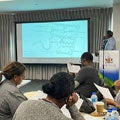
Respiratory viruses can cause serious illness and disrupt daily life. To better prepare for future outbreaks, the Ministry of Health and PAHO strengthened virus detection systems for influenza and SARS-CoV-2. International experts collaborated with local specialists to tailor the National Sentinel Surveillance Plan to the country’s needs. A multisectoral capacity building session brought together key epidemiology and laboratory personnel from various sectors, fostering a shared purpose in monitoring and managing outbreaks. Dr. Maria Johnson, an epidemiologist, noted: “This mission has been a game-changer. The knowledge and skills we’ve gained will help us protect our communities and respond more effectively to future outbreaks.”
Our partners
- Environmental Management Authority, Trinidad and Tobago. Dedicated to protecting and conserving the natural environment to enhance
the quality of life. - India-UN Development Partnership Fund. A collaborative initiative between the Government of India and
the United Nations, established in 2017. - University of Trinidad and Tobago. A state-owned university established in 2004 that aims to provide “education with a global vision.”
Photograph: © iStock/Ridofranz

Thinking regionally,
acting locally
2024 Country Annual Reports
of the Pan American Health Organization