
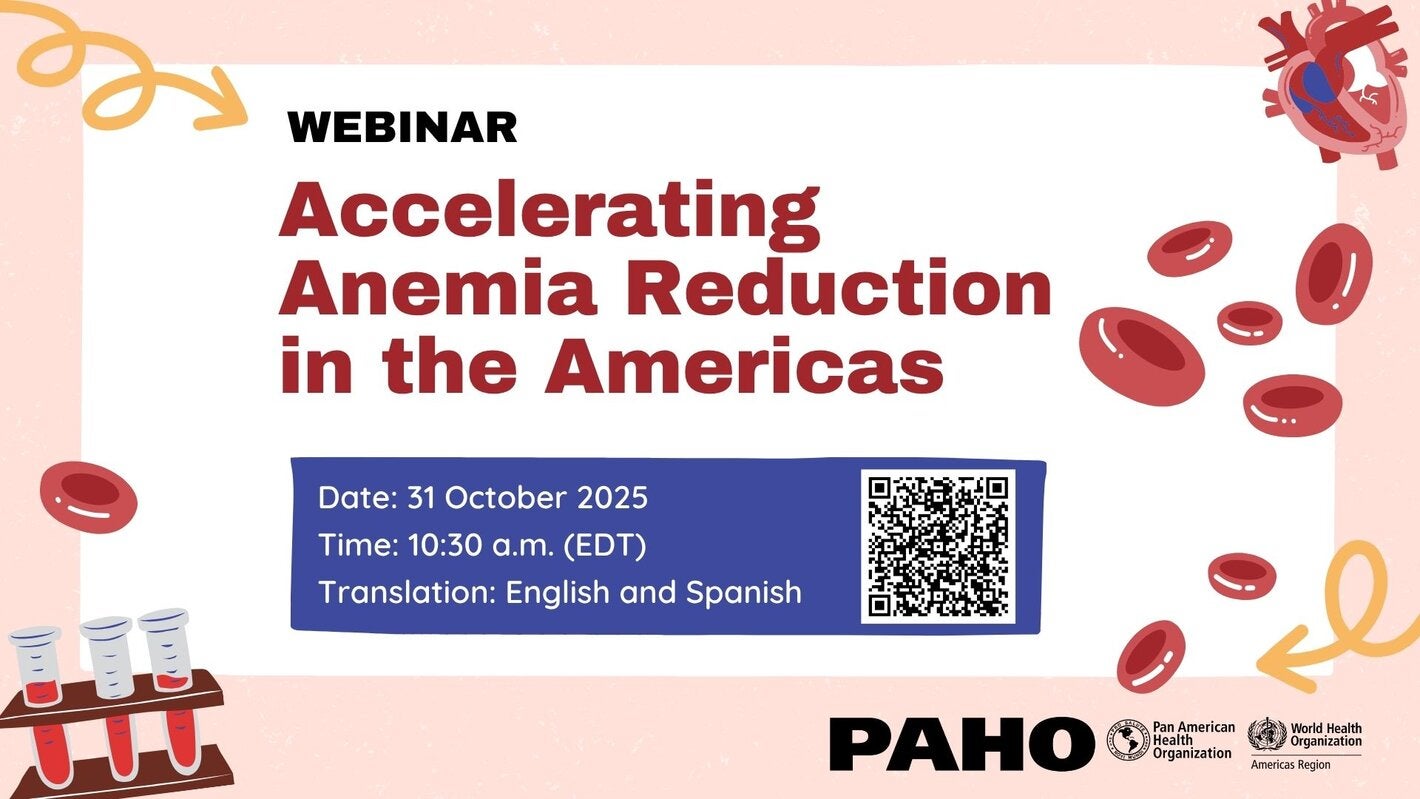
Join us on Friday, October 31, at 10:30 a.m. (Washington, D.C. time or EDT) for the webinar "Accelerating Anemia Reduction in the Americas." The event will further describe the situation of anemia in the Americas and introduce these tools, along with a discussion on how countries can leverage them to accelerate anemia reduction.
Objectives
- Present the regional situation of anemia and its implications.
- Introduce the WHO’s Comprehensive Framework for Action and related tools for the detection and prevention of anemia.
- Facilitate discussion on regional challenges, priorities, and opportunities for collaboration.
RECORDING
How to participate
- DATE: Friday, October 31, 2025
- TIME: 10:30 a.m. (Washington, DC time or EDT) [Check at the end of the page the time in other cities]
- LANGUAGES: Spanish and English, with simultaneous interpretation in those languages
- REGISTER: https://paho-org.zoom.us/webinar/register/WN_b_jDUf60S0O-a5OsuY5gwA#/registration
Agenda
10:30 a.m. Welcome and Opening Remarks
- Vanessa Garcia Larsen, Chief, Risk Factors and Nutrition Unit, Department of Noncommunicable Diseases and Mental Health, PAHO
10:35 a.m. Status of anemia in the Americas, progress and challenges
- Leo Nederveen, Advisor, Food, Nutrition and Physical Activity in Schools, Risk Factors and Nutrition Unit, Department of Noncommunicable Diseases and Mental Health, PAHO
10:45 a.m. Measurement of anemia and the WHO Guideline on hemoglobin cutoffs to define anemia in individuals and populations
- Maria Nieves Garcia-Casal, Scientist, Food and Nutrition Actions in Health Systems, Department of Nutrition and Food Safety, WHO
11:00 a.m. WHO’s Comprehensive Framework for Action on Accelerating Anemia Reduction and Global Anemia Alliance
- Lisa Rogers Technical Officer, Food and Nutrition Actions in Health Systems Department of Nutrition and Food Safety, WHO
11:15 a.m. PAHO’s food and nutrition systems approach to address malnutrition in all its forms
- Fabio Da Silva Gomes, Regional Advisor, Nutrition and Physical Activity, Risk Factors and Nutrition Unit, Department of Noncommunicable Diseases and Mental Health, PAHO
11:25 a.m. Experience of Peru in preventing anemia: progress and challenges
- Government of Peru
11:40 a.m. Virtual group exercise on identifying opportunities and challenges (poll)
- Lesly Véjar, Technical Officer, Malnutrition and Food Systems, Risk Factors and Nutrition Unit, Department of Noncommunicable Diseases and Mental Health, PAHO
11:45 a.m. Discussion, questions, and answers
- Leo Nederveen, Advisor, Food, Nutrition and Physical Activity in Schools, Risk Factors and Nutrition Unit, Department of Noncommunicable Diseases and Mental Health, PAHO
11:55 a.m. Closing Remarks
- Leo Nederveen, Advisor, Food, Nutrition and Physical Activity in Schools, Risk Factors and Nutrition Unit, Department of Noncommunicable Diseases and Mental Health, PAHO
Context
Anemia remains a significant global public health challenge, affecting approximately 40% of children 6-59 months of age and 31% of women 15-49 years of age.
In the Region of the Americas, the prevalence of anemia among children aged 6-59 months was 16.5% in 2019. Since 2000, many low- and lower-middle-income countries in the Region have achieved significant reductions, while progress has stagnated in some upper-middle-income countries. Among women of reproductive age (15-49 years of age), anemia prevalence declined until about a decade ago but has since plateaued, with 21,2% affected in 2023, putting the Region at risk of not achieving the Global Nutrition Target for anemia reduction.
Anemia contributes to fatigue, reduced physical and work capacity, and, during pregnancy, increases the risk of complications such as placental abruption, postpartum hemorrhage, and prenatal depression. Infants born to anemic mothers are more likely to be preterm, have low birth weight, and experience impaired cognitive development due to reduced iron stores.
Anemia undermines health, well-being, and economic productivity, and addressing this public health problem is essential for achieving the World Health Assembly Global Nutrition Targets and Sustainable Development Goals. Increased attention and coordinated action are needed to accelerate progress.
To guide countries, the World Health Organization (WHO) developed the Accelerating anemia reduction: a comprehensive framework for action (“Comprehensive framework”), which consolidates recommendations on the prevention, diagnosis, and management of anemia caused by micronutrient deficiencies, infections, obstetric and gynecological disorders, and inherited red blood disorders. This framework also emphasizes addressing social determinants of health and fostering multi-disciplinary collaboration.
In alignment with this, PAHO has developed a roadmap to address malnutrition in all its forms, including micronutrient deficiencies, through a food systems approach.
Accurate characterization of anemia is critical for understanding its burden, planning public health interventions, and guiding clinical care of people across the life course. Multiple interventions are aimed at alleviating anemia worldwide, but their selection, implementation, and monitoring are founded on reliable data on anemia prevalence and distribution, especially among vulnerable groups.
To support Member States and their partners in making evidence-informed decisions, WHO has issued the Guideline on hemoglobin cutoffs to define anemia in individuals and populations. Additionally, the WHO is developing:
- An implementation guide to support program managers in operationalizing the Comprehensive framework across five action areas: data collection and use, selection of interventions, their delivery, leadership and coordination, and research and learning.
- A complementary monitoring guide to support performance management and progress tracking, providing a consolidated set of priority indicators and tools for data collection and organization.
Time in other cities
- 7:30 a.m. – Los Angeles, Vancouver
- 8:30 a.m. – Belmopan, Guatemala City, Managua, Mexico City, San José (CR), San Salvador, Tegucigalpa
- 9:30 a.m. – Bogotá, Panamá City, Kingston, Lima, Quito
- 10:30 a.m. – Bridgetown, Caracas, Georgetown, Havana, La Paz, Nassau, Ottawa, Port of Spain, Port-au-Prince, San Juan, Santo Domingo, Washington D.C.
- 11:30 p.m. – Asunción, Buenos Aires, Brasilia, Montevideo, Paramaribo, Santiago,
- 3:30 p.m. – Geneva, Madrid
For other cities, please refer to the local time at this link.