
Recording of the event
Organization
Pan American Health Organization (PAHO); World Organization of Family Doctors (WONCA) - Ibero and North America Regions; and the PAHO/WHO Collaborating Center for Innovative Health Workers Education, Service and Research Models at the University of New Mexico Health Sciences Center.
Background
Family and Community Medicine (FCM) constitute a strategic cornerstone health systems strengthening, operationalizing a comprehensive, continuous, and person-centered care model that integrates individuals, families, and communities as fundamental units of care. This specialty directly contributes to enhanced effectiveness, care coordination, and quality improvement at the first level of care, thereby optimizing health system performance.
FCM represents a critical enabler for building resilient health systems capable of integrating lessons learned while simultaneously enhancing preparedness capacities for future health emergencies. The specialty demonstrates relevance in addressing health equity gaps by expanding care access to historically underserved populations—including rural, underserved, and in situations of vulnerability—where geographical, economic, and social barriers persistently limit healthcare access. Despite this strategic importance, substantial regional heterogeneity persists across the Americas in terms of specialty development, health system integration, professional recognition, regulatory frameworks, and workforce distribution, resulting in suboptimal FCM capacity to fulfill its transformative potential.
To address challenges related to human resources for health, the Pan American Health Organization (PAHO) Policy on the Health Workforce 2030: Strengthening Human Resources for Health to Achieve Resilient Health Systems provides Member States with strategic lines to strengthen governance, develop and consolidate regulatory mechanisms, strengthen the development of interprofessional teams, enhance capacity building, and promote decent working conditions, with physical and mental protection for health workers. Collectively, these efforts seek to enhance the contributions of the health workforce to expanding access to services, aligning with Primary Health Care (PHC) based health system models oriented toward achieving universal health coverage and the health-related Sustainable Development Goals (SDGs).
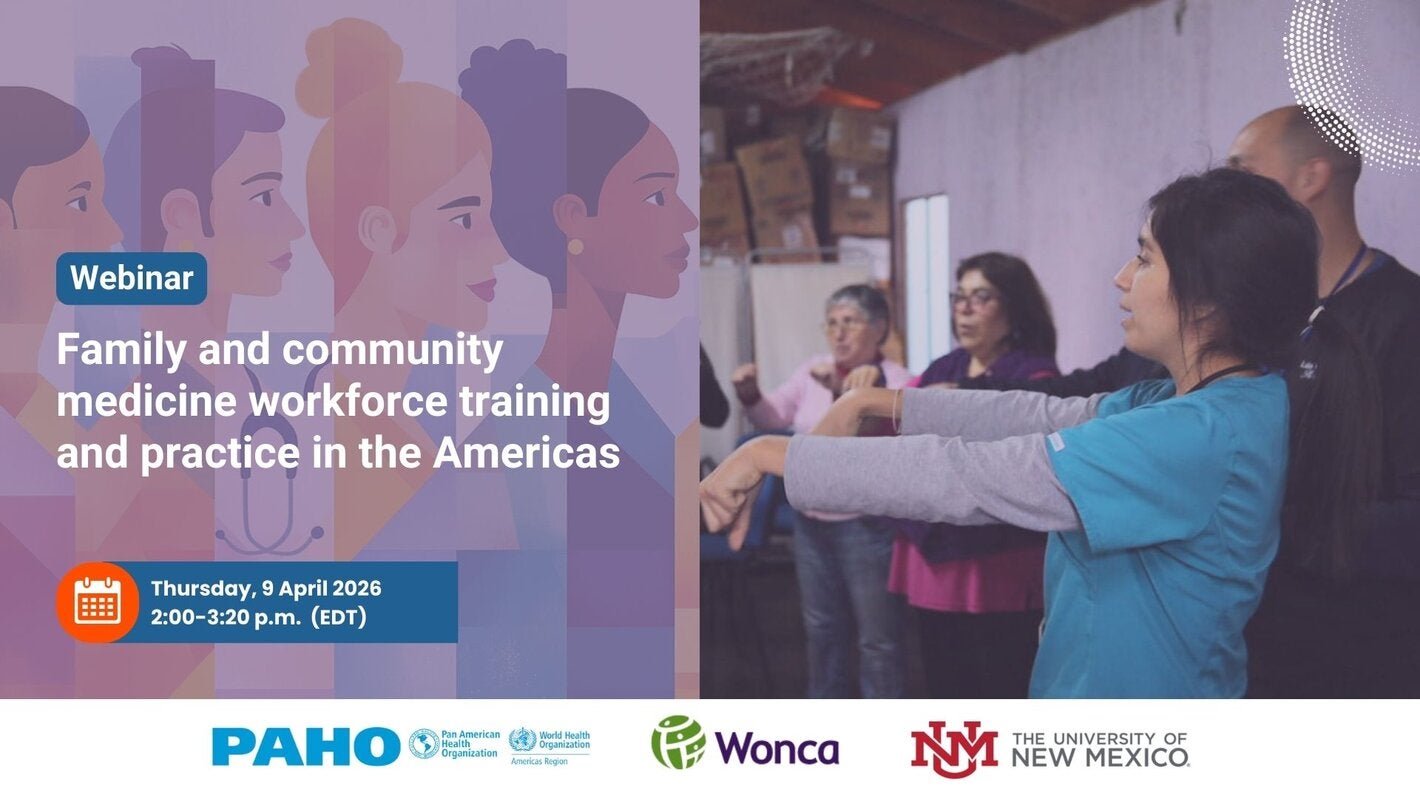
Within this strategic framework PAHO, in partnership with the World Organization of Family Doctors (WONCA) - Ibero and North America Regions, and the PAHO/WHO Collaborating Center for Innovative Health Workers Education, Service and Research Models at the University of New Mexico Health Sciences Center conducted a comprehensive regional study—Family and community medicine workforce training and practice in the Americas—examining ecosystems on training and practice environments of Family and Community Medicine across the Americas. The study findings provide novel evidence-based insights essential for informing policy development, guiding curricular reform, strengthening accreditation systems, and optimizing professional practice environments. This webinar aims to present and discuss these findings, fostering a regional dialogue that contributes to strengthening FCM as an essential pillar of PHC and the health workforce.
Participation
- DATE: Thursday, 9 April 2026
- TIME: 2:00 pm - 3:20 p.m. (EDT)
- PLATFORM: ZOOM
- LANGUAGE: Interpretation in English, Portuguese, and Spanish
Objective
To disseminate evidence from the regional study on FCM training and practice while fostering multistakeholder dialogue oriented towards policy development, educational strengthening and practice environment optimization in the Region of the Americas.
Audience
Representatives of ministries of health, universities and academic institutions, family and community physicians, PAHO collaborating centers, professional associations and scientific societies of family and community medicine, students and residents, PAHO staff, and other interested parties.
Agenda
Topic
Yohana Díaz de Valle, Advisor, Human Resources for Health Unit, PAHO
Opening remarks
Mary Lou Valdez, Deputy Director, PAHO
Viviana Martinez-Bianchi, President, World Organization of Family Doctors
Arthur Kaufman, University of New Mexico Health Sciences Center, PAHO/WHO Collaborating Center for Innovative Health Workers Education, Service and Research Models
Keynote presentation: Regional evidence from the study on family and community medicine in the Americas
E. Benjamin Puertas, Unit Chief, Human Resources for Health, PAHO
Panel 1: Policy and Practice Perspectives - From evidence to action: advancing the integration of FMC into health systems in the Americas
Moderator: Jacqueline Ponzo, WONCA
Juan Carlos Esquivel, Executive Director of the Centro de Desarrollo Estratégico de Información en Salud y Seguridad Social (CENDEISSS), Costa Rica
María Sofia Cuba-Fuentes, Universidad Peruana Cayetano Heredia, Peru (TBC)
Fabiano Gonçalves Guimarães, President, Brazilian Society of Family and Community Medicine, Brazil (TBC)
Panel 2: Innovation and Future Directions - Innovations in FCM Education and Practice Models
Moderator: Erin Bouquin, University of New Mexico
Residency Program Director – Cármen Cabezas, Pontificia Universidad Católica del Ecuador
FCM Specialist – Rolando Herrera, General Secretary of the Ethics and Medical Deontology Tribunal of the Bolivian Medical Association. Cochabamba Branch
Characteristics of Primary Health Care Policies and Care Models in the Region of the Americas – Ernesto Báscolo, Unit Chief, Primary Health Care and Integrated Services Delivery, Health Systems and Services, PAHO
Closing remarks
James Fitzgerald, Director, Health Systems and Services, PAHO