
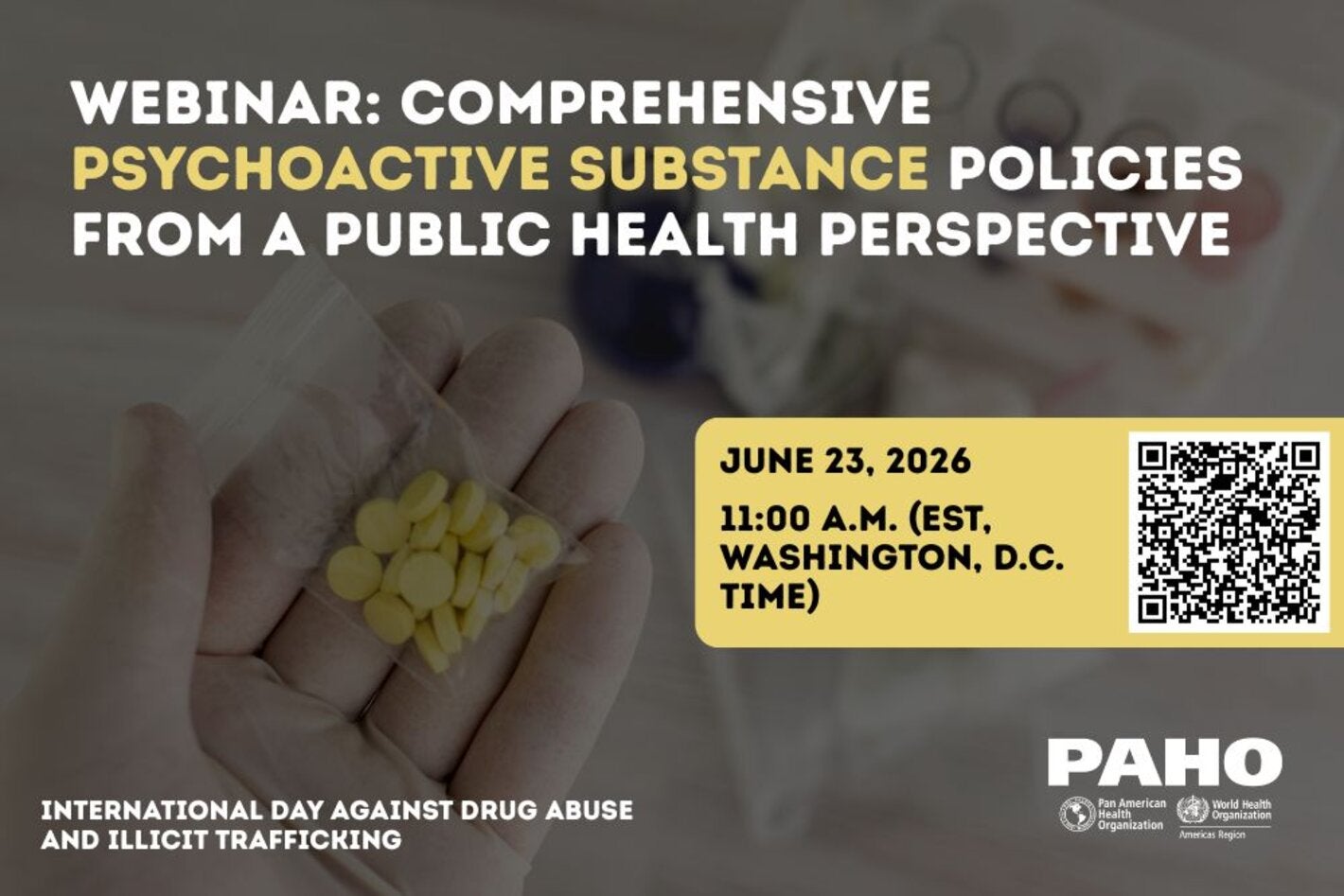
Join us on Tuesday, June 23, at 11:00 a.m. (Washington, DC time or EST) on the webinar "Comprehensive Psychoactive Substance Policies from a Public Health Perspective". This webinars general objective is to commemorate the International Day against Drug Abuse and Illicit Trafficking through a space for reflection, technical updates, and exchange of experiences that contributes to raising awareness about the impact of substance use disorders on public health in the Region of the Americas, while strengthening the capacities of health systems, public policies, and intersectoral cooperation for prevention, early detection, treatment, and recovery, in line with international evidence-based recommendations.
Objectives of the webinar
- Analyze the regional context and the growing burden of substance use disorders in the Americas and their implications for public health.
- Promote the exchange of experiences and good practices implemented across the Region to strengthen comprehensive policies and evidence-based prevention systems.
- Foster regional dialogue on the challenges and opportunities for consolidating comprehensive, sustainable, and intersectoral responses.
RECORDING
How to participate
- DATE: Tuesday, June 23, 2026
- TIME: 11:00 a.m. (Washington, DC time or EST) [Check at the end of the page the time in other cities]
- LANGUAGES: English, Portuguese and Spanish, with simultaneous interpretation in those languages.
- REGISTER: https://paho-org.zoom.us/webinar/register/WN_zOOaqqiURi67QUu0AI4FcA#/registration
Agenda
Welcome remarks: Commemoration of the International Day against Drug Abuse and Illicit Trafficking in the Americas, Renato Oliveira, Head of the Mental Health and Substance Use Unit, PAHO
The Growing Burden of Substance Use Disorders in the Americas: Evidence and Public Health Challenges, Raúl Martín del Campo, Advisor on Alcohol and Psychoactive Substances, PAHO
Challenges in the implementation of drug policies with a public health approach at a country level, Raúl Martín del Campo, Advisor on Alcohol and Psychoactive Substances, PAHO
- National Council Jamaica
- National Drug Board of Uruguay
- CONASAMA México
Q&A, Leonardo García, Consultant on Alcohol and Psychoactive Substances, PAHO
Closing remarks, Renato Oliveira, Unit Chief, Mental Health, PAHO
Context
Substance use disorders represent one of the most significant emerging public health challenges in the Region of the Americas. The growing burden of disease, mortality, and disability associated with substance use underscores the need to strengthen comprehensive responses through health systems and evidence-based public policies (UNODC, 2025).
Recent data published by PAHO show that, in 2021, approximately 17.7 million people were living with substance use disorders in the Region of the Americas, resulting in more than 77,000 deaths and over 7.5 million disability-adjusted life years (DALYs). The study also highlights a sustained increase in the burden associated with substance use, particularly related to opioids and amphetamines, as well as a significant rise among women and young people.
In this context, PAHO has been developing technical tools to support countries in the formulation, implementation, and evaluation of public health policies on psychoactive substances, promoting comprehensive, evidence-based, and people-centered responses. Among these tools is the Guide for the Development of Public Policies on Drugs from a Public Health Perspective, which promotes a comprehensive and balanced approach to strengthening national responses to problems associated with psychoactive substance use (Pan American Health Organization, 2021).
Despite the availability of evidence-based interventions and policies, significant gaps remain in access to comprehensive prevention, treatment, and care services, as well as challenges related to the implementation of sustainable public health response systems, particularly in contexts of social vulnerability and institutional limitations. In this context, strengthening the technical capacities of countries to develop comprehensive responses to psychoactive substance use is a priority. This includes promoting evidence-based public policies, public health approaches, intersectoral coordination, and sustainable prevention systems.
Time in other cities
- 8:00 a.m. – Los Angeles, Vancouver.
- 9:00 a.m. - Belmopan, Guatemala City, Managua, Mexico City, San Salvador, San José (Costa Rica), Tegucigalpa.
- 10:00 a.m. - Bogotá, Kingston, Lima, Panama City, Quito,
- 11:00 a.m. - Havana, Port-au-Prince, Nassau, Ottawa, Washington D.C., Bridgetown, Caracas, Georgetown, La Paz, Port of Spain, San Juan, Santo Domingo, Saint George's, Saint John's (Antigua), Santiago.
- 12:00 p.m. – Asunción, Buenos Aires, Brasilia, Montevideo, Paramaribo.
- 5:00 p.m. – Geneva, Madrid.
For other cities, check the local times in the following link.