
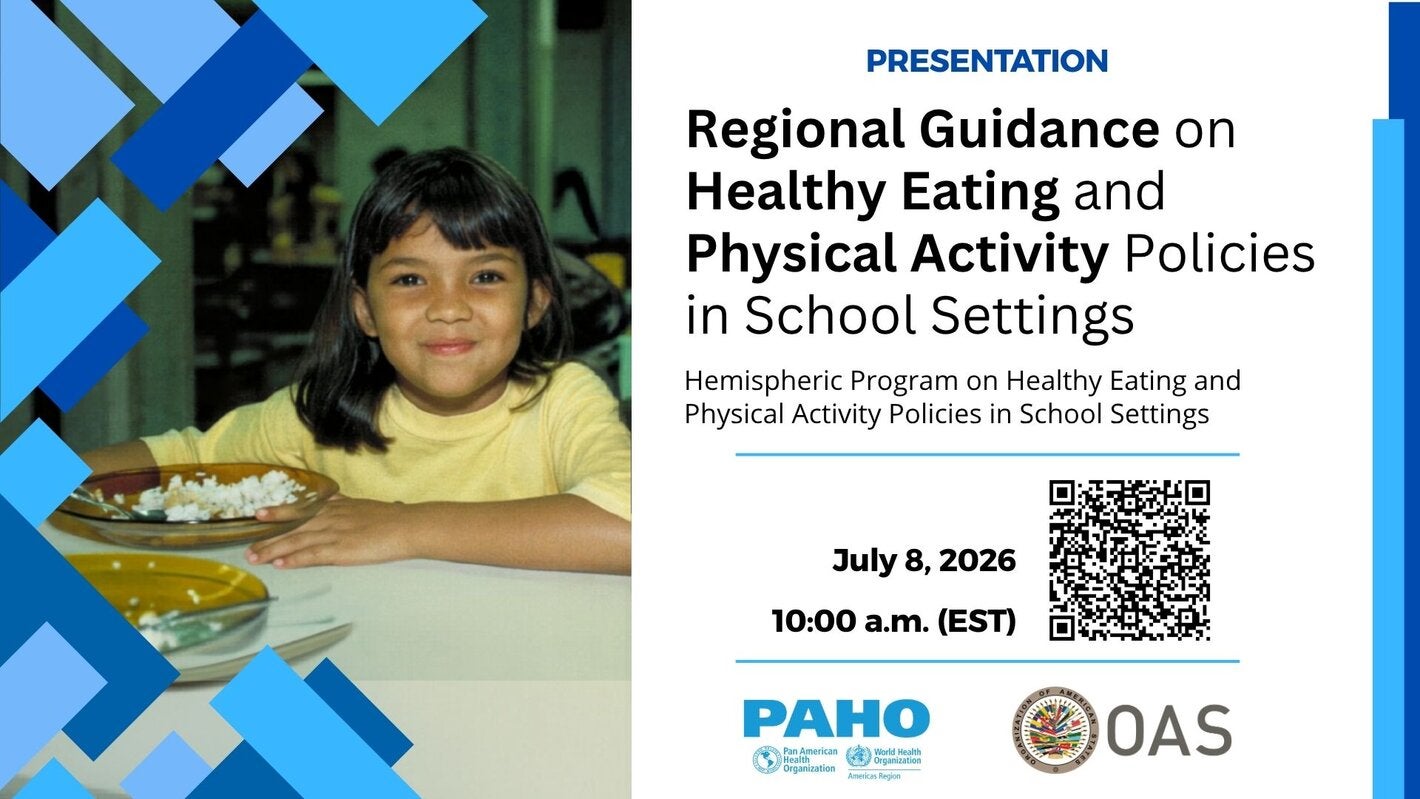
Join us on Wednesday, July 8, at 10:00 a.m. (Washington D.C. time or EST) for the Presentation of the Regional Guidance on Healthy Eating and Physical Activity Policies in School Settings. The purpose of the event is to present the final version of the Regional Guidance, as part of this ongoing process of technical dialogue with Member States, and will contribute to their understanding and ownership in preparation for future phases of adoption and implementation at the national level.
Schools are a critical environment for determining how available, accessible, and attractive healthy foods and physical activity opportunities are. They also function as spaces where lifelong skills and habits can be developed. Therefore, it is essential to design, implement and evaluate effective strategies, programs and policies within educational systems to improve school environments. These include:
- promote healthy eating and water consumption by regulating the sale of food and beverages in schools.
- restrict access to and advertising of ultra-processed products.
- support active lifestyles through physical education, play, active recreation, active classrooms, active transportation, and reducing sedentary behaviors.
The launch of the Regional Guidance document will provide Member States with a comprehensive technical instrument to support the design, implementation, monitoring and evaluation of policies that promote healthier school environments.
RECORDING
How to participate
- DATE: Wednesday, July 8, 2026
- TIME: 10:00 a.m. (Washington, D.C. time or EST) [Check the time in other cities at the bottom of the page]
- LANGUAGES: English and Spanish, with simultaneous interpretation in both languages.
- REGISTRATION: https://paho-org.zoom.us/webinar/register/WN_kPGXKcd2TYKACJ4QwzDaYw#/registration
Publication
Context
The Hemispheric Program on Healthy Eating and Physical Activity Policies in School Settings is a joint initiative of the Organization of American States (OAS) and the Pan American Health Organization (PAHO). Its goal is to advance policies that promote healthy eating and physical activity in schools across the Americas.
Overweight and obesity continue to rise, affecting 37.6% of children and adolescents (ages 5–19) in the Americas in 2022. This is largely due to unhealthy environments where children live, grow, learn, and play, characterized by the widespread availability, affordability, and marketing of ultra-processed products and sweetened drinks. These products are excessive in sugar, fat, and sodium, displacing healthier options such as fruits and vegetables, legumes, and whole-grain cereals. At the same time, insufficient physical activity is widespread: in 2016, 80.7% of adolescents aged 11–17 did not meet recommended levels of physical activity. Across the Americas, girls consistently show higher inactivity levels than boys, highlighting a persistent gender gap in adolescent physical activity.
Unhealthy diets and physical inactivity are major contributors to obesity, which affects immediate health, educational outcomes, self-esteem, and quality of life. Children living with obesity are more likely to remain with overweight into adulthood and are at higher risk of noncommunicable diseases (NCDs) such as diabetes, cardiovascular disease, and certain cancers.
Schools are a critical setting in shaping how available, accessible, and appealing healthy foods and physical activity opportunities are. They also serve as spaces where lifelong skills and habits can be developed. Therefore, it is essential to design, implement, and evaluate effective strategies, programs, and policies within education systems to improve school environments. These include promoting healthy eating and water consumption through regulation of food and beverage sales in schools; restricting access and advertising of ultra-processed products; and supporting active lifestyles through physical education, play, active recreation, active classrooms, active transport, and reducing sedentary behaviors.
Within this context, the Hemispheric Program on Healthy Eating and Physical Activity Policies in School Settings launched a regional call in 2023. Eleven proposals were received from Member States. After review, Bahamas, Belize, and Colombia were selected for intensified technical support. From 2023-2025, their experiences have been documented and lessons learned systematized, which directly informed the development of the draft Regional Guidance on Healthy Eating and Physical Activity Policies in school settings (PASAFE). In addition, feedback from Ministries of Health and Ministries of Education was integrated.
The development of the Regional Guidance followed a structured, evidence-informed, and country-driven process. Experiences from the Bahamas, Belize, and Colombia were documented and systematized through ongoing technical exchanges, field-based learning, and comparative analysis, generating practical insights on policy design, implementation, monitoring, and intersectoral coordination. These lessons directly informed the conceptual framework and operational components of the Guidance, strengthening its relevance, feasibility, and applicability across diverse national contexts.
This process is part of a progressive effort of technical and intergovernmental dialogue with Member States, which included presenting the draft guidance to the Ministries of Education and Health in October 2025, as well as incorporating their contributions into the development of the document.
Time in other cities
- 7:00 a.m. – Los Angeles, Vancouver.
- 8:00 a.m. - Belmopan, Guatemala City, Managua, Mexico City, San Salvador, San José (Costa Rica), Tegucigalpa.
- 9:00 a.m. - Bogotá, Kingston, Lima, Panama City, Quito,
- 10:00 a.m. - Havana, Port-au-Prince, Nassau, Ottawa, Washington D.C., Bridgetown, Caracas, Georgetown, La Paz, Port of Spain, San Juan, Santo Domingo, Saint George's, Saint John's (Antigua), Santiago.
- 11:00 a.m. – Asunción, Buenos Aires, Brasilia, Montevideo, Paramaribo.
- 4:00 p.m. – Geneva, Madrid.
- For other cities, please check local times in the following link.