
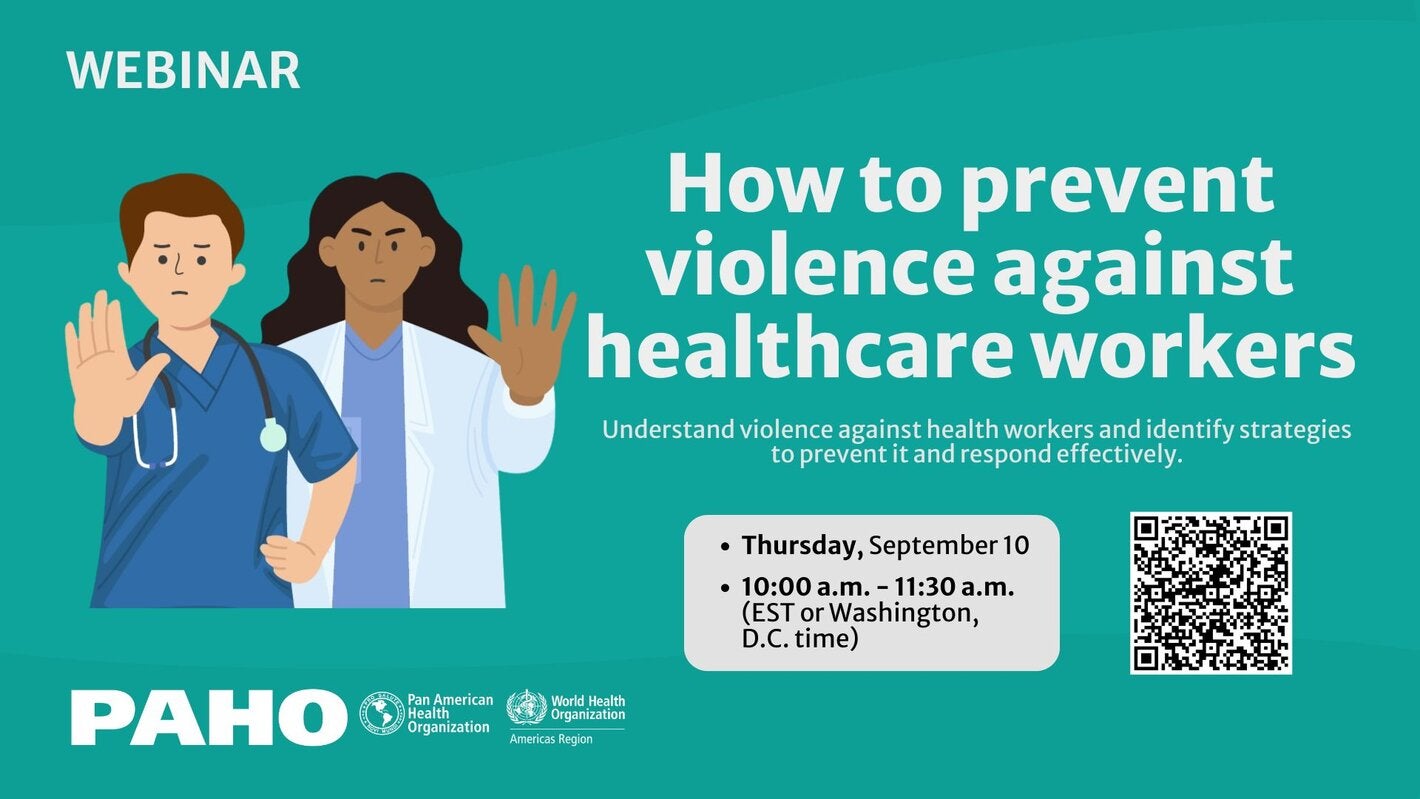
Join us on Thursday, September 10, at 10:00 a.m. (Washington, D.C. time/EST) for the event "Prevention of and Response to Violence Against Health Workers in the Americas." The webinar will strengthen understanding and multisectoral responses to prevent and address violence against health personnel.
Goals:
- Understand the magnitude, forms, and risk factors of violence against health workers in the region.
- Identify effective prevention and response strategies at the institutional and health system levels, including the implementation of PAHO/WHO regulatory frameworks, tools, and guidelines.
- Strengthen the health sector's role in the detection, recording, reporting, and addressing of violence, as well as the use of information systems to guide decision-making.
- Highlight the importance of self-care and psychosocial support for health workers.
- Disseminate technical tools and recent evidence regarding violence against health workers in the region.
RECORDING
How to participate
- DATE: Thursday, September 10, 2026
- TIME: 10:00 a.m. (Washington, D.C. time or EDT) [Check the time in other cities at the bottom of the page]
- LANGUAGES: Spanish and English, with simultaneous interpretation in both languages
- REGISTRATION: https://paho-org.zoom.us/webinar/register/WN_17t71EgYTSGUCbJtlM35fg#/registration
Agenda
- 10:00 a.m.
- Welcome
Presentation of the PAHO factsheet
- Welcome
- 10:15 a.m. Panel discussion with panelists
- Magnitude and types of violence against health workers
- Risk factors and impacts on health and health systems
- Institutional strategies and the role of the health sector in preventing and addressing violence
- Promising experiences or practices in the region
- 11:15 a.m. Interactive exercise and wrap-up
Context
Violence against health workers constitutes a growing problem affecting public health, human rights, and the functioning of health systems. It encompasses abuse, threats, or aggression occurring in work-related circumstances—including physical, psychological, sexual, and verbal violence, as well as workplace harassment. Globally, 62% of health workers have experienced some form of workplace violence. Furthermore, a study covering 22 countries—20 of them in Latin America—found that 67% of surveyed personnel had suffered aggression within the past year, with physical violence involved in one out of every ten cases.
In the Region of the Americas, this issue manifests in various settings. Violence perpetrated by patients and their families—including insults, threats, and physical aggression—tends to intensify in high-demand services (such as emergency departments) or during health crises and periods of misinformation. Community and contextual violence can take the form of direct threats, restrictions on movement, intimidation, or even attacks on health facilities by gangs or organized crime groups, particularly in areas with high levels of insecurity or during emergencies.
Protecting health workers from violence is backed by a robust normative framework in the Region. The *Strategy and Plan of Action for Strengthening the Health System to Address Violence against Women (2015–2020)* and the *Global Plan of Action to Strengthen the Role of the Health System within a National Multisectoral Response to Address Interpersonal Violence, in Particular against Women and Girls* recognize the pivotal role health systems play in preventing violence, caring for those affected, and creating safe environments. Likewise, the *Health Workforce Policy 2030* and the *Plan of Action on Workers’ Health (2015–2025)* provide a strategic framework for promoting safe, healthy, and violence-free work environments, thereby strengthening the protection and well-being of health workers. Despite growing international recognition of this issue, progress in preventing and addressing violence against health workers remains limited. Only 26 of the 195 WHO Member States have policy instruments and national occupational health and safety programs in place for health workers.
Against this backdrop, PAHO seeks to strengthen regional dialogue on preventing and responding to violence against health workers in the Americas. This initiative will be carried out in coordination with new technical products regarding violence against health workers, including a regional factsheet and the upcoming World Health Organization report on violence against health workers, scheduled for the fourth quarter of 2026.
Time in other cities
- 7:00 a.m. – Los Angeles, Vancouver.
- 9:00 a.m. – Belmopan, Guatemala City, Mexico City, Managua, San José (Costa Rica), San Salvador, Tegucigalpa.
- 10:00 a.m. – Bogotá, Lima, Quito, Kingston, Panama City, Memphis, Havana, Nassau, Ottawa, Port-au-Prince, Washington, D.C.
- 11:00 a.m. – Bridgetown, Caracas, Castries, Georgetown, La Paz, Port of Spain, San Juan, Santo Domingo, St. George's, St. John's.
- 12:00 p.m. – Asunción, Buenos Aires, Brasília, Montevideo, Paramaribo, Santiago.
- 4:00 p.m. – Geneva, Madrid.
For other cities, check the local time in this link.