
Mercury is highly toxic, persistent in the environment, and one of WHO’s top ten chemicals of public health concern, especially for vulnerable groups such as children, women, adolescents, and older adults. To address this, the Minamata Convention was adopted to protect human health and the environment, including actions to reduce or eliminate dental amalgam and to manage its waste responsibly.
Through funding from the Global Environment Facility, WHO and UNEP launched the project “Accelerating the Implementation of Provisions on Dental Amalgam and Strengthening National Capacities for the Environmentally Sound Management of Associated Waste.” Uruguay was selected to represent Latin America and the Caribbean because of its strong commitment and progress in phasing out dental amalgam.
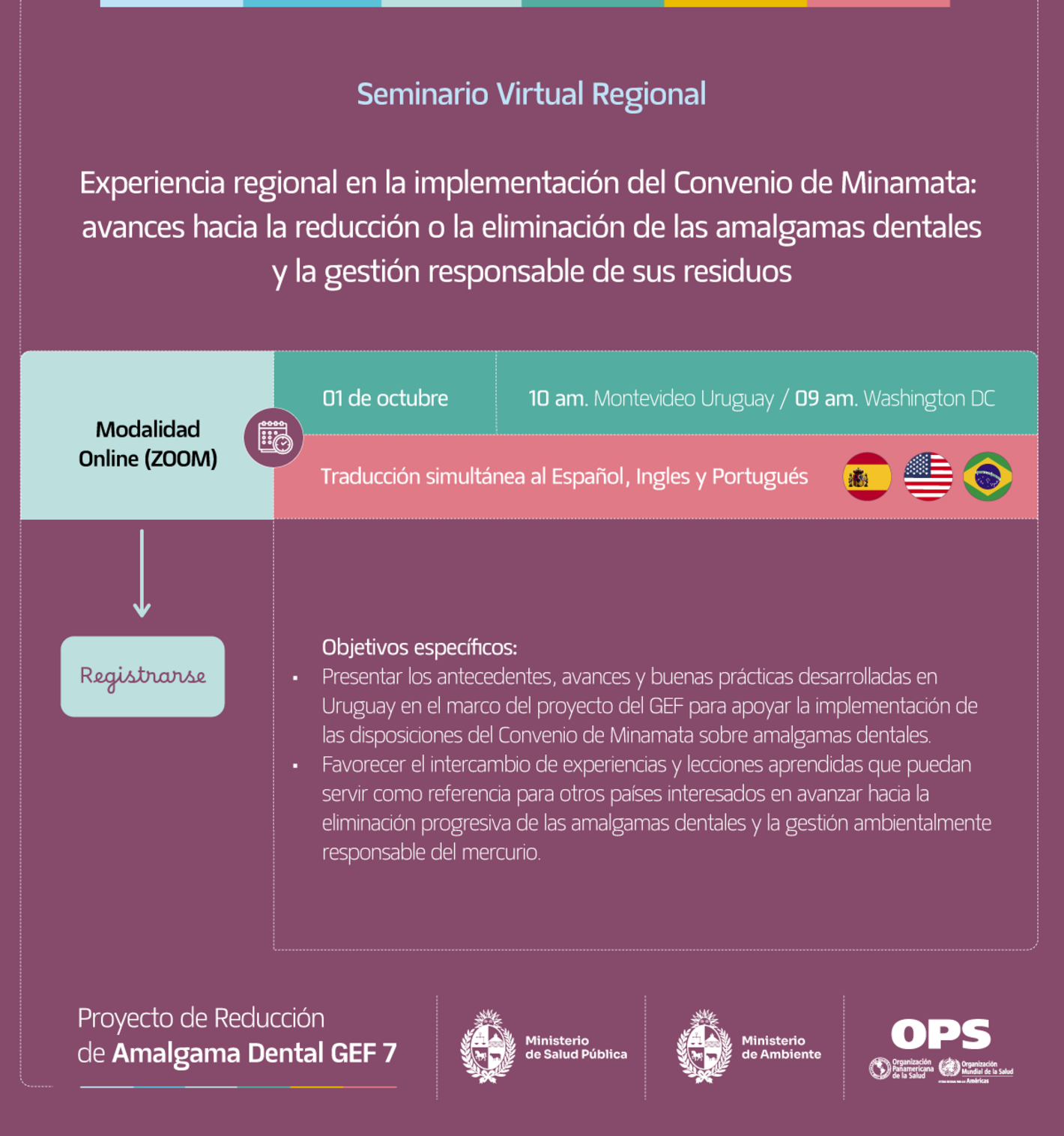
This virtual seminar will present Uruguay’s experience and achievements under this project and share best practices to help guide and inspire other countries in reducing dental amalgam use and enhancing mercury waste management.
Watch the recording
Specific objectives
- To present the background, progress, and best practices developed in Uruguay under the GEF project in support of implementing the Minamata Convention’s provisions on dental amalgam.
- To foster the exchange of experiences and lessons learned that can serve as a reference for other countries seeking to phase out dental amalgam and ensure environmentally sound mercury management
Agenda
Activity and panelists
Opening remarks and introduction
Caroline Chang, Country Representative, PAHO-Uruguay
Grace Halla, PNUMA
The Minamata Convention and the Importance of Addressing Dental Amalgam Mercury’s Impact on Public Health and the Environment
Francisco Sánchez, PAHO
Global Perspective: Project Background and Opportunities in the Americas
Gabriela Sardon, WHO
Uruguay’s Experience: Progress, Challenges, and Lessons Learned National case study on the progressive elimination of amalgam and waste management
Judith Torres, Ministry of Environment, Uruguay
Agustín Cataldo, Ministry of Public Health, Uruguay
Mónica Méndez, PAHO-Uruguay
Overview of Initiatives in Other Countries in the Region: Verbal commentary based on the country’s experience. Panel discussion
Moderador: Carolina Hommes, PAHO
Next Steps. Summary of key points and recommendations to enhance implementation at both regional and global levels.
Gabriela Sardón, WHO
Agustín Cataldo Ministry of Public Health, Uruguay
Closing remarks
Wilson Benia, PAHO-Uruguay