
This section brings together courses and learning resources designed to strengthen the capacities of health teams to implement and use telehealth services.
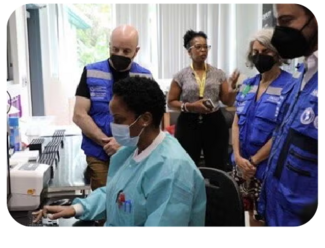
The new perspective that the COVID-19 pandemic has given us regarding the need to accelerate the digital transformation in the health sector and thus understand the importance of adopting telehealth services, has also generated the need to propose renewed strategies to promote not only their adoption and adaptation but also their appropriate, safe and effective use.
From the latter arises the importance of designing a set of educational resources that involve generating new competencies from the lived experience (knowledge, skills and attitude) of health personnel and focused on people.
Quick access
Plan overview
The content of these resources is designed as a comprehensive and integrated set of inputs, with cross-cutting features, to support the implementation of digital transformation programs across countries in Latin America and the Caribbean.
It is based on a series of actions developed through an innovative approach grounded in a simulation model, which provides a controlled and reliable environment for the teaching and learning process.
This simulation model offers a renewed perspective to respond to current demands related to health services, proposing immersive tools and strategies that enable users to acquire the knowledge needed to strengthen maturity and capabilities for advancing digital transformation in health. This plan is intended for different types of users, including decision-makers, health service providers, and service users (from macro-management to micro-management levels).
Methodological approach
Simulation in the health sector enables the recreation of both clinical and non-clinical environments designed to apply critical thinking, improve decision-making, and support training and guidance in procedures and skills.
In addition, considering health safety conditions and their link to human resource management, a simulation model allows for the development of teaching and learning strategies focused on leadership, teamwork, problem-solving, and effective communication.
Through this simulation model, different approaches are addressed to adapt teaching and learning content. In this way, PAHO provides tools for training, education, and learning interventions in the field of digital health, as well as for technical capacity building.
Digital Literacy Program | Meet the Expert: Efficient and Safe Use of Telehealth
Digital Literacy Program | Masterclass: Strategic Role of University Networks in Telehealth
Digital Literacy Program | Webinar: Implementation Frameworks
Virtual Course on Change management for Telehealth services and programs
Virtual course for the integration of telehealth in the first level of care with the application of simulation models
Virtual Course on Introduction to Interoperability and FHIR standard
Virtual Course on Introduction to Health Information Systems
Change management for Telehealth services and programs
The Americas region is undergoing a process of rapid adoption of telehealth service models, motivated by the need to provide and expand services in the context of COVID-19, as well as by the opportunities derived from the investment made by the States and the contributions of international cooperation, including PAHO. In this new technological and health scenario within health systems, it is critical to advance in the creation and strengthening of capacities of health teams that must design, plan, execute and evaluate care processes that use information and communication technologies (ICT).
These actions require knowledge and change management skills that allow them to lead digital transformation processes to align them with the health objectives and principles agreed upon by the countries within the framework of PAHO. Change management involves the ability to understand and intervene appropriately in the collective processes that individuals go through, facilitating dialogue and effective action that guides digital transformation towards agreed needs and priorities, anticipating, preventing and addressing difficulties, as well as celebrating achievements.
Upon completion of the course, participants will be able to:
- To create change management capabilities in health teams to adopt information and communication technologies in order to initiate or enhance telehealth services, particularly in the prevention and treatment of non-communicable diseases, including mental health.
- Health personnel in the Americas, from all disciplines and profiles linked to the health field, interested in acquiring change management tools.
- Those in charge of implementing or managing telehealth projects, with the task of implementing or optimizing telecare services, with an emphasis on non-communicable diseases, including mental health.
- Members of health teams, who act as change agents or need change management tools to support telehealth projects and services.
This course is recommended for the following profiles:
- Telehealth program implementers
Asynchronous, self-administered online course.
20 hours.
8 weeks, for a total of 20 hours.
Virtual course for the integration of telehealth in the first level of care with the application of simulation models
The Telehealth Training Center is an initiative of the Pan American Health Organization whose main purpose is to integrate telehealth at the first level of care, in order to promote and contribute to the necessary digital transformation in the Region of the Americas. The focus of the training center's activities is linked to the prevention, promotion, diagnosis, monitoring and treatment of non-communicable diseases. It consists of a professional development program to support the creation of resilient health systems in the post-pandemic era, created from various learning environments, and scalable for the continuous training of health personnel in the Region of the Americas in Telehealth, under the E-learning modality.
It is designed in a playful way and is based on the competency-based approach, seeking not only to transfer knowledge, but to develop know-how (skills) and, above all, to reinforce know-how, mobilizing the necessary attitudes and associated fundamental competencies.
As it is adult education, innovative methodologies are taken into account that favor the teaching-learning process, including andragogy, didactics for adults, and mental training, considering an adequate balance of multimedia and interactivity.
The Telehealth training center seeks that, upon completion, the participant will be able to integrate telehealth in the first level of care, to facilitate prevention, promotion, diagnosis, monitoring and treatment actions of non-communicable diseases.
Upon completion of the training center activities, participants will be trained to:
- Explain the functions of telehealth and benefits for a better understanding of its operation at the first level of care.
- Identify the basic organizational and technological structure for the operation of the telehealth service at the first level of care.
- Recognize teleconsultations as an essential element for the implementation of telehealth at the first level of care.
- Identify digital tools associated with teleconsultations as fundamental axes for the implementation of telehealth at the first level of care.
- Identify the main types of teleconsultations for a better understanding of the functioning of telehealth at the first level of care.
- Describe the normative, ethical, and communication regulations necessary for the operation of telehealth at the first level of care.
- Explain the main barriers that telehealth faces at the first level of care to facilitate the operation of services.
- Distinguish good from bad practices in telehealth in order to promote the provision of efficient and quality services.
- Place the learning in the prevention, promotion, diagnosis, monitoring, and treatment of non-communicable diseases.
The training center is aimed at health sector workers in the Region of the Americas who do not have prior knowledge of telehealth and who are interested in learning and training about its potential.
This course is recommended for the following profiles:
- Telehealth program implementers
- Telehealth end users
Self-learning course, free, open to the public and without deadlines to complete it.
40 hours.
The training center is free access, since it is a self-learning space. Participants can decide the time and moments they dedicate to doing it.
Introduction to Interoperability and FHIR standard
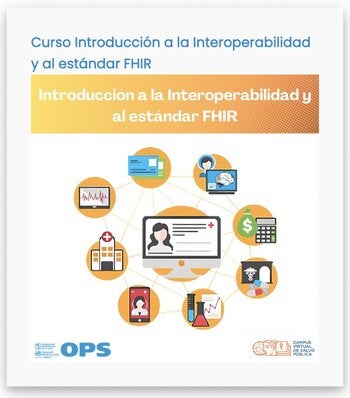
The purpose of this course is to provide an introductory and general overview of the essential concepts of interoperability, health standards and FHIR. Contemporary health information systems are made up of integrated healthcare networks that use standards to interoperate and manage all health information pertaining to the care and attention of people, originating in multiple sites and sources of information, within different organizations and/or health entities.
Currently, there is no single application that can solve all the needs related to the exchange of information, which is why it is necessary for the different systems to interoperate, avoiding task redundancy, reducing errors and increasing efficiency.
Upon completion of the course, participants will be able to:
- Understand the importance of interoperability in the field of health information systems.
- Define, explain and effectively use the concept of interoperability.
- Recognize the benefits of achieving communication or interoperability between different health information systems.
- Understand the importance of standards in the health field, as well as the problems that arise from the lack of these.
- Identify different standards used in the health field, at local, regional and international level.
- Know the HL7 standard, the vocabulary standards and their integration with clinical information systems, among others.
- Identify the main characteristics of the FHIR standard, and the advantages in solving problems and limitations of other previous standards.
- Understand the concept of FHIR resources and create them to interact with FHIR servers.
- Recognize profiles, restrictions and the use of extensions.
- Analyze the use of REST in FHIR documents, transactions and messages.
The course is aimed at professionals and technical staff of the health team.
This course is recommended for the following profiles:
- Staff related to digital transformation processes in general
- Junior technical staff in Interoperability
Free, open to the public, self-learning course with no deadlines for completion.
120 hours.
The course is free to attend, since it is a self-learning course, participants can decide the time and moments they dedicate to completing it.
Introduction to Health Information Systems
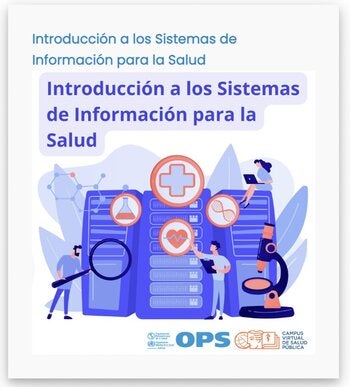
The purpose of this course is to provide an overview of the complexity of Information Systems for Health (IS4H), considering the functioning of the elements that compose them, through the analysis of their constituent dimensions. IS4H that interoperate in comprehensive care networks play an essential role in the health care of people throughout their lives, promoting access to timely health care, improving the quality, safety and cost effectiveness of health care.
As a line of action, the strengthening of Information Systems for Health promoted by the Pan American Health Organization, considers the training of human capital as a strategy to improve decision-making mechanisms, considering the exchange of knowledge and the adoption of knowledge management methodologies to support the implementation of IS4H.
The course provides opportunities to develop skills aimed at the effective application of Information Systems for Health.
Upon completion of the course, participants will be able to:
- Identify the main problems of health information that generate the main challenges when implementing health information systems.
- Recognize the characteristics of information management and flow in the health institution and the main proposals to solve its deficiencies.
- Describe the benefits of information technologies applied to the health field.
- Recognize the strategic importance of using eHealth to support universal health coverage (UHC).
- Describe the characteristics of health information systems from technological and functional perspectives.
- Identify the impact of redesigning information systems to ensure the quality of medical care and continuous care, as well as to make the use of health resources more effective.
The course is aimed at:
- Officials involved in health decision-making.
- Professionals and technical staff of the health team.
This course is recommended for the following profiles:
- Staff related to digital transformation processes in general
- IS4H implementers
Free, open to the public, self-learning course with no deadlines for completion.
100 hours.
The course is open access, since it is a self-learning course, participants can decide the time and moments they dedicate to completing it.