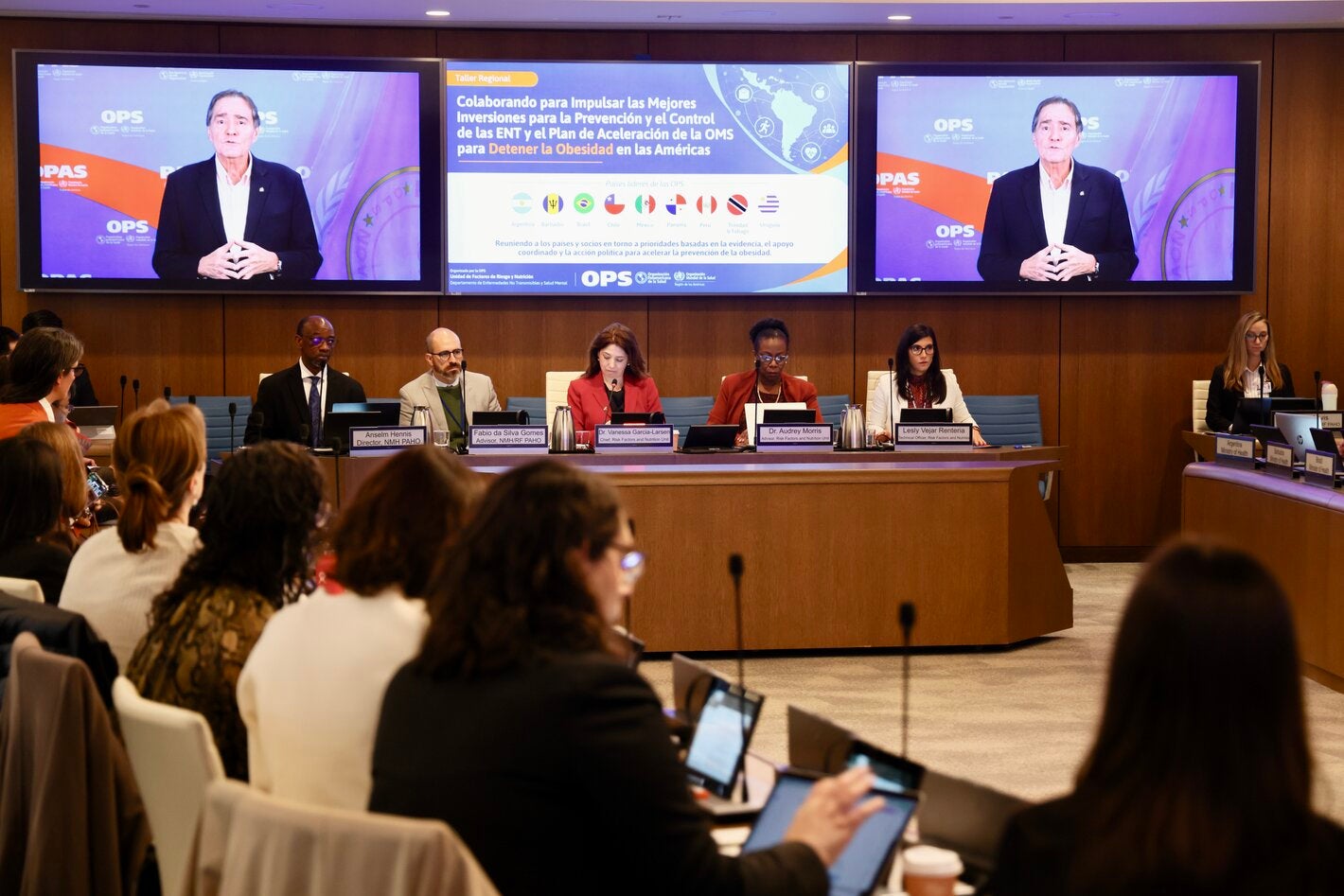
Washington, D.C., 18 November 2026 (PAHO) – Ministry of Health representatives from the nine frontrunner countries in the Americas joined technical experts and partners at the Pan American Health Organization (PAHO) headquarters in Washington, D.C., to strengthen regional mechanisms needed to advance and scale up interventions to prevent and manage obesity.
“Our Region faces one of the world’s highest burdens of overweight and obesity. In 2022, 68% of adults and 38% of children and adolescents aged 5–19 were affected. If current trends continue, the prevalence among adults could reach 73% by 2030, accelerating noncommunicable diseases, widening inequities and increasing pressure on health systems,” said PAHO Director Dr. Jarbas Barbosa, as he emphasized the importance of addressing obesity.
The meeting brought together all nine frontrunner countries for the first time — Argentina, Barbados, Brazil, Chile, Mexico, Panama, Peru, Trinidad and Tobago, and Uruguay. PAHO’s relevant country focal points, academic institutions, technical agencies, development partners, and civil society organizations also participated in this event. The meeting addressed the status of country progress, implementation barriers, and opportunities for accelerated action on obesity. Participants discussed coordination and alignment based on country roadmaps, economic and public health evidence, research, capacity-building, implementation, monitoring and evaluation, and policy dialogues.
Discussions built on priorities agreed at the Global Summit of Obesity in Madrid in October and focused on translating them into practical actions tailored to each country's context. The meeting also explored the integration of obesity prevention and management into primary health care through the PAHO Initiative, Better Care for Noncommunicable Diseases (NCDs).
A key focus was strengthening the economic and public health case for investing in obesity prevention and management. Participants examined the potential health and economic benefits of scaling up obesity-related NCD Best Buy interventions, including policies that improve food environments and support behavioral change, front-of-package warning labels, and promotion of physical activity. Participants also discussed economic modeling of interventions to reduce premature deaths, avert DALYs, and add healthy-life years, noting that country-specific modeling can inform policy discussions, priority setting, and resource allocation.
A framework for regional coordinated action
The WHO Acceleration Plan to Stop Obesity provides countries with a framework to select, implement, and sustain evidence-based actions to promote healthier diets and physical activity, including NCD Best Buy interventions that create healthier food and built environments. This framework is organized around five interconnected workstreams covering evidence-based and cost-effective actions, delivery for impact, global advocacy, partner engagement, and accountability.
The meeting addressed the three strategic domains for transformation: Adopt, Create, and Transform (ACT) Operational Framework: adapting environments to enable healthy diets and active living; creating knowledge, motivation, and skills for healthy behavior; and transforming health systems to respond to the obesity crisis. Using this reference framework, countries and partners identified strategic opportunities to strengthen actions to achieve measurable impact and work toward reducing obesity by five percentage points by 2030.