São Paulo, November 16, 2026 (BIREME/PAHO/WHO) - BIREME, a Specialized Center of the Pan American Health Organization/World Health Organization (PAHO/WHO) within the Department of Evidence and Intelligence for Action in Health (EIH), is beginning a new cycle of institutional development, guided by six strategic directions for 2026–2031. These priorities build on recent progress and respond to transformations in the production and use of health knowledge, the expansion of artificial intelligence (AI), and the growing need to transform information and knowledge into intelligence to guide action in health.
The new cycle coincides with a significant milestone for the Center, which will celebrate its 60th anniversary in March 2027. The signing of the Headquarters Agreement between the Government of Brazil and PAHO in July 2026 represents an institutional milestone that provides better conditions for long-term planning and the continuity of technical cooperation with Brazil and the countries of the Region.
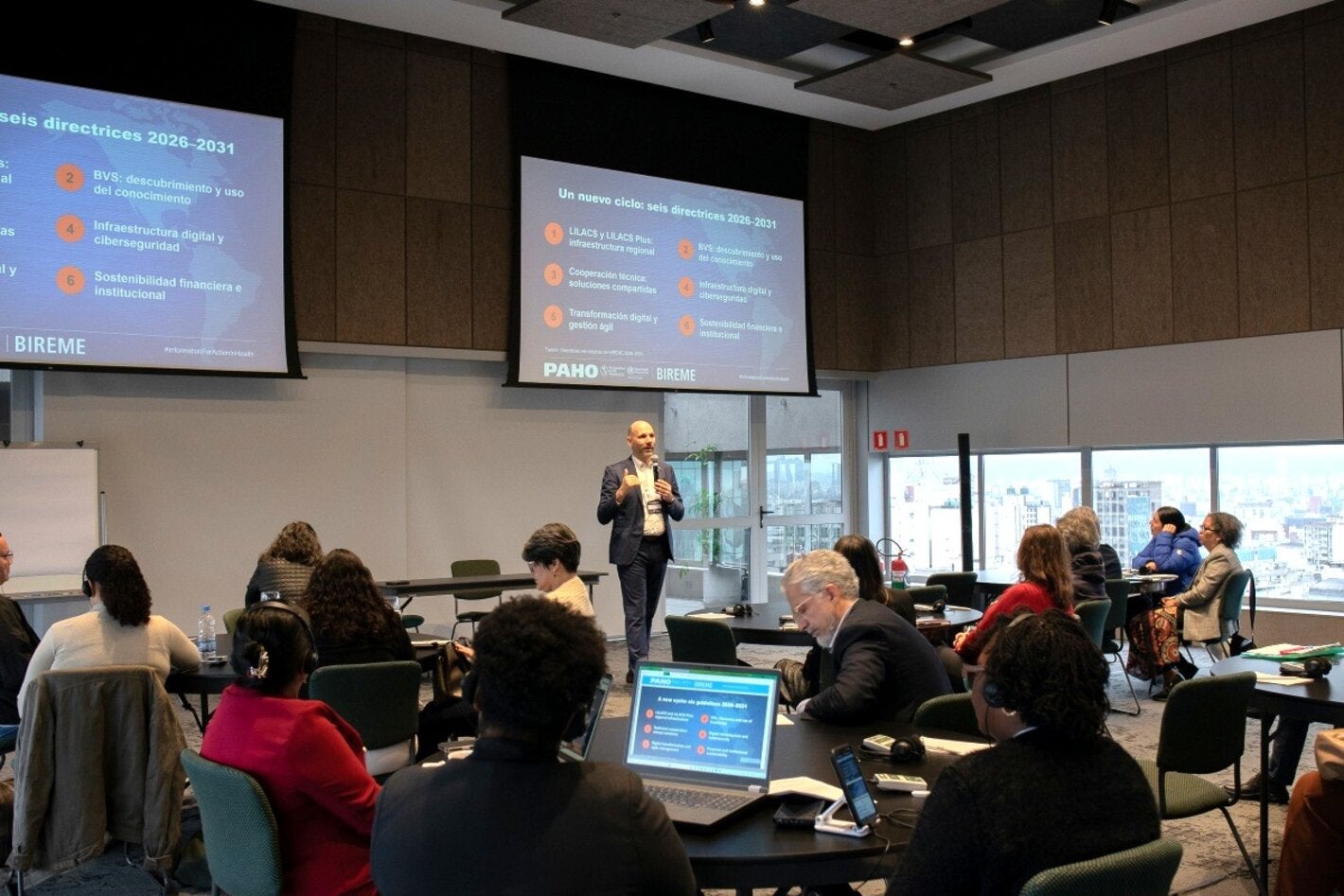
Presentation of the Strategic Directions for 2026–2031 during the 8th Regional Coordination Meeting of the Virtual Health Library (VHL) Network, held in São Paulo on October 26, 2026.
In recent years, BIREME has strengthened its scientific information infrastructure and expanded the development of knowledge services. LILACS Plus has reached approximately 2.8 million records, while AI has begun supporting information indexing, retrieval, and synthesis processes. Initiatives such as the SUS Digital Platform, the COVID-19 Pandemic Digital Memorial, and the WHO Traditional Medicine Global Library demonstrate the expansion of the Center’s technical cooperation opportunities.
Aligned with the PAHO Strategic Plan 2026–2031, the six strategic directions provide a reference framework for the preparation of successive Biennial Work Plans (BWPs), through which they will be translated into priorities, initiatives, and results, taking into account countries’ needs and the institutional conditions of each period.
According to João Paulo Souza, Director of BIREME, the new cycle represents an opportunity to integrate the technical and scientific heritage accumulated by the Center with the ongoing transformations in the field of health information. “BIREME’s Strategic Directions for 2026–2031 build on a history of significant institutional progress and achievements while positioning the Center for a future marked by profound and rapid transformations. Artificial intelligence, climate change, and demographic transition are redefining health needs and the information and knowledge environment itself. In an increasingly complex, volatile, and uncertain world, our challenge is to go beyond adaptation: we need to anticipate change, innovate responsibly, and strengthen our capacity for technical cooperation so that BIREME continues to fulfill its mission, expands its relevance, and makes a tangible difference in the health and well-being of populations across the Americas.”
In this regard, he emphasizes that planning for 2026–2031 combines the continuity of the Center’s historical functions with the incorporation of new technological, organizational, and cooperation capacities, taking PAHO’s strategic priorities and the needs of countries in the Region as references.
Six Strategic Directions for the Next Cycle
The six strategic directions are organized around complementary dimensions of institutional development. The first three focus on strengthening the regional information and knowledge infrastructure, advancing services for the discovery and use of evidence, and expanding technical cooperation with countries. The remaining directions address the capacities needed to sustain these advances, including technological infrastructure, cybersecurity, management transformation, and institutional sustainability.
“Together, these priorities seek to enhance BIREME’s capacity to deliver meaningful results for health systems by connecting cooperation networks, scientific information, digital technologies, and knowledge produced in different contexts,” adds João Paulo Souza.
1. Consolidate LILACS and LILACS Plus as a Regional Reference Infrastructure
The first strategic direction builds on BIREME’s historical commitment to identifying, organizing, and increasing the visibility of scientific production from Latin America and the Caribbean.
LILACS will continue to fulfill its role in the specialized selection and indexing of scientific literature produced in Latin America and the Caribbean, with a focus on quality and a commitment to open science, while LILACS Plus will more broadly expand the discovery, collection, and integration of regional scientific production as a whole, connecting different databases and information sources.
Strengthening national and thematic networks, interoperability, and process automation should expand collection coverage and reduce the time between the production of scientific knowledge and its availability to users, promoting timely access to evidence.
The evolution of scientific collections, knowledge discovery environments, and solutions developed in cooperation with countries also requires continued investment in infrastructure, processes, and institutional capacities. In this context, technological innovation and organizational transformation are interdependent components of BIREME’s development strategy.
2. Transform the VHL into an Environment for Knowledge Discovery and Use
The second strategic direction seeks to expand the capacity of the Virtual Health Library (VHL) to support users not only in locating scientific and technical information but also in discovering, understanding, and using available knowledge.
This transformation will combine the strength of bibliographic databases and controlled vocabularies, such as DeCS/MeSH, with AI capabilities, natural language processing, semantic search, synthesis, visualization, and knowledge translation, bringing evidence closer to the needs of health managers, professionals, and communities.
The evolution of the VHL should also foster a multi-epistemic approach that is inclusive and open to different ways of producing knowledge, bringing together scientific information, good practices, and the experiences of health workers and services, the lived experiences and memories of communities, and traditional, popular, and ancestral knowledge. This will require appropriate mechanisms to record, preserve, increase visibility, and facilitate access to these forms of knowledge while respecting their characteristics and contexts of origin.
Technological advances should improve the performance of information services and the user experience while preserving source quality, methodological transparency, and human oversight.
3. Intensify Technical Cooperation with Countries, Transforming Experiences into Shared Solutions
The third strategic direction proposes expanding the reach of technical cooperation based on the concrete needs of countries and their health systems.
Experiences such as the Traditional Medicine Global Library, the SUS Digital Platform, the COVID-19 Pandemic Digital Memorial, Formative Second Opinion, and Decision Aids demonstrate the potential to combine methodologies, technologies, and specialized knowledge into solutions adaptable to different contexts.
The priority will be to transform these developments into reusable components, promoting the efficiency, interoperability, and sustainability of initiatives. Technical cooperation will continue to be carried out in coordination with PAHO/WHO Country Offices, technical units, and national institutions, seeking to strengthen local capacities, encourage the exchange of experiences and good practices, and develop shared solutions adaptable to countries’ needs.
4. Strengthen Digital Infrastructure and Cybersecurity
The fourth strategic direction seeks to ensure that technological infrastructure, computing capacity, and cybersecurity mechanisms evolve in line with the needs of BIREME’s products and services.
The modernization of information and communication technology (ICT) infrastructure should help ensure performance, operational continuity, and efficient use of resources, particularly in view of the expansion of digital services and AI applications.
System stability, protection against digital threats, and performance monitoring will be supported by governance, evaluation, transparency, and human oversight mechanisms.
5. Consolidate the Digital and Agile Transformation of Institutional Management
The fifth strategic direction recognizes that digital transformation has two components: digital innovation and the transformation of processes toward greater agility, with the delivery of value to users and institutional partners at its core.
Accordingly, BIREME will continue advancing the adoption of agile management practices, including approaches such as Scrum and Kanban, adapted to the characteristics of projects and operational activities. Strengthening the Project Management Office (PMO) should help connect strategic priorities, resources, implementation, and results, consolidating a culture of collaboration, learning, and continuous improvement, as well as the development of individual competencies and organizational capacities.
6. Expand Financial Sustainability and Promote Institutional Improvement
The sixth strategic direction brings together the conditions needed to sustain the strategy over the long term through the diversification of funding sources, stronger partnerships, and improved resource management.
Institutional improvement will be carried out in alignment with the PAHO Forward/OPS Adelante initiative, aiming to increase operational efficiency and strengthen human and organizational capacities.
A New Stage Built on Six Decades of Cooperation
The six strategic directions establish a framework for BIREME’s development through 2031, while preserving the flexibility needed to respond to changing contexts and countries’ needs.
The approaching 60th anniversary adds a historical dimension to strategic planning. Since its establishment in 1967, BIREME has accompanied transformations in the ways scientific and technical health information is produced, organized, shared, and used. This trajectory, built on the principles of cooperation, equitable access, and strengthening countries’ capacities, provides the foundation for developing new solutions and addressing the challenges of the next cycle.
Reflecting on the prospects for 2026–2031, João Paulo Souza, Director of BIREME, emphasizes the importance of connecting this institutional legacy with contemporary transformations in public health. “The new cycle does not represent a break with the Center’s history. Rather, it builds on the heritage developed over nearly six decades: methodologies, scientific collections, digital platforms, and a cooperative network spanning 35 countries.”
Through its new strategic directions, BIREME seeks to consolidate its position among the largest scientific and technical health sciences libraries in Latin America and the Caribbean and strengthen its role as a strategic infrastructure for information, knowledge, and evidence. The direction set for the new cycle combines the historical commitment to democratizing access to scientific and technical health information with the development of capacities to transform different forms of knowledge into intelligence that supports decisions and actions to advance health in the Americas.