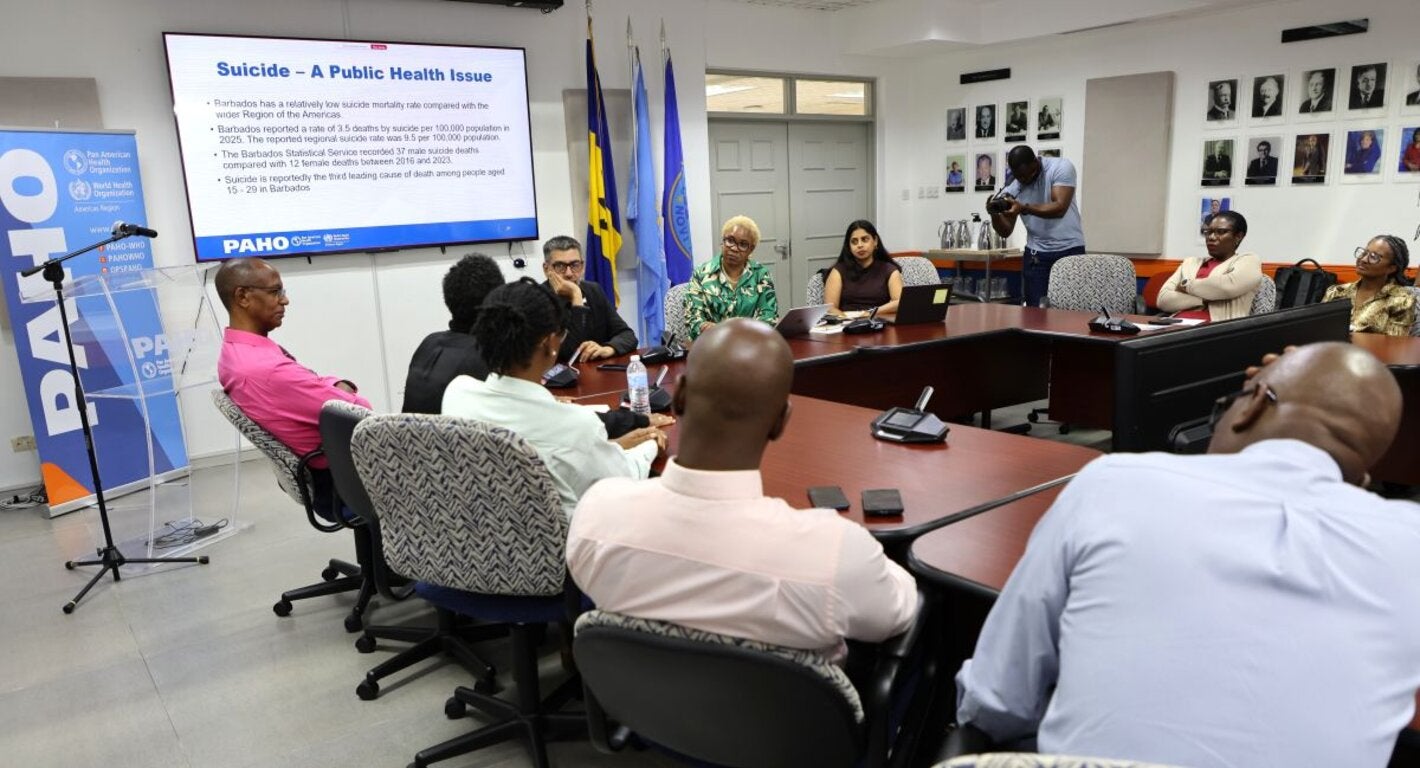
Bridgetown, Barbados, 18 August 2026 (PAHO/WHO) – Media professionals, content creators, emergency service communicators and journalism educators in Barbados have strengthened their capacity to report responsibly on suicide and mental health following a two-day practical training hosted by the Ministry of Health and Wellness and the Pan American Health Organization/World Health Organization (PAHO/WHO).
Suicide remains an important public health issue globally and across the Caribbean. The way suicide is communicated can influence public understanding, attitudes towards mental health, help-seeking behaviours, stigma and perceptions of recovery. Media professionals and others who communicate with the public therefore have an important role in ensuring that coverage is accurate, responsible and sensitive.
Research has shown that sensationalised, repetitive, detailed or stigmatising reporting of suicide can increase the risk of imitative behaviour, contribute to misinformation and reinforce stigma. Conversely, responsible reporting can encourage help-seeking, improve public understanding of mental health, reduce stigma and contribute to suicide prevention efforts.
Recognising this important role, the training brought together journalists, media owners and editors, news producers, digital media personnel, social media influencers and content creators, government communications personnel, journalism educator, mental health practitioner and students and instructors from the Barbados Community College Mass Communications Programme. Public relations personnel from the Barbados Police Service and Barbados Fire Service also participated, recognising their important role as sources of information during incidents that may subsequently become the subject of media coverage.
Dr. Prabhjot Singh, Interim PAHO/WHO Representative for Barbados and the Eastern Caribbean Countries said, “Responsible communication plays a critical role in suicide prevention. We are encouraged by the diverse group of stakeholders who participated in this workshop, reflecting a shared commitment across sectors to communicate about suicide responsibly and sensitively. This is the second workshop on responsible reporting that we have jointly facilitated with the Ministry of Health and Wellness, and PAHO/WHO remains committed to providing technical support to strengthen these efforts.”
Applying responsible reporting principles
The training explored the relationship between suicide, mental health and communication, drawing on examples from around the world to demonstrate how reporting can affect individuals, families and communities. Participants examined responsible reporting practices and considered how international guidance could be adapted to the realities of the Barbados media environment.
Sessions included discussions on why responsible reporting matters, the suicide and mental health context, examples of reporting and their impact, responsible reporting practices, the realities of the Barbados newsroom, and practical exercises focused on adapting guidelines and moving from guidance to everyday newsroom practice.
Carol Martindale, Editor-in-Chief, The Nation Publishing Co. Ltd, emphasized the importance of accountability and putting mechanisms in place to translate the guidelines into everyday newsroom practice. “We need to look at accountability and responsibility and ensure that media houses have the tools and monitoring systems in place to help us implement and adhere to the PAHO/WHO guidelines. We also discussed the possibility of coming together as a collective body to look at what we are doing across the media, rather than approaching these issues individually.”
The participation of social media content creators also reflected the changing communications landscape, where information can reach large audiences rapidly and where individuals outside traditional newsrooms increasingly contribute to public conversations about suicide and mental health.
For content creator Shakira Perira, the training reinforced the responsibility that comes with communicating about suicide and mental health online. “As content creators, we have a big responsibility to educate, but there can be a very thin line between educating and unintentionally providing harmful information. Whenever I share my struggles with mental health and my story about suicide, I make sure to provide information about where people can go for support. I learned a lot from this training, particularly that we can tell these important stories while still following responsible reporting guidelines.”
Participants concluded the training by identifying several actions to support the continued application of responsible reporting practices, including refresher training, strengthened newsroom mechanisms, integration of responsible reporting principles into journalism education, and continued collaboration among stakeholders.
PAHO/WHO supported the initiative through the Universal Health Coverage (UHC) Partnership, with an emphasis on moving beyond the dissemination of guidelines to creating a collaborative space that acknowledges the realities of modern journalism and supports the practical application of responsible reporting principles within the local context.