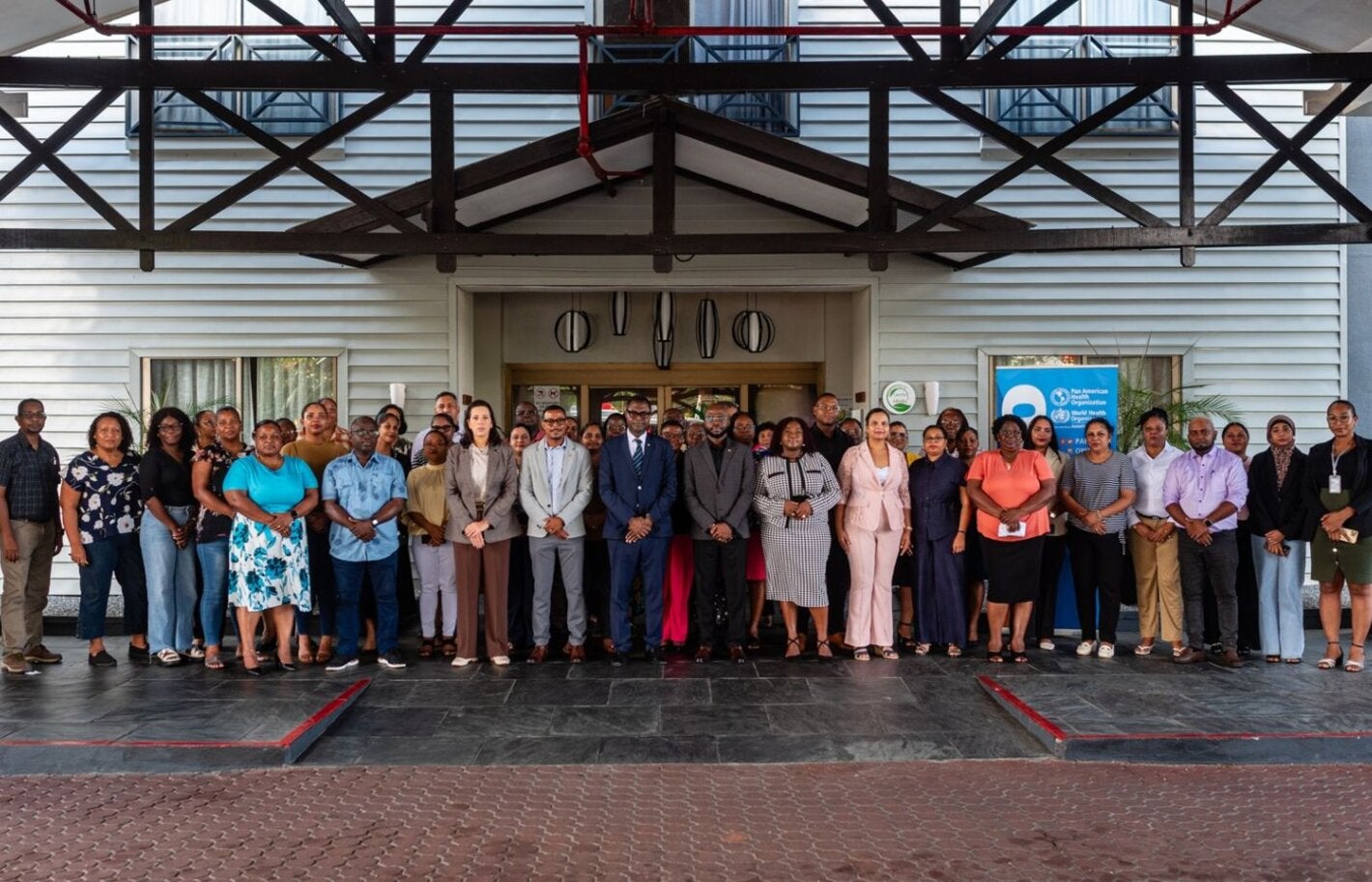
Washington, DC, 13 November 2026 (PAHO) – The Pan American Health Organization (PAHO) and the World Health Organization (WHO) supported Suriname in a policy dialogue aimed at strengthening the nursing and midwifery workforce in the country. Held on 11 and 12 November in Paramaribo, the dialogue brought together 52 participants, including authorities from the Ministry of Health, Welfare and Labour and representatives of training institutions and health services, who worked together to turn the available evidence into national priorities.
At the opening session, Minister Andre Misiekaba recalled that the State of the World’s Nursing 2025 report highlights a global workforce shortage and the need to invest in nursing and midwifery, a challenge that the country also faces. He identified as key areas of work intersectoral leadership and governance; regulation focused on access, quality, and safety of care, including advanced practice nursing roles; and the retention of professionals, also taking into account those who have emigrated and wish to return to the country.
“Nursing sustains health systems. This dialogue is an opportunity to turn evidence into action: if nursing and midwifery are strong, the country will be able to face the challenges of its health system,” said Yafflo Ouattara, PAHO/WHO Representative in Suriname.
Organized into four groups (leadership and governance; education and training; regulation and service delivery; and employment and working conditions), participants proposed, among other measures, ensuring the formal representation of nursing and midwifery in decision-making spaces, establishing career pathways with transparent promotion criteria and mentoring programs, updating regulations on professional registration and competencies, and reviewing salaries, benefits, and well-being and mental health conditions. Workforce retention in the face of migration was present in the discussions of all groups as a relevant issue for the sustainability of the country’s workforce. Participants also proposed developing a national baseline of the nursing and midwifery workforce and establishing a national working group to follow up on the commitments.
Policy dialogues are consensus-building spaces that bring together stakeholders from the health, education, labor, and regulatory sectors to jointly analyze the situation of the workforce, agree on evidence-based policy priorities, and make interinstitutional commitments.
“These dialogues, which we have held in Mexico, the Caribbean, Guatemala, and Honduras, make it possible to identify both the challenges and the opportunities for the development of nursing and midwifery in each country. We hope that Suriname will conclude this process with an action plan to guide the work of the coming years, and the Pan American Health Organization will continue to provide technical cooperation to support its implementation,” said Benjamín Puertas, Unit Chief, Health Workforce, PAHO.
This activity was carried out with the support of the World Health Organization and with funding from the Burdett Trust for Nursing.