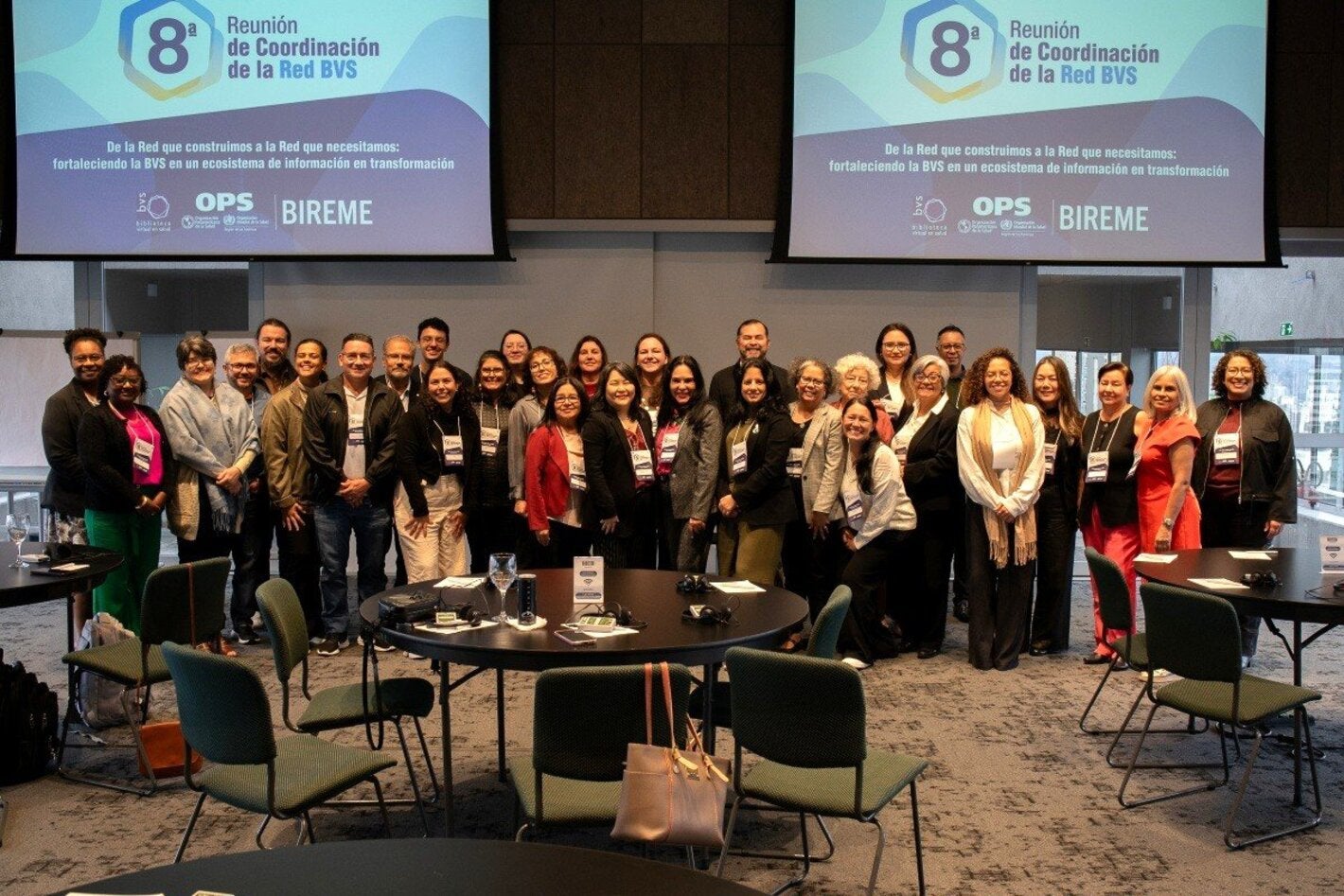
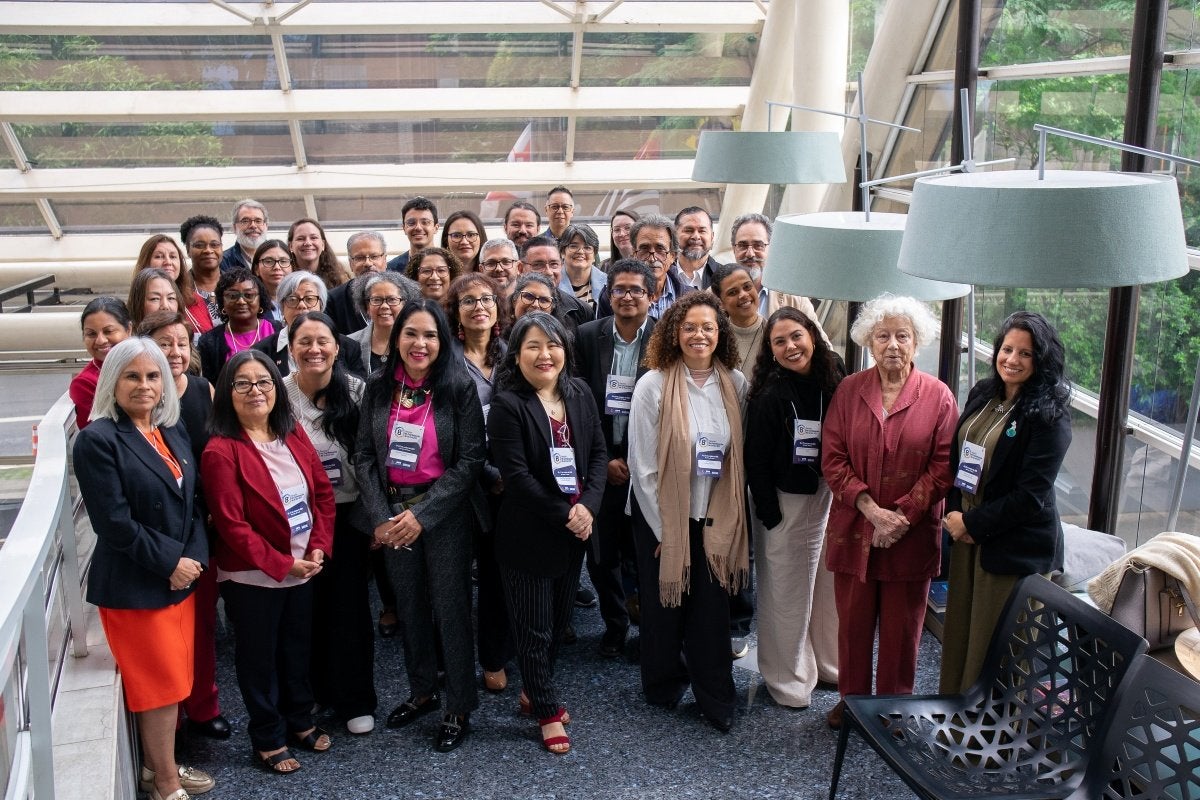
São Paulo, November 19, 2026 (BIREME/PAHO/WHO) – BIREME held the 8th Regional Coordination Meeting of the Virtual Health Library (VHL8) on October 26 and 27, 2026, in São Paulo. The meeting brought together 23 members of the VHL Network from 17 Latin American and Caribbean (LAC) countries to discuss development challenges and prospects in light of digital transformations in the production, organization, discovery, and use of scientific and technical health information.
Under the theme “Building the Network we need: transformation and the future of the VHL”, the program combined strategic and technical presentations, exchanges of national experiences, and working group activities. The activities aimed to discuss proposals to strengthen the VHL Network, aligned with BIREME’s strategic guidelines for 2026–2031, with a focus on regional information and knowledge infrastructure, technological innovation, and technical cooperation to support health decisions and actions.
Collectively shaping the VHL Network’s priorities
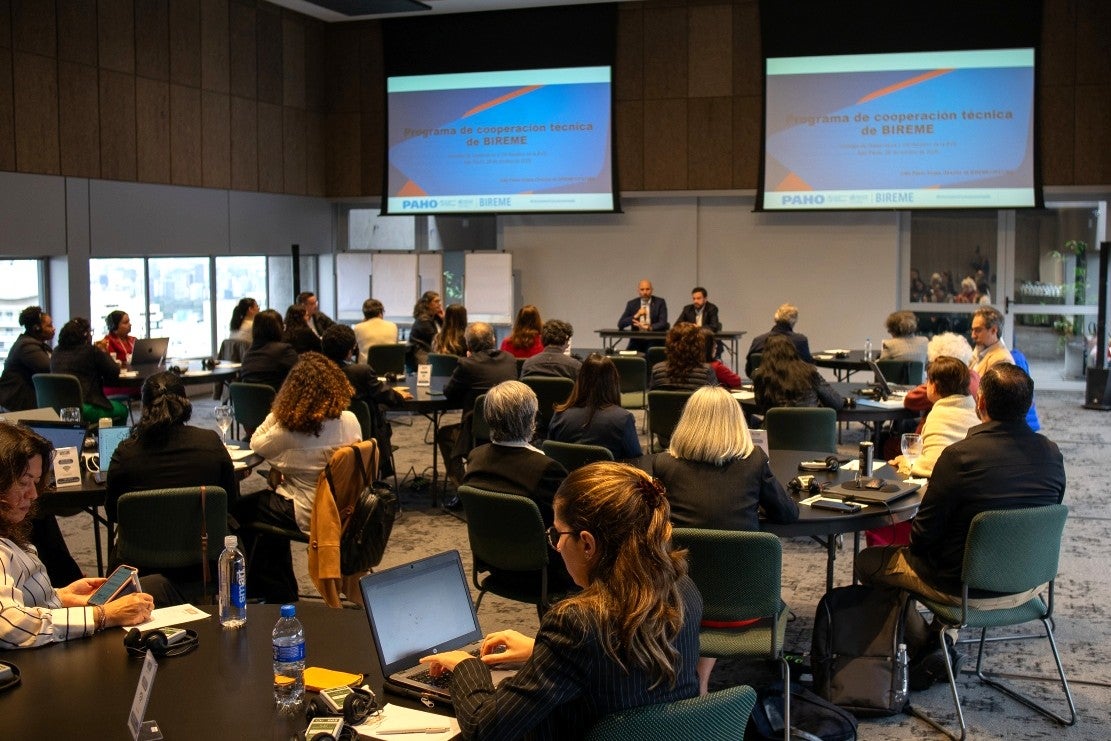
João Paulo Souza, Director of BIREME, presented the institution’s strategic outlook for the next cycle and highlighted the need to expand the VHL Network’s contribution to the discovery and use of knowledge. The proposal envisions the evolution of information services toward more integrated, specialized, and user-oriented environments, combining emerging technologies with the quality of information sources, expert curation, and knowledge of national contexts.
Verônica Abdala, Manager of Information Products and Services at BIREME, highlighted that the VHL “plays a strategic role in the Region, serving as an integrated regional ecosystem for health information and cooperation, helping increase the visibility of countries’ scientific output while also addressing health priorities and strengthening countries’ health systems.”
In her presentation, Verônica also emphasized the importance of coordination among the VHL Network’s national coordination teams, PAHO/WHO Representative Offices, and government institutions, noting that “the foundations of the VHL Model remain valid: work based on cooperation networks, information quality criteria, equity in the production, publication, and access to information, and, last but not least, the importance of local contexts at the different stages of the health decision-making process.”
The first day of the meeting was devoted to recognizing the VHL Network’s trajectory and the capacities it has developed, collectively analyzing its current situation, and discussing prospects for strengthening it. In this context, BIREME presented a proposal to integrate countries into the VHL Regional Portal, aiming to increase the visibility of and access to countries’ scientific and technical health output.
The proposal was discussed in working groups, where country representatives were invited to share their perspectives, identify opportunities and needs, and contribute to its improvement, considering different national circumstances, capacities, and priorities.
The groups’ main recommendations included the need to increase the visibility of countries’ scientific and technical output while respecting their different circumstances and information structures; integrate thematic and institutional VHLs into the new portal architecture; recognize the value of national databases, evidence collections, and local initiatives; and incorporate access and usage indicators. The groups also highlighted the importance of an integrated, intuitive, and user-centered information architecture that reconciles regional standardization with national specificities and strengthens coordination with health institutions.
Regarding governance and sustainability, participants emphasized the strategic role of national coordination teams in engaging with PAHO Representative Offices and institutions in their countries, the importance of agreements that ensure continuity of activities, and the holding of regular meetings for planning, monitoring, and exchanging experiences. Training and technical capacity development were also highlighted as priorities, along with expanded identification and incorporation of national scientific and technical output into VHL information sources.
Digital transformation, artificial intelligence, and regional scientific output
BIREME presented developments that apply artificial intelligence at different stages of information management, including the identification of DeCS descriptors (DeCS Finder IA), support for bibliographic indexing, summary generation (Super Resumos), identification of duplicate records in databases, link checking, and semantic document retrieval.
The need for human oversight, transparency, validation of results, and institutional accountability in the use of artificial intelligence in the VHL was emphasized. In this process, the Network can and should play an active collaborative role in developing and improving solutions, expanding its participation beyond traditional information management activities.
Another focus of the program was expanding bibliographic control of scientific health output from Latin America and the Caribbean, aligned with BIREME’s strategic guideline to consolidate LILACS and LILACS Plus as regional reference infrastructures.
LILACS will continue to perform its role in the selection and specialized indexing of regional scientific literature, with a focus on quality and open science. LILACS Plus will expand the discovery, collection, and integration of scientific output, connecting different information sources through interoperability and process automation. These advances, combined with stronger national and thematic networks, are expected to expand collection coverage and reduce the time between the production of scientific knowledge and its availability to users, facilitating timely access to evidence.
“Expanding the Region’s bibliographic coverage requires combining technological innovation, quality criteria, and cooperation among countries, helping make scientific output that remains scattered or underrepresented in international sources more accessible,” said Director João Paulo Souza.
National experiences highlight diverse contexts and opportunities for cooperation
The Caribbean contribution highlighted challenges in identifying, preserving, and disseminating regional scientific and technical output, particularly institutional reports, evaluations, program documents, and other gray literature. The experience related to MEDCARIB reinforced the importance of integrating sources, developing technical capacities, and establishing institutional mechanisms to ensure continuity of cooperation.
Honduras emphasized the contribution of the PAHO Representative Office to strengthening the national VHL, in alignment with technical cooperation and the country’s health priorities. The experience confirmed the importance of institutional agreements, the development of new leadership, the mobilization of partnerships, and coordination with universities, health authorities, and other institutions as essential factors for the development and sustainability of VHLs in countries across the Region.
Bolivia presented needs related to the production and visibility of national science, as well as capacity development for research and the use of evidence. Proposals for technical cooperation with BIREME include improving editorial quality and applying artificial intelligence tools.
Colombia shared its experience in national coordination of the VHL Network and presented information products and services developed to address the health system’s needs. Examples include Windows of Knowledge, Evidence Maps, and other resources that support information retrieval and use, demonstrating the benefits of coordination among the Network’s national coordination team, the PAHO/WHO Representative Office, and the country’s Ministry of Health.
The experiences demonstrated that the evolution of the VHL should consider different national contexts, facilitate the sharing of methodologies and technologies, and promote the exchange of good practices among countries in the Network.
Next steps for the 2026–2031 cycle
At the end of the two days, participants’ contributions were organized into three sets of priorities: 1) increasing countries’ visibility and integrating thematic VHLs; 2) strengthening governance, sustainability, and regional cooperation; and 3) improving bibliographic control, information quality, and capacity development.
Proposed next steps include consolidating national contributions to guide the organization of information services, identifying training and technical support needs, strengthening mechanisms for coordination and exchange among countries, and establishing ways to monitor the Network’s activities.
The preliminary document on next steps also proposes the progressive development of a work roadmap for 2026–2031, distinguishing regional coordination actions, initiatives that require coordination among countries, and activities that depend on national decisions and capacities. The proposals will be consolidated and validated with national coordination teams before responsibilities and implementation plans are defined.
At the closing session, Verônica Abdala noted that BIREME will continue its dialogue with country focal points to consolidate the proposals and organize the next steps in technical cooperation. João Paulo Souza thanked the institutions and professionals who contributed to the meeting and expressed the expectation that the ideas and commitments discussed during the sessions would be translated into concrete actions.
Sebastián García Saisó, Director of PAHO’s Department of Evidence and Intelligence for Action in Health, highlighted the importance of maintaining an ongoing collective reflection on the Network’s functions, priorities, and working methods. In his remarks, he linked the evolution of the VHL to technological and social transformations and emphasized the need to renew and reposition regional cooperation to address future challenges.
The contributions gathered at VHL8 will serve as a reference for continued dialogue with countries and the development of the Network’s priorities for 2026–2031, with a focus on the quality of scientific information, technological innovation, and stronger regional cooperation.