• Happy boys playing in the street, posing to the camera

Tetanus

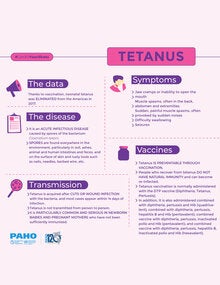
Tetanus is a severe illness contracted through exposure to the spores of the bacterium, Clostridium tetani (C. tetani), which live in soil, saliva, dust and manure. The bacteria can enter the body through a deep cuts, wounds or burns affecting the nervous system. The infection leads to painful muscle contractions, particularly of the jaw and neck muscle, and is commonly known as “lockjaw”.

People of all ages can get tetanus, but the disease is particularly common and serious in newborn babies and their mothers when the mother is unprotected from tetanus by the vaccine. Tetanus occurring during pregnancy or within 6 weeks of the end of pregnancy is called maternal tetanus, while tetanus occurring within the first 28 days of life is called neonatal tetanus.

PAHO Response
WHO logo position papers

WHO position papers on tetanus vaccine

View more

Children vaccinated showing vaccine card

Diphtheria, tetanus, and pertussis (DTP) vaccine

View more

Happy boy and girl smiling to the camera
  • There are three clinical presentations of tetanus:
    • generalized tetanus, which is the most common form;
    • localised tetanus; and
    • cephalic tetanus.
  • In generalized tetanus, the presenting symptoms include trismus (‘lock jaw’), episthotonus, facial grimacing (risus sardonicus), spasms, back and neck stiffness, muscle rigidity, dysphagia, and restlessness. Reflex spasms are triggered by minor external stimuli such as noise, light or touch.
  • Tetanus neonatorum is a generalized form of tetanus in newborns. Contamination of the cord stump with C. tetani spores occurs because of unclean delivery and cord care practices. Newborns of unimmunized mothers lack passive protection from maternal antibodies to the tetanus toxin and are at high risk. The typical case is a previously well and feeding newborn who presents at age 3-14 days with symptoms of irritability, inability to suck, muscle rigidity, facial grimacing, opisthotonos and severe spasms elicited by sound, light and sensory stimuli. The case definition for surveillance includes newborns aged 3-28 days.
  • Localized tetanus is an uncommon presentation localised to the site of spore entry, with weakness of the involved extremity and intense, painful spasms in severe cases.
  • Cephalic tetanus results from inoculation through head injury or middle ear infection and presents as motor cranial nerve palsies—commonly affecting the facial nerve.
  • Maternal tetanus typically develops in unimmunized women because of unsafe abortions and unclean deliveries.
  • There is a direct relationship between the distance from the inoculation wound to the central nervous system and the onset of symptoms. 
  • The direct transfer of C. tetani spores from soil and excreta of animals and humans to wounds and cuts spreads tetanus. It is not transmitted from person to person.
  • Contaminated puncture wounds, compound fractures, burns, frostbites, ulcers, gangrene, unclean deliveries, and unhygienic cord care practices are risk factors for tetanus in unvaccinated or partly vaccinated populations.
  • The incubation period for tetanus varies from 3-21 days after infection in non-neonatal cases and typically ranges from 3-14 days (averaging seven days) after birth in 90% of neonatal cases.
  • Healthcare providers usually decide if someone has tetanus by looking for common signs and symptoms. They may also ask about a recent history of cuts, scrapes, punctures, and trauma. Therefore, tetanus diagnosis relies mainly on clinical presentation and symptoms.
  • No lab or other kinds of tests can confirm tetanus.

Tetanus is a medical emergency requiring:

  • Supportive care
  • Human tetanus immune globulin (TIG)
  • Aggressive wound care and management
  • Drugs to control muscle spasms
  • Antibiotics

Depending on how serious the infection is, someone with tetanus may need a machine to help them breathe.

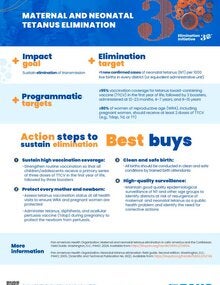
The administration of Tetanus Toxoid Containing Vaccines (TTCVs) is the most cost-effective measure for preventing maternal and neonatal tetanus (MNT) and injury-associated tetanus. These vaccines are safe and affordable, and should be administered according to the WHO recommended schedule of three primary infant series followed by three booster doses at 12 – 23 months, 4 – 7 years, and 9 – 15 years. 

Different national schedules are in use for the 3-dose primary paediatric series, including vaccination at the following ages: 6, 10, and 14 weeks; 2, 3, and 4 months; 3, 4, and 5 months; and 2, 4, and 6 months. The tetanus toxoid (TT) is available as a single-antigen vaccine and in combination vaccines to protect against other vaccine preventable diseases, including diphtheria, pertussis, poliomyelitis, hepatitis B, and illness caused by Haemophilus influenzae type b (Hib).

The pentavalent vaccine, which provides protection against diphtheria, tetanus, pertussis, hepatitis B, and Hib (DTP- HepB - Hib), is the most commonly used childhood vaccine worldwide, but other pentavalent (DTaP-IPV/Hib) and hexavalent (DTaP/DTwP- HepB-Hib-IPV) combinations are also available. For booster dosing, a tetanus-diphtheria combination with a lower concentration of diphtheria antigen (Td) is available. As of December 2023, nearly all countries have replaced TT with Td in their vaccination schedules based on WHO recommendations. The TT is also used as a carrier protein in some conjugate vaccines, including Hib, meningococcal (A, C, ACYW, and combinations C-Hib, CY-Hib), pneumococcal (PCV), and typhoid (TCV) conjugate vaccines.


Latest news

Stories

Documents

Communication Materials

Events