
Artificial intelligence in public health must be implemented in an ethical, transparent, and people-centered manner, promoting the responsible use of data and strengthening health systems.
Artificial intelligence has progressively begun to be incorporated into different areas of public health, including data analysis, epidemiological surveillance, process automation, and support for clinical and management decision-making.
Its implementation offers opportunities to strengthen health systems and improve access to information, but it also raises challenges related to transparency, data protection, equity, and human oversight of automated decisions. In this context, PAHO promotes an artificial intelligence approach grounded in ethical principles, scientific evidence, and people-centered digital transformation.

Principles for the use of artificial intelligence in health
The use of artificial intelligence in public health must be guided by ethical and technical principles that maximize its benefits without compromising people’s rights.

People-centered
Prioritize patient safety, quality of care, and respect for people’s rights.

Transparent
Promote algorithms and processes that can be understood, communicated, and evaluated.

Safe and privacy-respecting
Ensure the protection, confidentiality, and security of the data used.

Evidence-based
Rely on trustworthy, reproducible practices subject to external evaluation.

Equitable and non-discriminatory
Consider equality, inclusion, and diversity in the design and use of technologies.

Human-supervised
Incorporate mechanisms for human control and review in automated decision-making processes.
AI components and subfields that can benefit public health
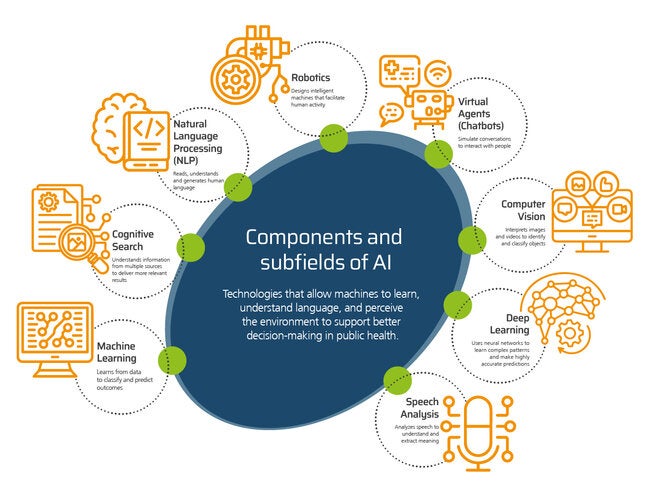
Artificial intelligence is based on different components and subfields that enable data processing, pattern recognition, information interpretation, and prediction generation. These capabilities can be applied across multiple areas of public health.
These include technologies focused on data analysis, understanding human language, process automation, and interaction with people. Their application can strengthen epidemiological surveillance, improve access to information, and support clinical and management decision-making.
Below are some of these components grouped according to their main function, together with examples of their use in public health.
Language Processing and Understanding
Enables computers to read, interpret, and extract meaning from human language in texts or conversations.
Applications in public health
Social media behavior analysis
Processing data generated by patients and users
Identification of health trends and needs
A subfield of NLP focused on understanding human texts and expressions through the analysis of grammar, syntax, and meaning.
Applications in public health
Automated interpretation of clinical information
Analysis of medical records and health documentation
Identification of patterns in clinical texts
Enables the transformation of structured data into texts or responses that are understandable to people.
Applications in public health
Automated report generation
Anonymization of electronic health records
Production of clinical content and summaries
Enables the analysis of spoken language to recognize patterns, interpret meaning, and detect characteristics of human speech.
Applications in public health
Analysis of behavior and emotional states
Assessment of symptoms related to voice or speech
Remote monitoring and clinical support tools
Prediction and Data Analysis
Enables the identification of patterns and the generation of predictions from large volumes of data using algorithms trained with previous information.
Applications in public health
Prediction of diseases and risk factors
Analysis of relationships between genetics, environment, and health
Models for epidemiological surveillance and decision-making
A subfield of machine learning based on deep neural networks capable of learning complex patterns from large volumes of data.
Applications in public health
Automated disease detection
Advanced analysis of clinical images
Prediction of health conditions using electronic health records
Enable the analysis of complex information and support decision-making processes through predictive models and automated analysis.
Applications in public health
Support for clinical and management decisions
Modeling of health scenarios
Integration of multiple variables and information systems
Integrates technologies such as artificial intelligence and natural language processing to analyze information from multiple sources.
Applications in public health
Search engines for health information
Analysis of scientific evidence and technical documentation
Rapid access to relevant information for decision-making
Interaction and Automation
An interdisciplinary field that develops intelligent machines and systems capable of assisting or automating human tasks.
Applications in public health
Automated disinfection of spaces
Distribution of medicines and supplies
Monitoring and measurement of vital signs
Applications capable of simulating conversations with people through written or spoken language.
Applications in public health
Promotion of healthy habits
Mental health and remote support
Smoking cessation and patient follow-up
Enables the interpretation of images and videos through models capable of recognizing objects, patterns, and visual characteristics.
Applications in public health
Analysis of medical images
Support for clinical diagnosis
Predictive modeling for respiratory diseases and other conditions
Artificial intelligence within the framework of digital transformation
Artificial intelligence is part of a broader process of digital transformation in health, which includes strengthening connectivity, interoperability, data governance, and the development of integrated information systems.
In this context, artificial intelligence is recognized as one of the components that can contribute to improving access to information, strengthening decision-making, and optimizing health services, provided that its implementation is supported by ethical frameworks, technical capacities, and appropriate oversight mechanisms.
PAHO promotes this approach through the principles for the digital transformation of the health sector, fostering people-centered, secure, interoperable technologies aimed at strengthening health systems across the Region.
Based on this approach, PAHO supports countries in developing capacities, tools, and frameworks to enable the safe and sustainable implementation of artificial intelligence.