
The digital transformation of Civil Registration and Vital Statistics (CRVS) systems represents an opportunity to modernize how data on births and deaths are recorded, processed, and used, strengthening the role of the health sector as a primary data source.
This process involves moving from paper-based forms to interoperable electronic medical certification, strengthening user capacities through digital literacy, and adopting international standards such as ICD-11 to improve the quality and level of detail of information.
It also promotes the integration of health, civil registration, and statistics systems through interoperable platforms, ensuring the security, timeliness, and traceability of data.
The digital transformation of CRVS is not only a technological shift, but a comprehensive improvement process that contributes to more efficient, inclusive, and people-centered systems, capable of producing timely and reliable vital statistics to support public health decision-making.
What do we do?
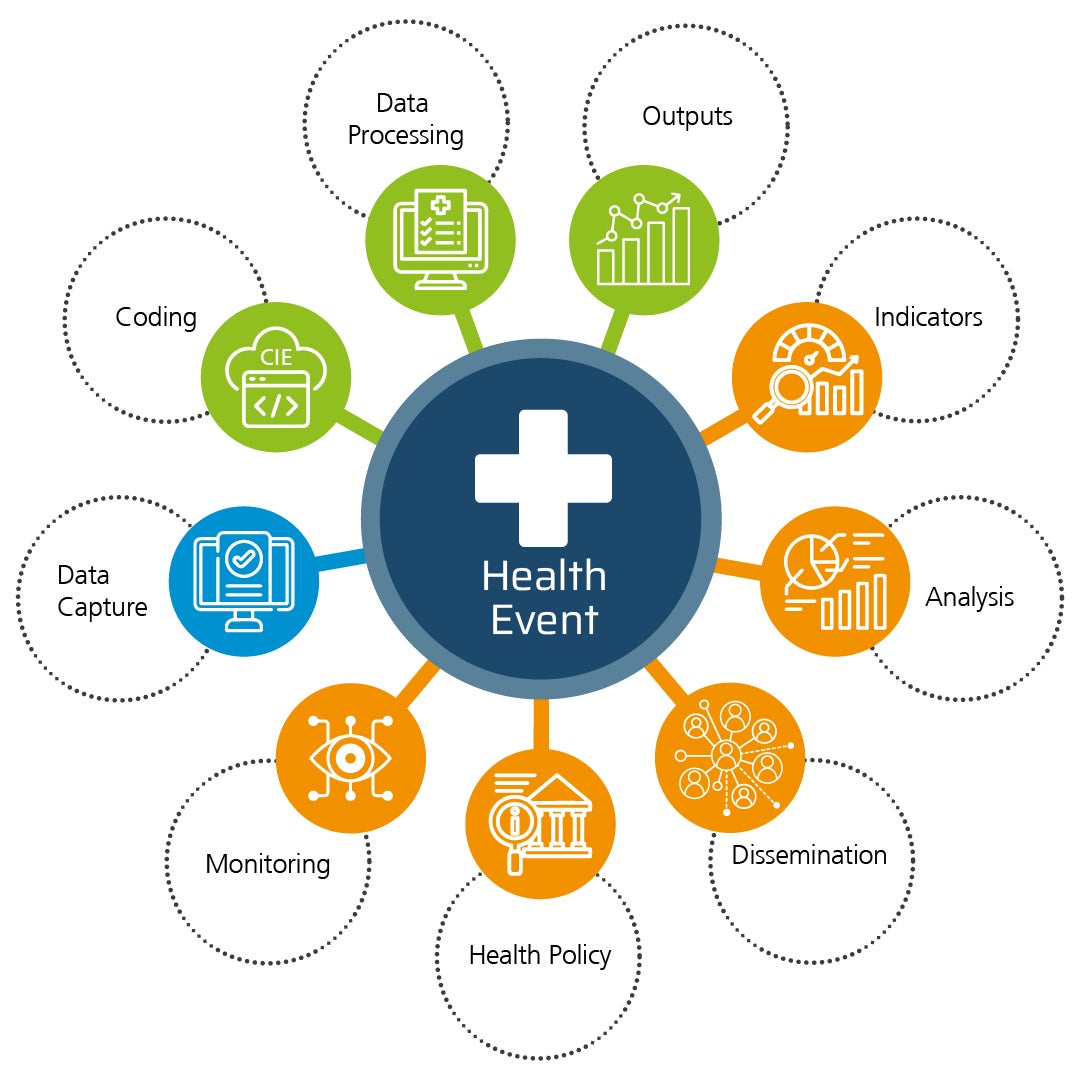
Participatory workshops are conducted to bring together key stakeholders in the system, including health personnel responsible for the certification and notification of births and deaths, civil registrars in charge of registering vital events, and statistics teams that process and consolidate the information at the national level, with the aim of mapping CRVS processes.
The objective is to represent the full system flow, from the occurrence of a birth or death to the production of vital statistics, identifying key milestones such as medical certification, civil registration, final disposition of the body in the case of deaths, and the generation of official statistics.
This mapping considers the different contexts in which vital events occur, recognizing the diversity of actors and situations that influence registration. It includes both events that take place in health facilities—where processes are usually more structured—and those occurring in rural communities or urban settings outside the health system, where additional challenges may arise, such as underregistration or the involvement of non-institutional actors.
The analysis of these processes helps identify gaps, bottlenecks, duplications, and regulatory gaps, providing a critical foundation for designing more efficient, inclusive, and context-adapted digital solutions.
We support the digital transformation of Civil Registration and Vital Statistics (CRVS) systems through concrete actions that facilitate the transition from paper-based processes to interoperable electronic systems.
Through participatory workshops, we assist in analyzing and redesigning system processes, identifying gaps, bottlenecks, and opportunities for improvement.
We provide specialized technical assistance for the implementation of digital solutions, including electronic medical certification of births and deaths, interoperability between systems, and the adoption of international standards.
We also offer ongoing support throughout the implementation process, assisting institutions with change management, capacity strengthening, and the progressive improvement of data quality.
We support the integration of ICD-11 into health information systems, incorporating it progressively into electronic health records and death registration systems.
This process involves adapting digital tools so that health professionals can record diagnoses and causes of death in a structured and standardized way, facilitating their storage, analysis, and use in decision-making.
At the same time, we promote mechanisms that ensure data quality, such as automated validations, traceability of records, and version control, ensuring that data are complete, consistent, and reliable.
A key component is capacity strengthening, providing tailored training for physicians, coders, and technical teams, and supporting their use in real-world settings.
We also promote the use of technological tools that support coding and data analysis, as well as the continuous evaluation of ICD-11 implementation, identifying progress, challenges, and opportunities for improvement.
In this way, the transition to ICD-11 contributes to improving the quality and level of detail of health information, strengthening the production of vital statistics and their value for public health.
We strengthen the capacities of stakeholders in Civil Registration and Vital Statistics (CRVS) systems to perform effectively in digital environments, promoting the development of the skills needed to use electronic systems, certify vital events, and manage information.
Through continuous training strategies—such as webinars, virtual courses, and communities of practice—we support ongoing learning and professional development for physicians, coders, registrars, managers, and technical teams.
We also develop tailored training programs for different profiles, covering topics such as the correct completion of medical certificates of birth and death, identification of the chain of causes of death, ICD-11 coding, and the use of technological tools such as IRIS and DORIS.
In addition, we provide support in real work settings, promoting the practical application of knowledge, addressing operational challenges, and supporting continuous improvements in data quality.