
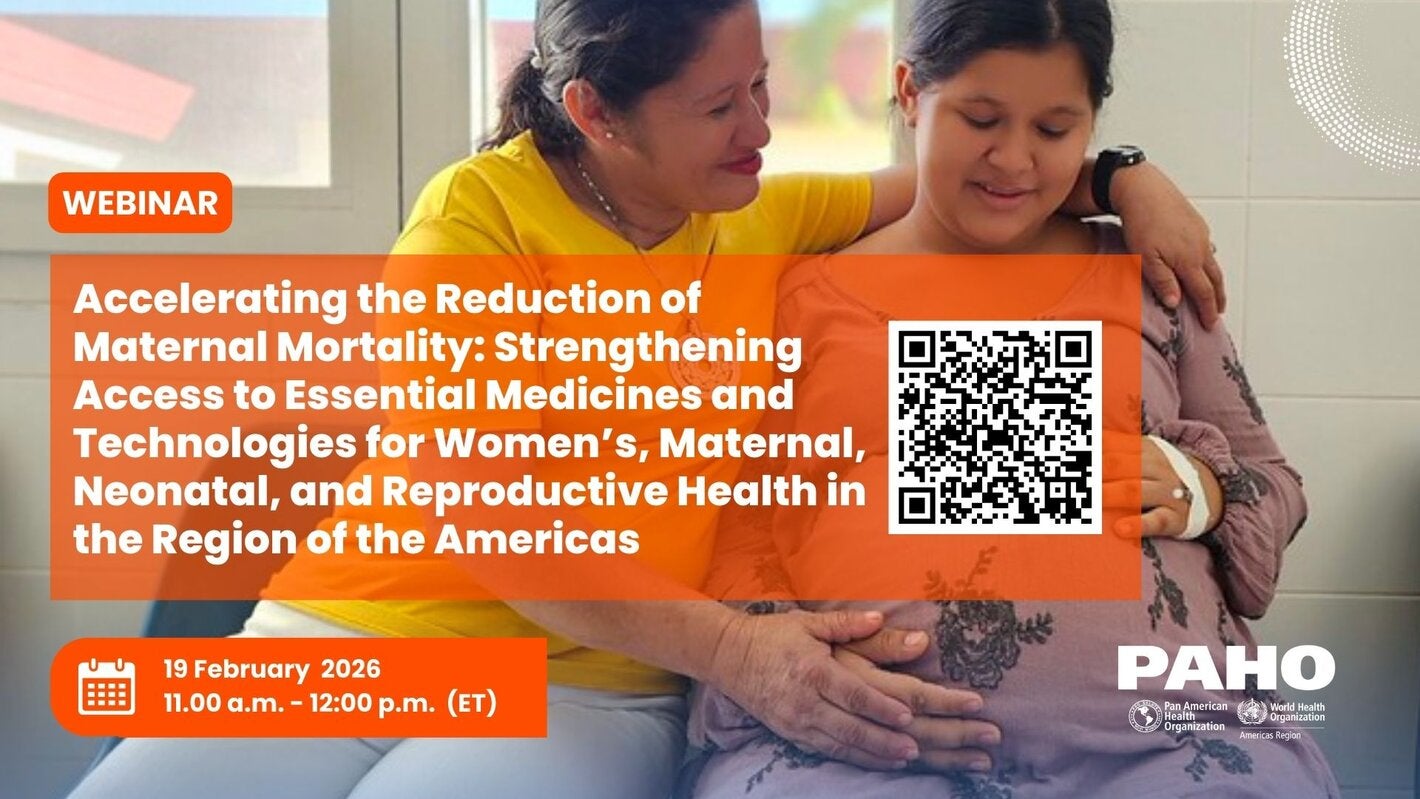
Join us on Thursday, February 19, at 11:00 a.m. (Washington, D.C. time or ET) for the event "Accelerating Maternal Mortality Reduction: Strengthening Access to Essential Medicines and Technologies for Women’s, Maternal, Neonatal, and Reproductive Health in the Americas".
Despite progress in recent years, preventable maternal and neonatal deaths remain a major challenge in the Americas. Persistent inequalities in access to essential health services and supplies continue to affect the most vulnerable populations. Strengthening access to high‑impact interventions—such as essential medicines, maternal and neonatal health technologies, and modern family planning—is crucial to reducing mortality and improving outcomes for women and newborns across the region.
This webinar aims to promote regional collaboration and reinforce countries’ capacities to ensure equitable availability of these critical health commodities. By sharing experiences, discussing barriers, and presenting PAHO’s technical strategies, the session seeks to support Member States in advancing evidence‑based actions that accelerate maternal and neonatal mortality reduction.
Specific Objectives
Understand Member States’ access barriers, challenges, and needs related to health technologies for women’s, maternal, neonatal, and reproductive health.
Present PAHO’s regional technical packages and strategies to improve access to essential maternal and neonatal health commodities.
Facilitate dialogue and exchange of experiences among countries aligned with regional and global frameworks.
Promote intersectoral collaboration and resource mobilization to strengthen supply chains.
Identify opportunities for technical cooperation and demand consolidation for upcoming procurement cycles (2026 ad hoc purchase and 2027 demand planning).
How to Participate
DAY: Thursday, February 19th, 2026
TIME: 11:00 a.m. – 12:00 p.m. (Washington, D.C. time / ET)
SIMULTANEOUS INTERPRETATION: Translation available
REGISTRATION: Click here
Agenda
11:00 a.m. – Welcome Remarks
Christopher Lim, Unit Chief, Strategic Fund, Regional Revolving Funds (RRF), PAHO
11:02 a.m. – PAHO Framework for Interventions to Reduce Maternal and Perinatal Mortality
James Fitzgerald, Director, Health Systems and Services (HSS), PAHO
11:12 a.m. – Regional Challenges and Advances in Maternal and Perinatal Health
Suzanne Serruya, Unit Chief, Life Course, Women’s and Children’s Health (HSS/HL), PAHO
11:22 a.m. – Technical Packages for Maternal and Neonatal Health and Supply Chain Strengthening
Santiago Cornejo, Executive Manager, Regional Revolving Funds (RRF), PAHO
11:32 a.m. – Panel: Country Experiences
Dominican Republic – TBD
Colombia – TBD
Brazil – TBD
11:57 a.m. – Conclusion and Final Remarks
PAHO - TBD
Context
Despite progress, preventable maternal and neonatal deaths remain a concern in the Americas. In 2020, Latin America and the Caribbean saw a maternal death every hour, with a maternal mortality ratio of 88 per 100,000 live births—levels not seen in over twenty years. Inequalities in access to health services persist, affecting vulnerable communities. By 2019, over 15 million DALYs were attributable to neonatal conditions and congenital anomalies.
Modern family planning is a highly cost-effective intervention and reduces maternal and perinatal mortality. In the region, where 66.7% of women use some form of contraception, millions of unintended pregnancies, unsafe abortions, and maternal deaths have been averted, reducing maternal mortality by around 30%. Early adolescent pregnancy increases the risk of maternal death and leads to adverse perinatal outcomes. Expanding contraception among adolescents -especially in the most vulnerable settings -especially in the most vulnerablen settings-, is vital, as more than 60% of maternal deaths occur in these contexts.
PAHO has a regional strategy to accelerate the reduction of maternal mortality, focusing on governance, primary health care, health workforce strengthening, and the empowerment of women and communities. Globally, PAHO supports the Every Newborn Action Plan (ENAP), which aims to end preventable newborn deaths by 2030, with 80% of these deaths preventable through interventions such as antibiotics and neonatal resuscitation.
These efforts align with global strategies and the United Nations’ Sustainable Development Goals. The main causes of maternal mortality—hemorrhage, hypertensive disorders, sepsis, and unsafe abortion—require improved access to emergency medicines and supplies. Immediate post-pregnancy contraception, including Long-Acting Reversible Contraception (LARC), together with PAHO-supported training of health professionals, can reduce maternal mortality by at least 30%.
Prematurity, congenital defects, infections, and asphyxia are the leading causes of neonatal death. The COVID-19 pandemic exposed vulnerabilities in supply chains, underscoring the need to strengthen health systems.
Ensuring access to and availability of strategic essential medicines, medical devices, and appropriate equipment is critical for the effective implementation of the Maternal and Perinatal Mortality Reduction Initiative through the Regional Revolving Funds mechanism. Obstetric and neonatal care require specific supplies, including oxytocin and misoprostol for the prevention and management of postpartum hemorrhage, magnesium sulfate for the treatment of preeclampsia and eclampsia, antibiotics for maternal and neonatal infections, and vital equipment such as incubators, fetal monitors, suction devices, and neonatal resuscitation equipment. In this context, PAHO’s Regional Revolving Funds, together with inputs from HSS, IMT, and PRO, have developed comprehensive packages that enable Member States to jointly and securely procure these supplies, ensuring their availability at points of care and helping to save lives through timely, evidence-based interventions.
Time in other cities
- 8:00 a.m. – Los Angeles, Vancouver.
- 10:00 a.m. - Belmopan, Guatemala City, Managua, Mexico City, San Salvador, San José (CR), Tegucigalpa.
- 11:00 a.m. - Bogotá, Havana, Kingston, Lima, Port-au-Prince, Nassau, Ottawa, Panama City, Quito, Washington D.C.
- 12:00 p.m. – Bridgetown, Caracas, Georgetown, La Paz, Port of Spain, San Juan, Santo Domingo, Saint George´s, Saint John´s (Antigua).
- 1:00 p.m. - Asunción, Buenos Aires, Brasilia, Montevideo, Paramaribo, Santiago.
- 5:00 p.m. – Geneva, Madrid.
For other cities, please refer to the local time at this link.