
SAFER webinar series: Webinar 1
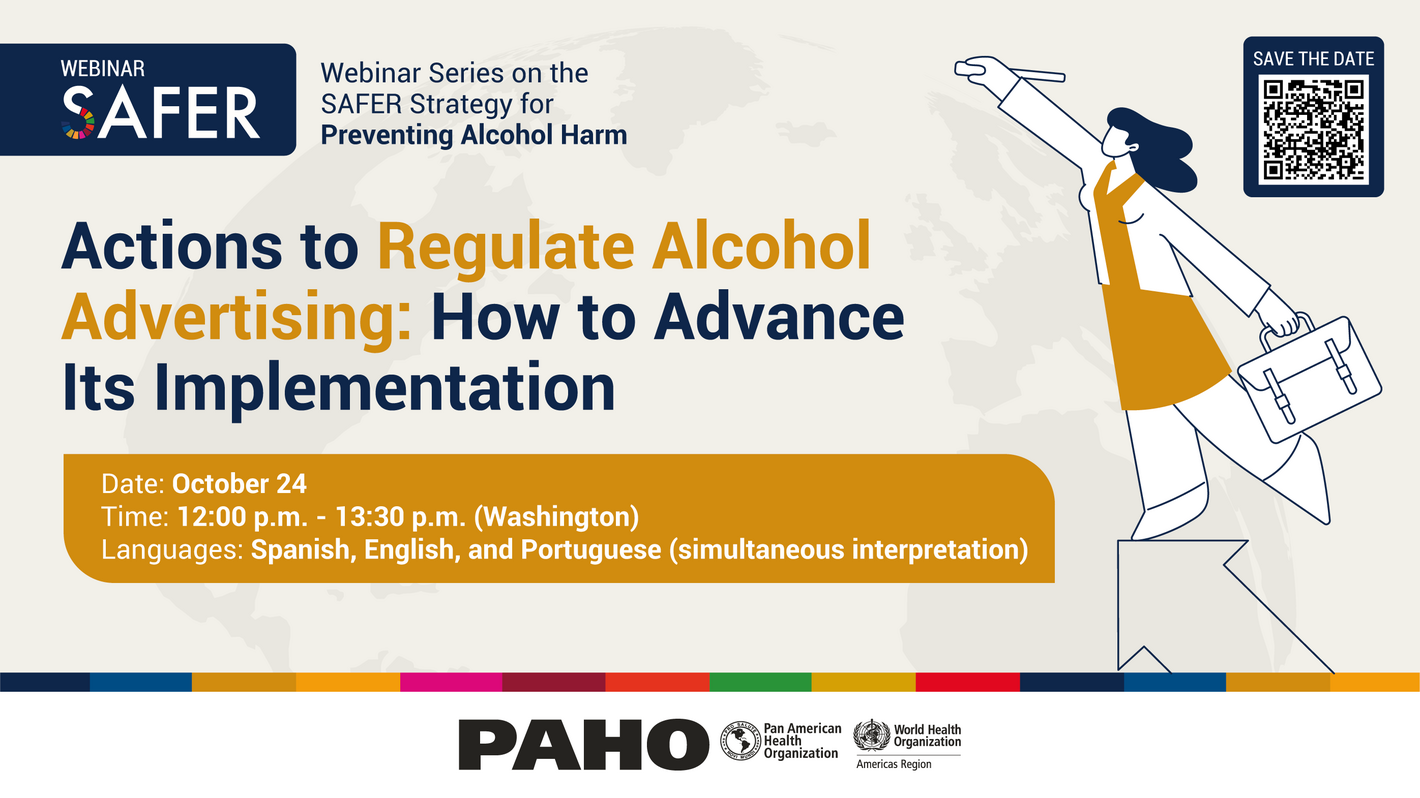
The Pan American Health Organization (PAHO) cordially invites you to attend the webinar Actions to Regulate Alcohol Advertising: How to Advance Implementation, on Friday, 24 October, from 12:00 to 1:30 pm (EDT or Washington DC time). This is the first of a series of seven webinars that will address the interventions included in the SAFER technical package to reduce alcohol use.
This first session will focus on the exposure to alcohol advertising, sponsorship, and marketing, particularly among adolescents and young people. Evidence shows that exposure to commercial messages normalizes alcohol use and increases the risk of early initiation, more frequent consumption, and high-risk drinking episodes. This webinar aims to share scientific evidence, foster reflection, inspire actions to strengthen national regulatory frameworks, exchange experiences from across the Region, and promote international cooperation on marketing regulation, helping countries in the Americas advance toward healthier and safer environments.
General Objective
Promote the effective implementation of comprehensive restrictions on alcohol advertising in the countries of the Americas by providing evidence, tools, and experiences that support progress toward the Global Action Plan and the SAFER initiative.
Specific Objectives
- Raise awareness of the impact that alcohol advertising regulation has on preventing alcohol-related harm.
- Analyze regulatory experiences in the Region of the Americas and other parts of the world, identifying enabling factors and common barriers.
- Promote regional cooperation and the exchange of good practices among Member States, civil society, and academia.
RECORDING
How to participate
- DAY: Friday, October 24, 2025
- TIME: 12:00 to 1:00 pm (Washington DC, or EST) [Check the bottom of this page for the time in other cities]
- LANGUAGES: English, Spanish, and Portuguese with simultaneous translation.
- REGISTRATION: https://paho-org.zoom.us/webinar/register/WN_wMeXap2vT2a5zk4r4aEubg
Agenda
Moderator: Leonardo García, International consultant, Alcohol Substance Use, PAHO
- Opening and objectives
- Renato Oliveira, Head, Mental Health, Alcohol and Psychoactive Substances Unit, PAHO
- Introducing the webinar series and their context
- Raúl Martín del Campo, Advisor Alcohol and Psychoactive Substances PAHO
- Evidence on restricting alcohol advertising to prevent harm
- David Jernigan, Boston University School of Public Health
- Panel – Implementation of alcohol advertising restrictions: enabling factors and challenges
- Pablo Norambuena, Ministry of Health, Chile
- Angélica María Claro, Movendi
- Karine Gallopel-Morvan, EHESP School of Public Health, Rennes France
- Options for regulating online marketing
- Benn McGrady, PhD, Unit Head, Public Health Law and Policies (LAW), WHO
- Conclusions and closing
- Raúl Martín del Campo, Advisor, Alcohol and Psychoactive Substances, PAHO
Context
Alcohol use is one of the leading risk factors for public health worldwide, accounting for 2.6 million deaths annually (4.7% of all global deaths) and over 115 million healthy life years lost in 2019. In the Region of the Americas, per capita consumption reaches 7.5 liters. This level is above the global average of 5.5 liters.
A key factor fueling this burden is exposure to alcohol advertising, sponsorship, and marketing, particularly among adolescents and young people. Evidence shows that exposure to commercial messages normalizes alcohol use and increases the risk of early initiation, more frequent consumption, and high-risk drinking episodes. In 2019, seven alcohol companies ranked among the 100 largest global advertisers, with investments exceeding 18 billion dollars in advertising, much of it in digital media and social networks—an area still poorly or not regulated at all.
Despite the magnitude of the problem, many countries lack effective alcohol advertising regulations and rely instead on voluntary self-regulation by the industry. This regulatory gap exposes millions of people—especially children and adolescents, pregnant women, and individuals in treatment and rehabilitation—to messages that normalize alcohol consumption, encourage early use, and reinforce social stigma.
The Global Alcohol Action Plan 2022–2030 sets the target that by 2030 at least 70% of Member States will have implemented comprehensive restrictions or total bans on alcohol advertising, sponsorship, and promotion. The SAFER initiative reinforces that this is one of the most cost-effective interventions to reduce harm: it achieves high population-level impact with low investment.
Digital marketing is one of the biggest current challenges, as industry messages across national borders and reaches children, adolescents, and young people rapidly through mobile phones and social media. Protecting them from this exposure is a public health responsibility aligned with global commitments to reducing the burden of noncommunicable diseases and achieving the Sustainable Development Goals.
Related links
- SAFER
- Global alcohol action plan 2022-2030
- Global status report on alcohol and health and treatment of substance use disorders. (2024)
Local time in other cities
- 9:00 a.m. – Los Angeles, Vancouver
- 10:00 a.m. – Belmopan, Guatemala City, Managua, Mexico City, San José (CR), San Salvador, Tegucigalpa
- 11:00 a.m. – Bogotá, Panamá City, Kingston, Lima, Quito
- 12:00 p.m. – Bridgetown, Caracas, Georgetown, Havana, La Paz, Nassau, Ottawa, Port of Spain, Port-au-Prince, San Juan, Santo Domingo, Washington D.C.
- 1:00 p.m. – Asunción, Buenos Aires, Brasilia, Montevideo, Paramaribo, Santiago,
- 6:00 p.m. – Geneva, Madrid
For other cities, please refer to the local time at this link.