
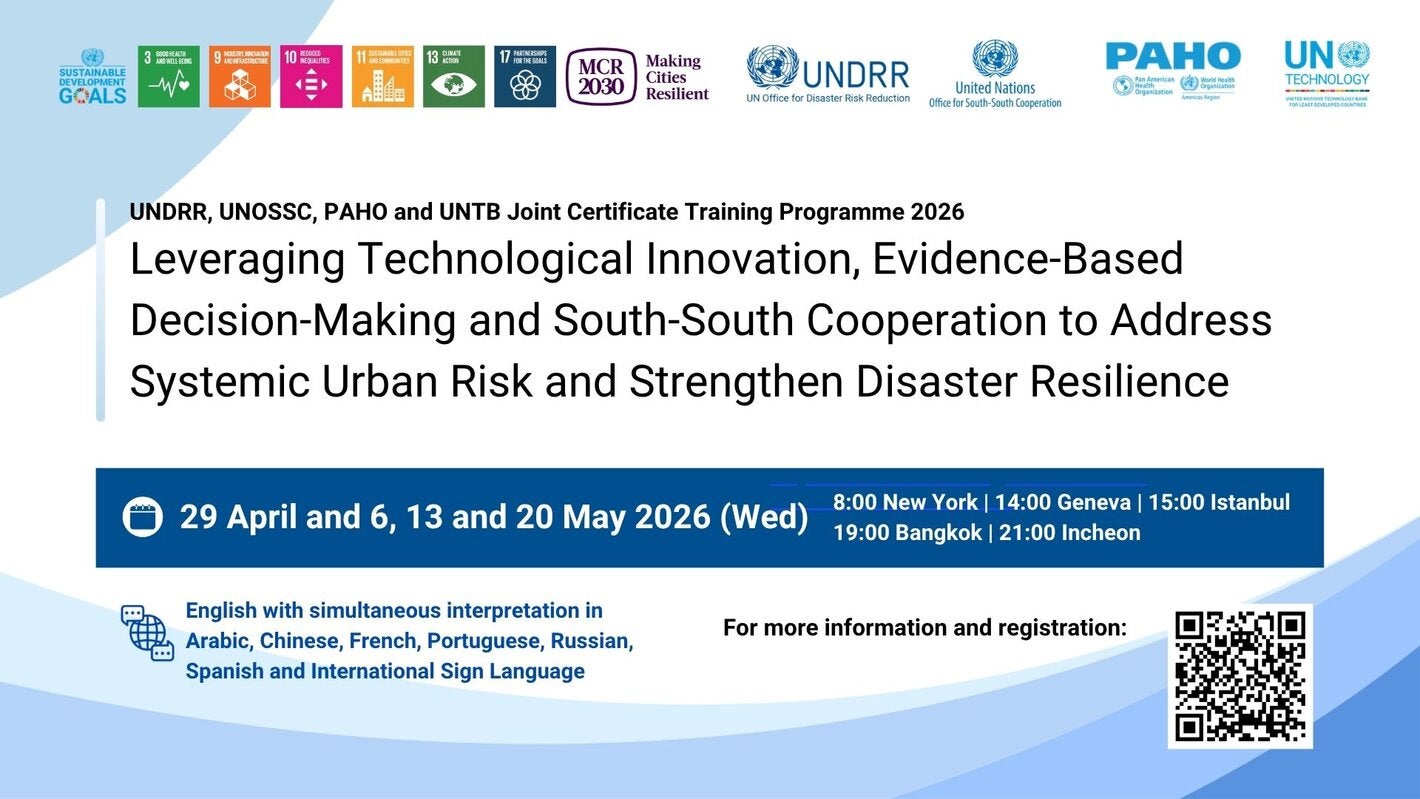
The United Nations Office for Disaster Risk Reduction (UNDRR), the Pan American Health Organization (PAHO), the United Nations Office for South-South Cooperation (UNOSSC), and the United Nations Technology Bank for the Least Developed Countries (UNTB) are pleased to invite you to participate in the Joint Certificate Training Programme:
“Leveraging Technological Innovation, Evidence-Based Decision-Making and South-South Cooperation to Address Systemic Urban Risk and Strengthen Disaster Resilience”.
29 April and 6, 13 and 20 May 2026 | 08:00 New York time | VIRTUAL FORMAT
This multi-session training builds on the success of the Joint Certificate Training Programme, which since 2020 has reached more than 11,000 live participants and 6,500 self-paced learners across 155 countries. The 2026 edition focuses on strengthening capacities to address systemic urban risks through science, technology and innovation (STI), practical tools, and South-South and triangular cooperation (SSTC), enhancing both disaster risk reduction (DRR) and health emergency preparedness.
Background
Urban areas are at the forefront of disaster risk reduction and climate resilience efforts, as they concentrate populations, infrastructure, and essential services increasingly exposed to complex and interconnected risks. This evolving context highlights the urgent need to strengthen evidence-based decision-making supported by science, technology, and innovation.
Cities play a critical role in advancing integrated approaches to reduce vulnerabilities, while national governments must provide enabling policy frameworks, financing, and technical support to implement risk-informed development strategies. Strengthening institutional capacities to access, interpret, and apply data, technological tools, and innovations is essential for effective urban planning and disaster preparedness.
South-South and Triangular Cooperation offer valuable opportunities for knowledge exchange, capacity building, and technology transfer, enabling cities to adopt innovative and scalable solutions for urban resilience.
However, many developing countries, particularly Least Developed Countries, face persistent challenges such as limited access to technology, insufficient technical capacities, and gaps in institutional frameworks. Strengthening science, technology, and innovation ecosystems is therefore essential, alongside initiatives that combine technological innovation, capacity development, and international cooperation to adapt and scale solutions to local contexts.
Sessions & Topics
Session 1: Applying Resilience Diagnostics for Extreme Heat Risk Management (UNDRR)
Introduction to practical tools such as the Disaster Resilience Scorecard for Cities – Addendum on Extreme Heat Risk Management, supporting evidence-based assessments and decision-making.
Watch Recording Download Presentation
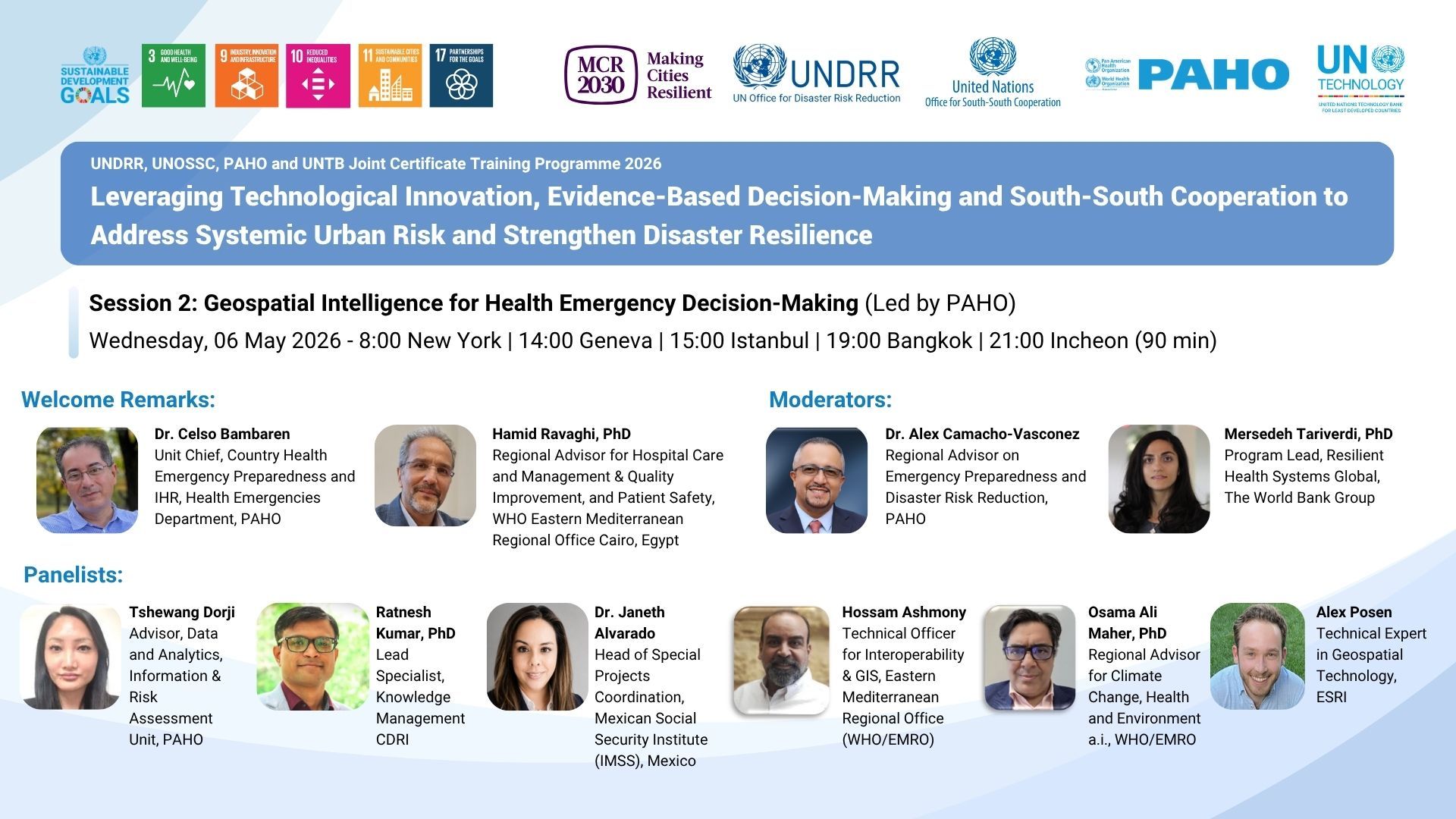
Session 2: Geospatial Intelligence for Health Emergency Decision-Making (PAHO)
Use of GIS, satellite data, and spatial analytics to strengthen risk analysis, identify vulnerabilities, and support preparedness and response.
Session 3: Technology Solutions for Climate and Disaster Resilience (UNTB)
Exploration of scalable technological solutions including early warning systems, climate monitoring, and data-driven preparedness tools.
Session 4: Harnessing South-South and Triangular Cooperation for DRR (UNOSSC)
Showcasing good practices and technological innovations from the Global South to promote proactive, data-driven disaster risk reduction.
Course Objective
This course provides practical policy training for urban planners, DRR practitioners, health emergency professionals, and national and local government decision-makers. By the end of this training, participants shall be able to:
- Articulate the conceptual foundations of DRR, systemic urban risk management, geospatial intelligence, and STI for resilience, as well as the role of SSTC in creating inclusive, resilient, risk-informed, and healthy cities;
- Apply key concepts and tools, such as the Disaster Resilience Scorecard for Cities – Addendum on Extreme Heat Risk Management, geospatial intelligence, and STI including digital technologies, data systems and early warning tools, in enhancing evidence-based decision-making and strengthening institutional capacities to address systemic urban risk and disaster resilience;
- Identify good practices and relevant solutions implemented by local authorities, national governments, development partners and diverse stakeholders to inform and enhance evidence-based urban resilience and health emergencies preparedness planning;
- Identify concrete entry points for SSTC in knowledge sharing, co-development, technology transfer, and the institutionalization of geospatial intelligence and technological innovations for health emergency and disaster preparedness decision-making.
Target Audience
Local and national government officials responsible for disaster risk reduction and management, urban development and planning, and public health emergency preparedness, national municipal associations, urban resilience and development practitioners, as well as representatives from civil society, private sector and academia.
Languages
This training will be conducted in English with simultaneous interpretation available in Arabic, Chinese, French, Portuguese, Russian, Spanish, and International Sign Language.