
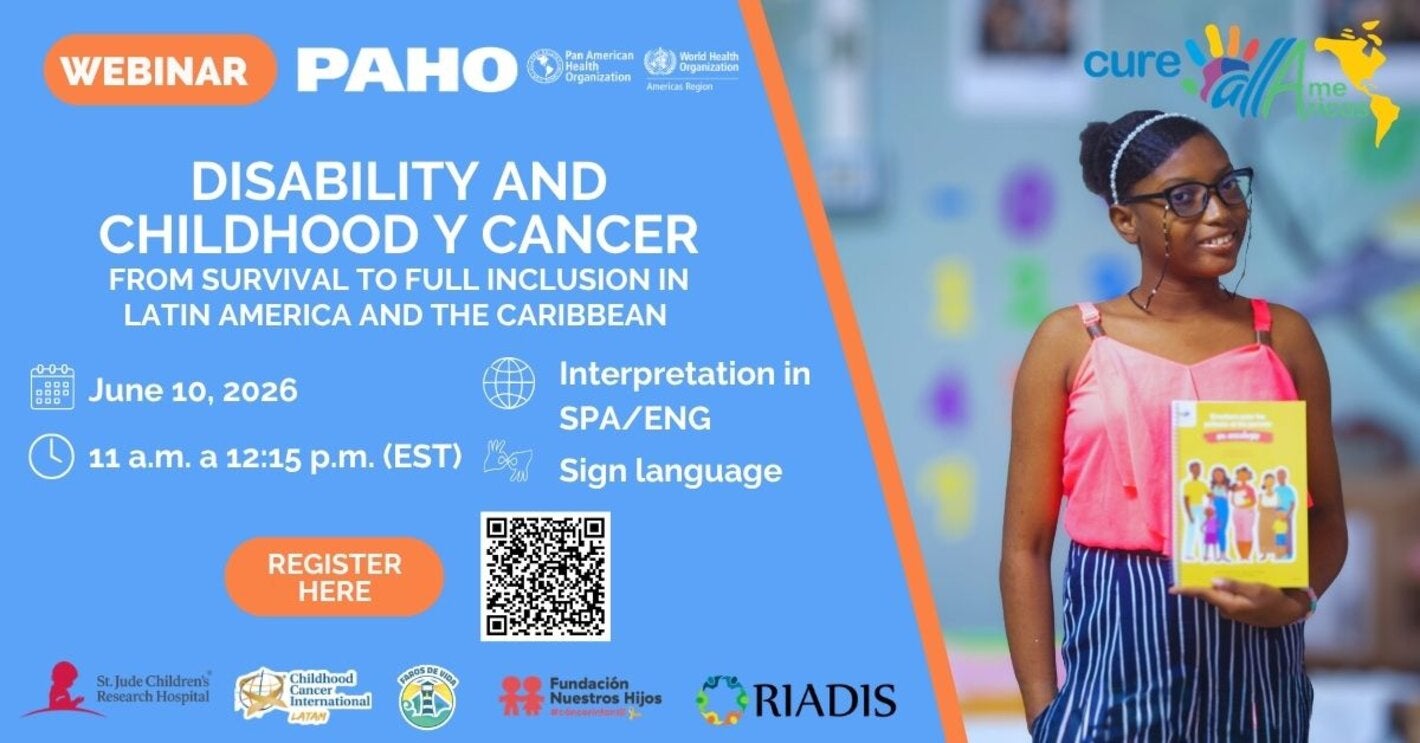
Join us on Wednesday, June 10, at 11:00 a.m. (Washington, DC time or EST) on the webinar "Disability and Childhood Cancer: From survival to full inclusion in Latin America and the Caribbean". This webinar will bring together key stakeholders from the health area, organizations of persons with disabilities, and childhood cancer survivor networks to discuss challenges and opportunities to integrate a disability perspective into childhood cancer policies and programs in the region.
The participation of leading institutions in pediatric oncology, such as St. Jude Children’s Research Hospital, disability networks such as RIADIS, survivor networks such as Faros de Vida, PAHO, and civil society organizations such as Fundación Nuestros Hijos/Childhood Cancer International, will enable the sharing of experiences, models, and recommendations to advance toward more inclusive health and social protection systems.
Objectives of the webinar
- To present evidence and experiences regarding sequelae and rehabilitation needs, psychosocial support, and social and educational reintegration of children and adolescents living with or surviving childhood cancer in the region.
- To share comprehensive care models developed by specialized institutions and civil society organizations, such as St. Jude and Fundación Nuestros Hijos, including rehabilitation, palliative care, family support, and linkages with social protection systems.
- To analyze, from the perspective of the disability movement (RIADIS), CRPD standards and regional commitments on inclusive education, decent work, and social protection in the context of childhood cancer.
- To give a voice to childhood cancer survivors organized in networks such as Faros de Vida, highlighting barriers and facilitators in their transition to adulthood, social participation, and the exercise of their rights as persons with disabilities.
- To explore the role of PAHO and other agencies in strengthening policies, national childhood cancer plans, and integrated rehabilitation services, with a life-course, equity, and human rights approach.
RECORDING
How to participate
- DATE: Wednesday, June 10, 2026
- TIME: 11:00 a.m. (Washington, DC time or EST) [Check at the end of the page the time in other cities]
- LANGUAGES: English and Spanish, with simultaneous interpretation in those languages, and sign language interpretation.
- REGISTER: https://paho-org.zoom.us/webinar/register/WN_UAJFgqEYREGFfg9M39S3bQ#/registration
Agenda
11:00 a.m. Welcome remarks, Silvana Luciani. Unit Chief, NMH, PAHO
11:10 a.m. Webinar objectives and introduction of panelists, Liliana Vásquez. Technical Officer, PAHO and Gustavo Pérez. Regional Advisor, PAHO
11:15 a.m. Panel discussion: International perspective, Models of care, Lived experiences, and Cancer, disability, and human rights
- Soad Fuentes-Alabi, St Jude Children’s Research Hospital
- Carlos Frías, Faros de Vida
- Marcela Zubieta, Fundación Nuestros Hijos
- RIADIS
12:00 p.m. Q&A
12:10 p.m. Closing remarks, Liliana Vásquez. Technical Officer, PAHO and Gustavo Pérez. Regional Advisor, PAHO
Context
Childhood cancer is one of the leading causes of disease-related death in children. However, advances in diagnosis and treatment have enabled an increasing number of children and adolescents to survive into adulthood, particularly in countries with well-developed care networks and social support systems. Nevertheless, the disease and its treatments may result in physical, sensory, cognitive, and psychosocial sequelae that often translate into disability, affecting full participation in family life, education, play, future employment, and community life.
When discussing cancer and disability, a dual perspective must be considered: on one hand, persons with disabilities often face worse outcomes than those without disabilities in terms of access to screening and treatment; on the other hand, cancer patients may develop disabilities as a result of treatment.
Historically, the response to childhood cancer has focused on clinical survival, with less emphasis on rehabilitation, long-term support, educational and labor inclusion, and recognition of disability for access to services and social protection. Organizations such as Fundación Nuestros Hijos in Chile have demonstrated that comprehensive models combining oncology care, rehabilitation, palliative care, and psychosocial support improve the quality of life of children with cancer and their families, and can serve as models for other countries in the region.
At the same time, disability networks, such as RIADIS, have promoted the full implementation of the Convention on the Rights of Persons with Disabilities (CRPD) and the 2030 Agenda, advocating for the active participation of organizations of persons with disabilities in the design of public policies.
Experiences from childhood cancer survivor networks such as Faros de Vida also highlight the importance of incorporating the voices of those who have lived through childhood cancer to identify gaps in rehabilitation, reintegration, and the exercise of rights.
More information on
Time in other cities
- 8:00 a.m. – Los Angeles, Vancouver.
- 9:00 a.m. - Belmopan, Guatemala City, Managua, Mexico City, San Salvador, San José (Costa Rica), Tegucigalpa.
- 10:00 a.m. - Bogotá, Kingston, Lima, Panama City, Quito,
- 11:00 a.m. - Havana, Port-au-Prince, Nassau, Ottawa, Washington D.C., Bridgetown, Caracas, Georgetown, La Paz, Port of Spain, San Juan, Santo Domingo, Saint George's, Saint John's (Antigua), Santiago.
- 12:00 p.m. – Asunción, Buenos Aires, Brasilia, Montevideo, Paramaribo.
- 5:00 p.m. – Geneva, Madrid.
For other cities, check the local times in the following link.