
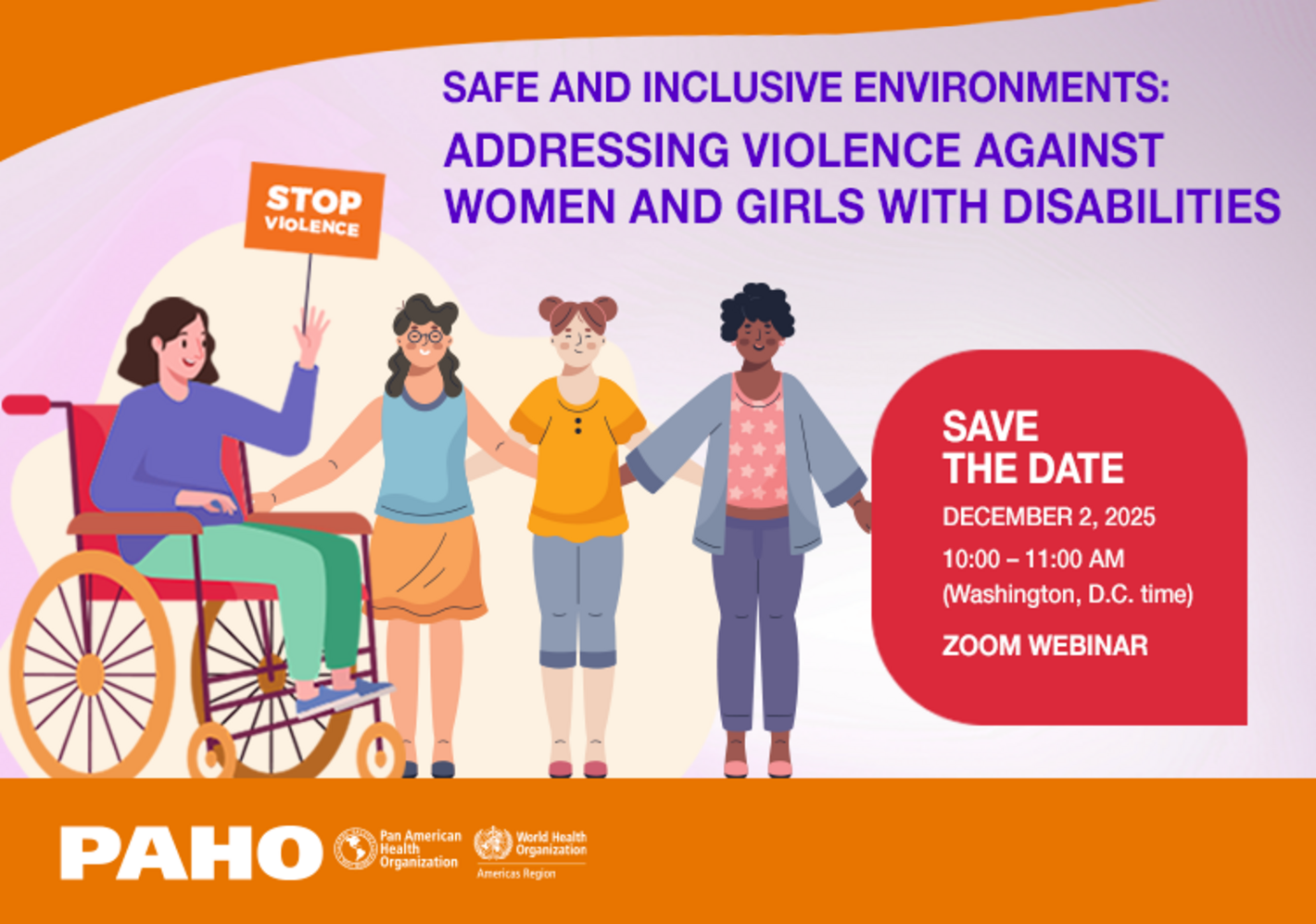
Join us on Tuesday, December 2, at 10:00 a.m. (Washington, D.C. time or EST) for the event "Safe and Inclusive Environments: Addressing Violence Against Women and Girls with Disabilities." During the event, the causes and risk factors contributing to violence against women and girls with disabilities will be analyzed, with the aim of better understanding the dynamics that perpetuate this problem. The barriers that hinder their access to services and support networks will also be addressed, identifying challenges and opportunities to improve the institutional and community response.
RECORDING
Objectives
- Analyze the causes and risk factors that contribute to violence against women and girls with disabilities.
- Address the barriers that prevent women and girls with disabilities from accessing support.
- Exchange experiences and suggestions to strengthen the prevention of and response to violence against women and girls with disabilities by adapting the first-line support (LIVES approach).
How to participate
- DATE: Tuesday, December 2, 2025
- TIME: 10:00 a.m. (Washington, DC time or EST) [Check at the end of the page the time in other cities]
- LANGUAGES: Spanish and English, with simultaneous interpretation in those languages
- REGISTER: https://paho-org.zoom.us/webinar/register/WN_PQIDv_2JQwS8HdU-zeVgeg#/registration
Agenda
10:00 a.m. Welcome Remarks
10:10 a.m. Panel Discussion on the Causes and Contributing Factors of Violence Against Women and Girls with Disabilities, the Barriers They Face in Accessing Support, and Suggestions for Prevention and Care for Survivors
- Guala Beathyate, Natalia Sofía - ONCE (Spanish National Organization of the Blind)
- Cristina A. Francisco Reyes - RIADIS (Latin American Network of Organizations of People with Disabilities and their Families)
- Marcela Tenorio/Constanza Lopez Radrigán - MICARE (Millennium Institute for Care Research - Chile)
- Carolina Buceta - REDI (Network for the Rights of People with Disabilities - Argentina)
- Anjela Jenkins – Gonzalo Larrabure - Special Olympics
10:55 a.m. Closing Remarks
Context
Although people with disabilities are increasingly visible and are included on the public agenda at the regional and national levels in the legal recognition of their rights, their situation in the Americas is characterized by profound inequality, manifested in socioeconomic and health gaps that place this population group in a vulnerable position.
The intersection of disability and violence in the Americas is a critical issue that demands urgent attention and coordinated action. People with disabilities, who number around 90 million in the region, are disproportionately more likely to suffer various forms of violence, and this violence is often exacerbated by discrimination and lack of access to justice and protection. Several studies reveal that women with disabilities are up to four times more likely to experience intimate partner violence. This risk can increase when girls, young women, or women are blind or deaf, on the autism spectrum, have a psychosocial or intellectual disability, or have multiple disabilities.
Violence can manifest in many ways: physical, psychological and emotional, sexual, economic abuse and exploitation, neglect and abandonment, institutional violence, and more. Furthermore, several factors can exacerbate the vulnerability of women and girls with disabilities, such as prejudice and stigma, dependency and isolation, communication barriers, lack of access to justice, poverty, and being Indigenous or LGBTQ+, among others. Therefore, it is crucial to train healthcare personnel on how to provide frontline support (LIVES) to women and girls with disabilities.
Ensuring safe and inclusive environments requires coordinated efforts among health, justice, education, and civil society to ensure that no woman or girl with a disability is left behind.
Time in other cities
- 7:00 a.m. – Los Angeles, Vancouver.
- 9:00 a.m. – Belmopan, Guatemala City, Mexico City, Managua, San José (Costa Rica), San Salvador, Tegucigalpa.
- 10:00 a.m. – Bogotá, Lima, Quito, Kingston, Panama City, Memphis, Havana, Nassau, Ottawa, Port-au-Prince, Washington, D.C.
- 11:00 a.m. – Bridgetown, Caracas, Castries, Georgetown, La Paz, Port of Spain, San Juan, Santo Domingo, Saint George´s Saint John´s.
- 12:00 p.m. – Asunción, Buenos Aires, Brasília, Montevideo, Paramaribo, Santiago.
- 4:00 p.m. – Geneva, Madrid.
For other cities, please refer to the local time at this link.