
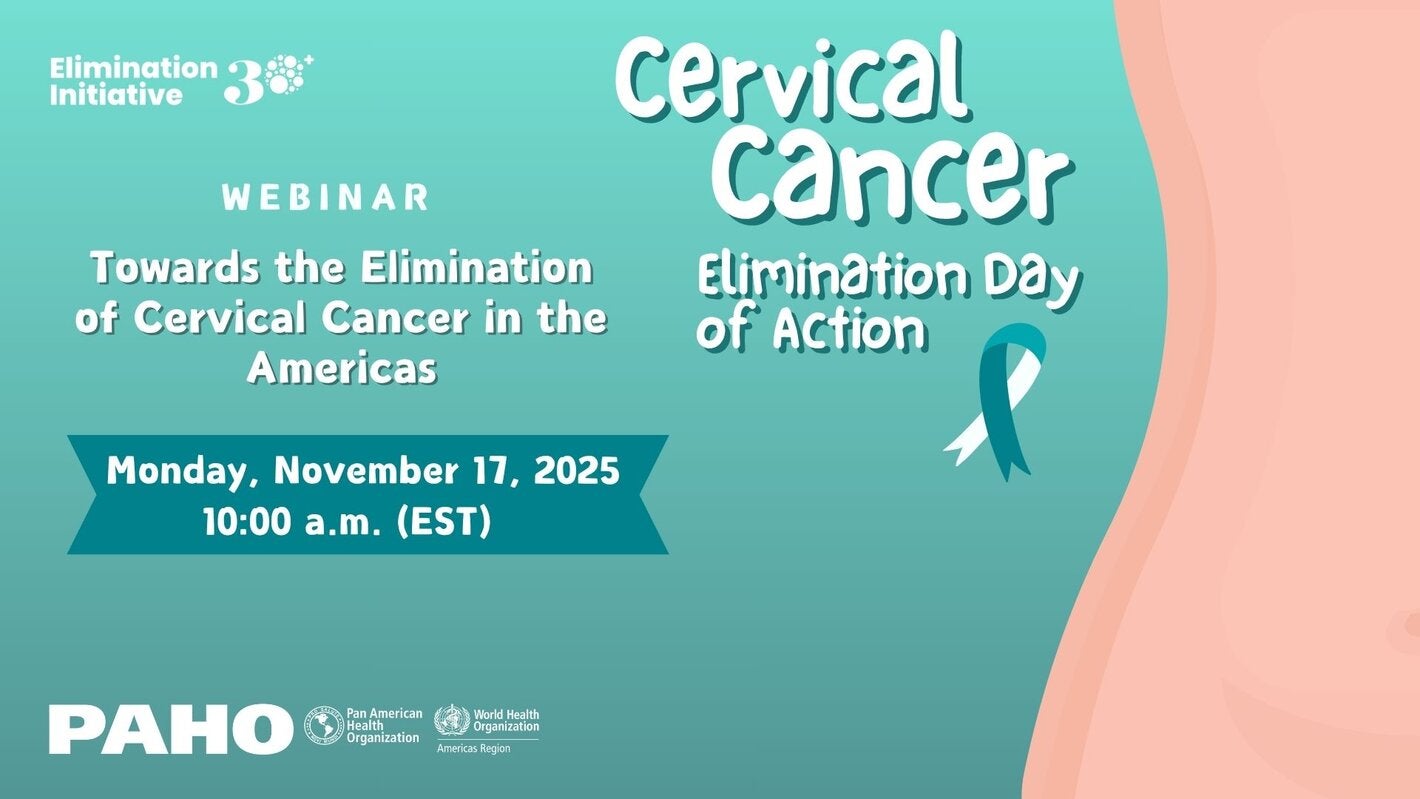
Join us on Monday, November 17, at 10:00 a.m. (Washington, D.C. time or EST) for the event "Towards the Elimination of Cervical Cancer in the Americas".
Objectives
- Commemoration of the launch of the World Cervical Cancer Elimination Day
- Present success stories of HPV prevention and screening in the Region, including progress by Antigua and Barbuda, Brazil, Chile and El Salvador towards cervical cancer elimination
- Present the development of the HPV test by IBMP in Brazil
- Disseminate plans for the elimination of cervical cancer in Latin America and the Caribbean
RECORDING
How to participate
- DATE: Monday, November 17, 2025
- TIME: 10:00 a.m. (Washington, DC time or EST) [Check at the end of the page the time in other cities]
- LANGUAGES: Spanish, English, and Portuguese, with simultaneous interpretation in those languages
- LIVE BROADCAST: https://youtu.be/PA92LqxZys0
Agenda
Moderator: Dr. Mauricio Maza, Regional Advisor, Cancer Prevention and Control, PAHO
10:00 a.m. Opening remarks
- Jarbas Barbosa, Director, PAHO
High-Level Interventions by Ministers of Health
10:05 a.m. Vaccination Experience in Brazil and Its Vision to Eliminate Cervical Cancer
- Hon. Alexandre Padilha, Minister of Health of Brazil
10:20 a.m. Screening Experience in Antigua and Barbuda and Its Vision to Eliminate Cervical Cancer
- Hon. Molwyn Joseph, Minister of Health of Antigua and Barbuda
10:35 a.m. HPV Vaccination, Screening, and Treatment in Primary Care Level, towards achieving the 90-70-90 goals by 2030
- Hon. Carlos Alvarenga, Vice-Minister of Health of El Salvador
10:50 a.m. Chile: The Path Toward the Elimination of Cervical Cancer
- Hon. Ximena Aguilera, Minister of Health of Chile
Partner Contributions and Support
11:05 a.m. AECID vision to support Cervical Cancer Elimination
- Oriana Ramírez Rubio, Head of Health Area, AECID
11:15 a.m. Unitaid - Expanding our reach to support cervical cancer elimination
- Dr. Philippe Duneton, Executive Director, Unitaid
11:25 a.m. Project ECHO – 5 years of bringing the region together
- Melissa Lopez Varon, MD Anderson Cancer Center
Innovation for Public Health Impact
11:35 a.m. Experience of IBMP, developing an HPV test to support cervical cancer elimination efforts
- Pedro Barbosa, IBMP
11:45 a.m. Closing Remarks
- Anselm Hennis, NMH Director, PAHO
Context
Although eminently preventable, cervical cancer is the third leading cause of cancer in women in Latin America and the Caribbean. More than 78,000 women were diagnosed with cervical cancer, and more than 40,000 died from the disease in the Region of the Americas in 2022. Regional age-standardized incidence and mortality rates for women with cervical cancer are 11.5/100,000 and 5.4/100,000, respectively. Cervical cancer death rates are three times higher in Latin America and the Caribbean than in North America, highlighting the inequities associated with this disease.
In 2020, the World Health Organization (WHO) launched the Global Strategy to accelerate the elimination of cervical cancer as a public health problem (defined as an incidence threshold of four per 100,000 women); establishing targets of 90% HPV vaccine coverage, 70% screening coverage with a high-performance test, and 90% treatment coverage.
The inclusion of cervical cancer elimination in both of the PAHO Director’s flagship initiatives: Better Care for NCDs, aimed at expanding equitable access to integrated and comprehensive noncommunicable disease services within primary health care, and the Disease Elimination Initiative, which seeks to eliminate over 30 diseases from the Americas by 2030, underscores the regional public health priority of this disease.
To date, 48 countries and territories have introduced the vaccine in national immunization programs in the Americas. Mass screening with Papanicolaou has been less effective in reducing cervical cancer mortality in developing countries, mainly because of shortcomings in laboratory infrastructure, equipment, logistic challenges associated with screening, and the limitations of the test itself. HPV testing is a more effective test, and its use in screening programs, along with innovative approaches, such as “screen and treat,” has been proven to prevent cervical cancer effectively. Antigua and Barbuda, Argentina, Canada, El Salvador, Mexico, and the United States are among the countries that have included HPV testing in their national screening programs.
PAHO is working to support local production of essential medicines, vaccines, and health technologies by fostering public-private collaboration, promoting research and innovation, and leveraging existing capacities. These efforts aim to ensure distribution of health products across the region through PAHO’s Revolving Funds.
Time in other cities
- 7:00 a.m. – Los Angeles, Vancouver.
- 9:00 a.m. - Belmopan, Guatemala City, Managua, Mexico City, San Salvador, San José (CR), Tegucigalpa
- 10:00 a.m. - Bogotá, Havana, Kingston, Lima, Port-au-Prince, Nassau, Ottawa, Panama City, Quito, Washington D.C.
- 11:00 a.m. – Bridgetown, Caracas, Castries, Georgetown, La Paz, Port of Spain, San Juan, Santo Domingo, Saint George´s Saint John´s
- 12:00 p.m. - Asunción, Buenos Aires, Brasilia, Montevideo, Paramaribo, Santiago
- 4:00 p.m. – Geneva, Madrid.
For other cities, please refer to the local time at this link.