
Organization
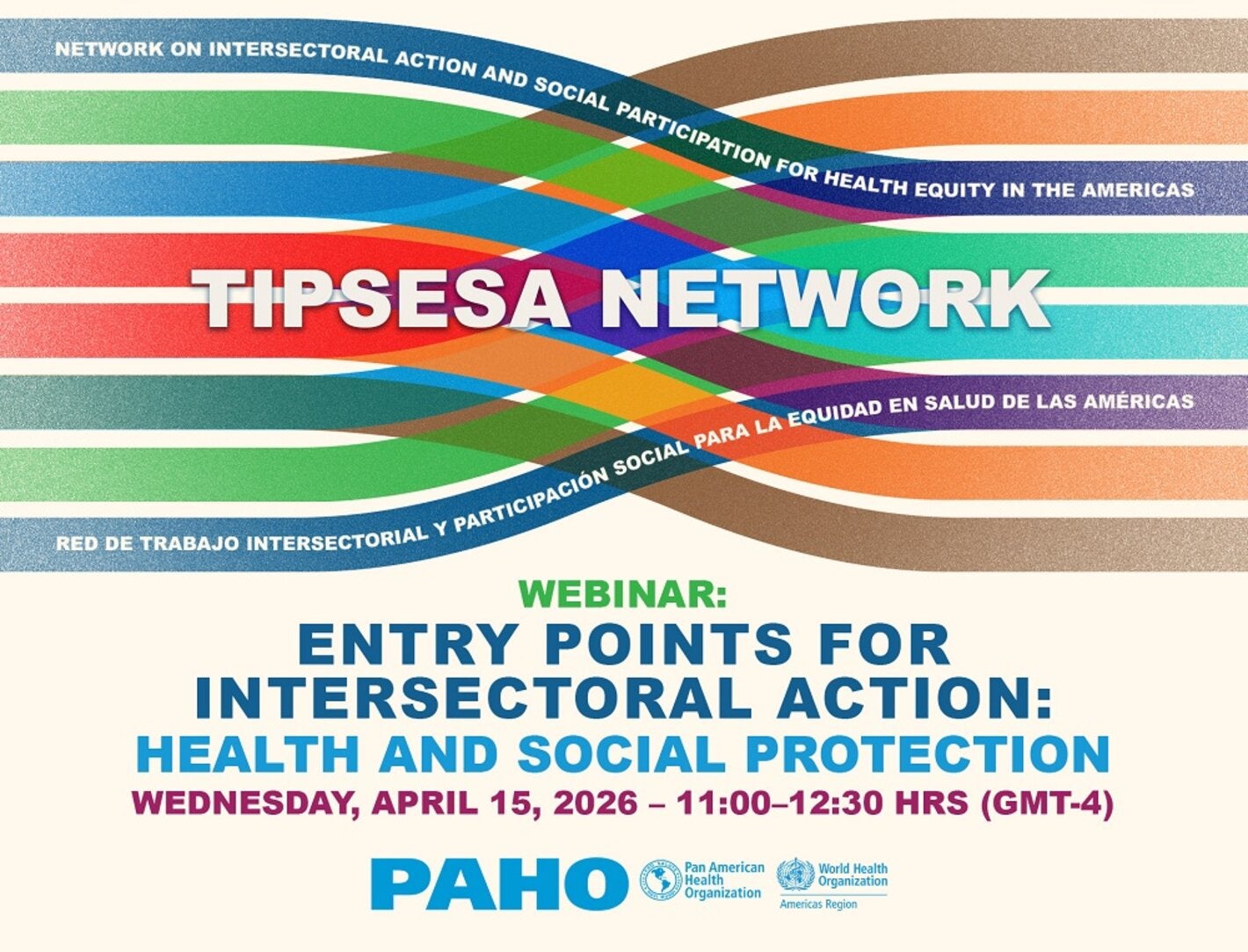
The Intersectoral Work and Social Participation Network for Health Equity in the Americas (TIPSESA Network) and the Pan American Health Organization are organizing this webinar as part of their efforts to generate synergies among government institutions and organizations, academia, and civil society across different countries in the region. The TIPSESA Network seeks to strengthen the exchange of experiences, learning, and capacities to promote intersectoral responses that help reduce health inequities and foster collective well‑being.
Context
In the Americas, deep social inequalities persist, reflected in avoidable and unjust gaps in health and well‑being. These inequities are closely linked to the social determinants of health, meaning the conditions in which people are born, grow, live, work, and age. In this context, intersectoral action takes on strategic relevance, as it enables more comprehensive public responses to address conditions that go beyond the exclusive scope of the health sector and require the involvement of multiple sectors, levels of government, and social actors.
Regional and international experience has consolidated intersectorality as a central component of efforts aimed at promoting health equity and well‑being from a comprehensive perspective. From Primary Health Care and health promotion to the social determinants of health and the Health in All Policies approach, the need to create mechanisms for cooperation, coordination, and integration across sectors has been repeatedly emphasized in order to respond more effectively to population needs. For example, coordination between health and social protection offers concrete opportunities to advance toward more integrated, people‑centered models of care and management, with greater capacity to respond to situations of vulnerability, diverse needs, and the complexity of these needs across the life course. It also facilitates the development of public policies that address the living and working conditions that affect the health and well‑being of different social groups, with particular attention to those facing situations of vulnerability.
This virtual seminar is conceived as a regional space for dialogue to reflect on the various entry points that can strengthen intersectoral action between health and social protection, as well as on the institutional arrangements, management capacities, and territorial experiences that make it possible to move from more limited forms of collaboration toward more integrated strategies. From this perspective, intersectorality is not understood solely as a mechanism of administrative coordination, but as a pathway to enhance the effectiveness of public policies, improve the relevance of institutional responses, and place equity and well‑being at the center of public action.
Objectives
The main purpose of the session is to promote the exchange of experiences and the dissemination of good practices for intersectoral action aimed at fostering the comprehensive well‑being of the population and advancing equity in the Region of the Americas. The seminar seeks to contribute to strengthening a regional agenda that recognizes that health and well‑being are the result of shared efforts among sectors, institutions, and communities, and that they require governance frameworks, social participation, and sustained cooperation to move toward more just, inclusive, and healthy societies.
Participation
- DATE: Wednesday, April 15, 2026
- LANGUAGES: English and Spanish
- TIME: 11:00 AM - 12:30 PM (ET, Washington DC, Santiago)
- OTHER TIME ZONES: Mexico City (9:00 AM). Bogotá, Lima, Quito, Panamá (10:00 AM). Buenos Aires, Brasilia, Asunción (12:00 PM)
- PLATFORM: ZOOM (with registration)

Agenda
Topic
Welcome remarks
Pan American Health Organization (PAHO)
Entry points for intersectoral action aimed at promoting equity in health and well‑being. Conceptual and programmatic framework for cross‑sector work in addressing the social determinants of health.
Department of Social and Environmental Determinants for Health Equity, PAHO
Policy Articulation and Health Equity: Lessons from 'Uruguay Crece Contigo'
Virginia Cardozo. Uruguay Crece Contigo - MIDES Uruguay. Director
Experience in Bogota (Colombia): Public governance and intersectorality
Diana Sofía Rios Oliveros. Determinants of Health Deputy Director. District Health Secretariat of Bogota
Closing
Questions and remarks