
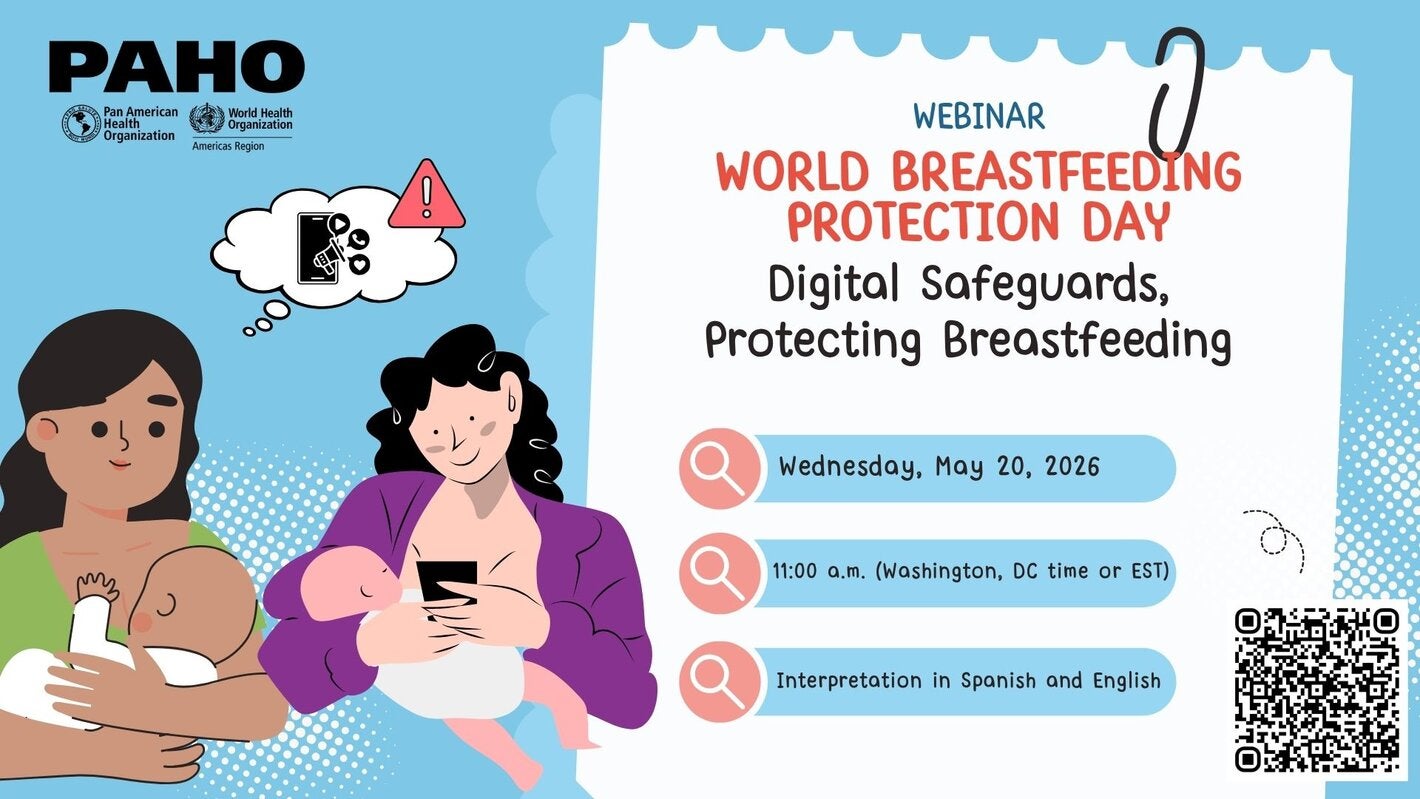
Join us on Wednesday, May 20, at 11:00 a.m. (Washington, DC time or EST) on the World Breastfeeding Protection Day Webinar: Digital Safeguards – Protecting Breastfeeding. This webinar will inform Member States about the need to monitor and sanction digital violations of the International Code and recommended strategies and tools. By integrating digital literacy into public health policy, member states can take steps to shield families from predatory commercial interests and safeguard the health of future generations.
Objectives of the webinar
- Analyze the extent of digital marketing on infant feeding choices and its role in circumventing national Code legislation in countries of the Americas.
- Present innovative monitoring tools to help Member States identify and document digital marketing violations.
- Inform the Audience about how to strengthen legal frameworks to specifically include digital, social media, and influencer-led promotions under national enforcement mechanisms.
RECORDING
How to participate
- DATE: Wednesday, May 20, 2026
- TIME: 11:00 a.m. (Washington, DC time or EST) [Check at the end of the page the time in other cities]
- LANGUAGES: Spanish and English with simultaneous interpretation in those languages
- REGISTER: https://paho-org.zoom.us/webinar/register/WN_tP91qFwTTae487KQbTciZQ#/registration
Agenda
Moderator: Audrey Morris, Advisor, Food and Nutrition, Department of Noncommunicable Diseases and Mental Health, PAHO
11:00 a.m. Welcome remarks, Vanessa Garcia Larsen, Chief, Risk Factors Unit, Department of Noncommunicable Diseases and Mental Health, PAHO
11:05 a.m. Monitoring of digital marketing of products that interfere with breastfeeding, Marina Rea, National Coordinator, International Baby Food Action Network (IBFAN), Brazil
11:20 a.m. Regulation of the digital marketing of commercial infant formulas and complementary feeding products in Central America and the Caribbean, Mónica Mazariegos, Researcher, Institute of Nutrition of Central America and Panama (INCAP)
11:35 a.m. Legal Tools: Updating National Laws for the Digital Era, Ignacio Ibarra, Regional Advisor on Health-Related Law, PAHO
11:50 a.m. Tools to track Digital Marketing of Breast-milk Substitutes, Laurence Grummer-Strawn, Head, Nutrition and Food Safety Action (NFA), World Health Organization (WHO)
12:05 p.m. Q&A
12:15 p.m. Closing: Call to Action for Digital Accountability, Vanessa Garcia Larsen, Chief, Risk Factors Unit, Department of Noncommunicable Diseases and Mental Health, PAHO
Context
Breastfeeding remains the most resilient and sustainable food system for infants, but now the protection of this biological right faces a complex digital frontier. Recent evidence from the WHO has revealed that the digital marketing of breast-milk substitutes (BMS) is no longer just an extension of traditional advertising, but a sophisticated, multi-layered ecosystem designed to bypass national regulations.
While traditional marketing is increasingly regulated, the rise of Artificial Intelligence (AI), influencer marketing, and algorithmic targeting has created a pervasive "digital environment of persuasion." This environment operates through hidden tactics, such as native advertising in parenting apps and influencer campaigns that promote commercial milk formula under the guise of personal advice, often without disclosing commercial ties.
The issue prompted the World Health Organization in 2023 to issue Guidance on Regulatory Measures aimed at Restricting Digital Marketing of Breast-milk Substitutes, and in 2025, the World Health Assembly approved a resolution to expand the provisions of the International Code of Marketing of Breast-milk Substitutes to tackle the digital marketing of formula milk and baby foods.
In the PAHO region, where digital penetration is high, the commercial milk formula (CMF) industry utilizes data mining to target vulnerable caregivers at their most receptive moments. This sophisticated interference directly contributes to the persistent "triple burden" of malnutrition and undermines global breastfeeding targets. For PAHO, the challenge in 2026 is no longer just the adoption of the International Code of Marketing of Breastmilk Substitutes, but its enforcement within the digital ecosystem.
Time in other cities
- 8:00 a.m. – Los Angeles, Vancouver.
- 9:00 a.m. - Belmopan, Guatemala City, Managua, Mexico City, San Salvador, San José (Costa Rica), Tegucigalpa.
- 10:00 a.m. - Bogotá, Kingston, Lima, Panama City, Quito,
- 11:00 a.m. - Havana, Port-au-Prince, Nassau, Ottawa, Washington D.C., Bridgetown, Caracas, Georgetown, La Paz, Port of Spain, San Juan, Santo Domingo, Saint George's, Saint John's (Antigua), Santiago.
- 12:00 p.m. – Asunción, Buenos Aires, Brasilia, Montevideo, Paramaribo.
- 5:00 p.m. – Geneva, Madrid.
For other cities, check the local times in the following link.