Panama City, September 1, 2026. (PAHO/WHO) — Generating a genomic sequence is only one part of the process. The challenge is to transform genomic data into public health evidence: interpreting it in context to understand what is happening and translating it into information that can guide public health decisions and actions.
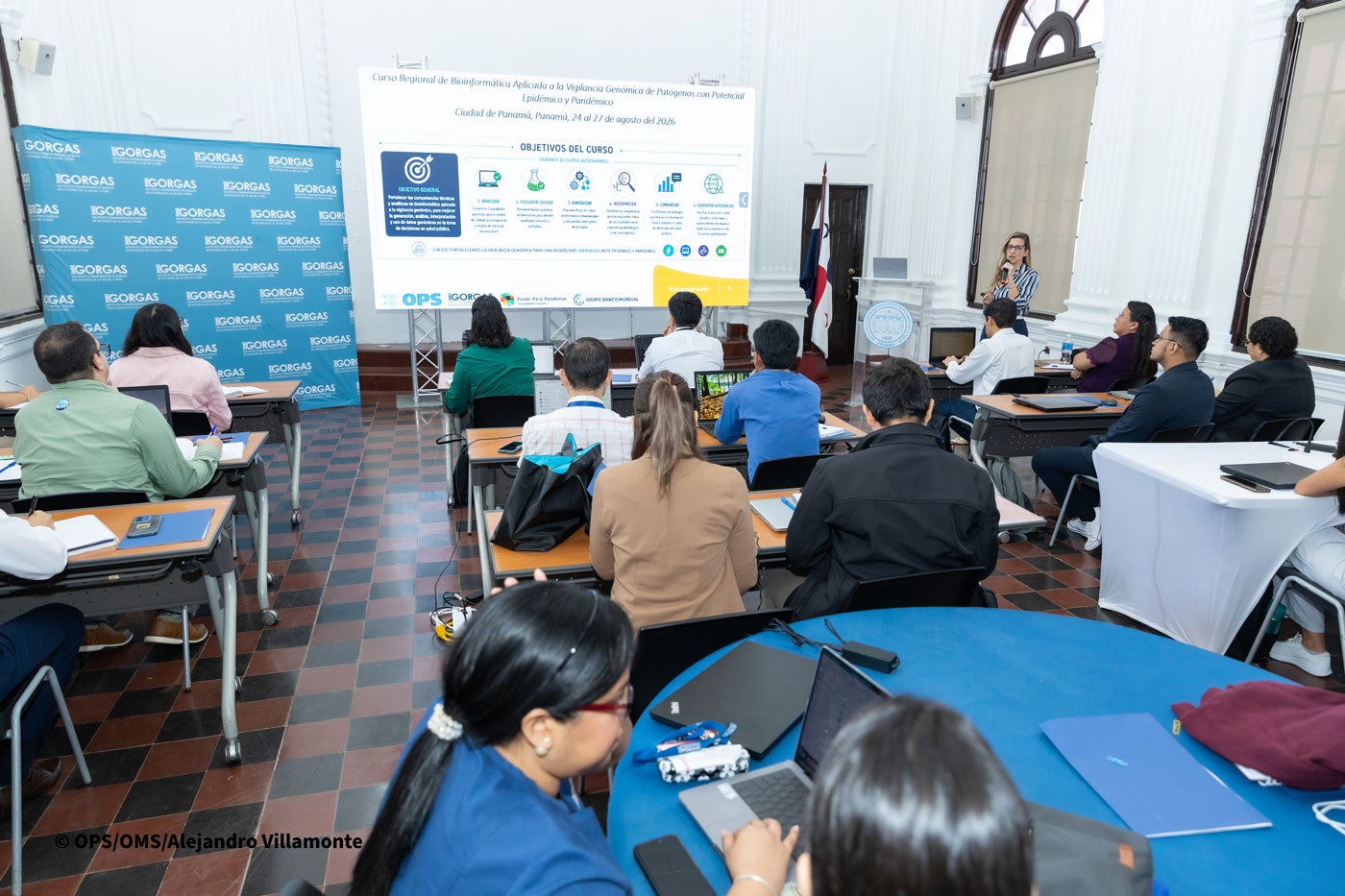
With this goal in mind, the Pan American Health Organization/World Health Organization (PAHO/WHO), together with the Gorgas Memorial Institute for Health Studies (ICGES), a PAHO/WHO Collaborating Centre for Genomic Surveillance of Epidemic and Pandemic Pathogens, organized the Regional Course on Bioinformatics Applied to Genomic Surveillance of Pathogens with Epidemic and Pandemic Potential. Held in Panama City from 24 to 27 August, the course brought together specialists from human and animal health laboratories in Bolivia, Colombia, Costa Rica, the Dominican Republic, Ecuador, El Salvador, Guatemala, Honduras, Nicaragua, Panama, and Paraguay.
The training, conducted within the framework of PROTECT, an initiative funded by the Pandemic Fund, and a project of the United States Centers for Disease Control and Prevention (CDC) for Central America, contributes to the implementation of the Regional Strategy for Genomic Surveillance for Epidemic and Pandemic Preparedness and Response.
According to Jairo Méndez-Rico, PAHO/WHO Regional Advisor on Viral Diseases, strengthening bioinformatics analysis capacities is essential to ensure that genomic surveillance complements traditional epidemiological surveillance by providing information to characterize circulating pathogens, identify variants, investigate chains of transmission, and detect unusual events. “As countries increase their capacity to generate sequences, the need for specialists who can analyze and interpret those data also grows,” he said.
Bioinformatics is a fundamental part of this process. Mariela Martínez, International Consultant with PAHO’s Health Emergencies Department, noted that the tools used during the course enable more in-depth analyses based on complete genome sequences, but that the challenge does not end with the analysis. “Our goal is for all public health laboratories to be able to produce reports that communicate findings to decision-makers in clear, understandable language,” she explained.
For David Jarrín, from Ecuador’s Agency for Phytosanitary and Zoosanitary Regulation and Control, sequencing makes an important contribution to surveillance but also presents new challenges: analyzing complete genomes requires bioinformatics tools and skills that are not always part of laboratory personnel’s training. In this regard, he highlighted that the course enabled participants to work with tools they can incorporate into their laboratories without requiring advanced programming knowledge.
Harmonizing these capacities is also key to regional surveillance. According to Jarrín, the use of standardized protocols facilitates the generation of comparable results and the reliable sharing of data among countries, which is particularly important for understanding how diseases spread and assessing the risks associated with their circulation across different territories.
Bringing genomic surveillance closer to local settings
In the Ecuadorian Amazon, the challenge also has a geographical dimension. Benito Taipe is a molecular biology analyst at the National Institute for Public Health Research (INSPI), based at its Tena Technical Office. His laboratory operates in a region where tropical diseases such as dengue, Zika, chikungunya, and yellow fever circulate. Currently, samples requiring genomic analysis must be transported to the reference laboratory in Quito.
As part of the PROTECT project, the Tena laboratory has acquired a real-time PCR platform and a sequencer, strengthening molecular diagnostic and genomic surveillance capacities in the region and reducing dependence on transporting samples to the capital. “It is very important for countries and institutions to think about decentralization,” Taipe said. To achieve this, he added, having the technology is not enough: qualified and trained personnel are also needed, with the capacity to apply it to the epidemiological needs of each territory.
Bioinformatics is a fundamental part of this process. Taipe noted that the tools used during the course will enable more in-depth analyses based on complete genome sequences. But the challenge does not end with the analysis: “Our goal is to produce a report that communicates the findings to decision-makers in clear, understandable language,” he explained.
Strengthening capacities for regional surveillance

“The main challenges we face in the country when it comes to contributing genomic data to surveillance are human resources, technology, and, without a doubt, financial resources,” said Leidy Johana Picco Hurtado of the Colombian Agricultural Institute (ICA).
For Picco, in addition to strengthening technical skills, these opportunities allow countries to share experiences and expand access to knowledge beyond the central level. “These gatherings give those of us working in the regions greater access to information, training, and the experience of other countries,” she said.
Alejandra Orellana, from El Salvador’s National Laboratory, highlighted the immediate applicability of what participants learned. Assessing sequence quality and alignment can help produce higher-quality reads, while visualizing and interpreting phylogenetic trees can help explore possible variant introductions and their relationships with other sequences.
The joint participation of human and animal health laboratories also made it possible to address these challenges through a One Health approach, promoting intersectoral exchange and collaboration in the surveillance of zoonotic pathogens capable of circulating at the human–animal–environment interface.
During the final session, participants integrated the results obtained through the analysis exercises and prepared reports aimed at interpreting those findings in a public health context. This activity reinforced the central objective of the training: to move from generating and analyzing genomic data to interpreting and using them as evidence to guide surveillance and decision-making.