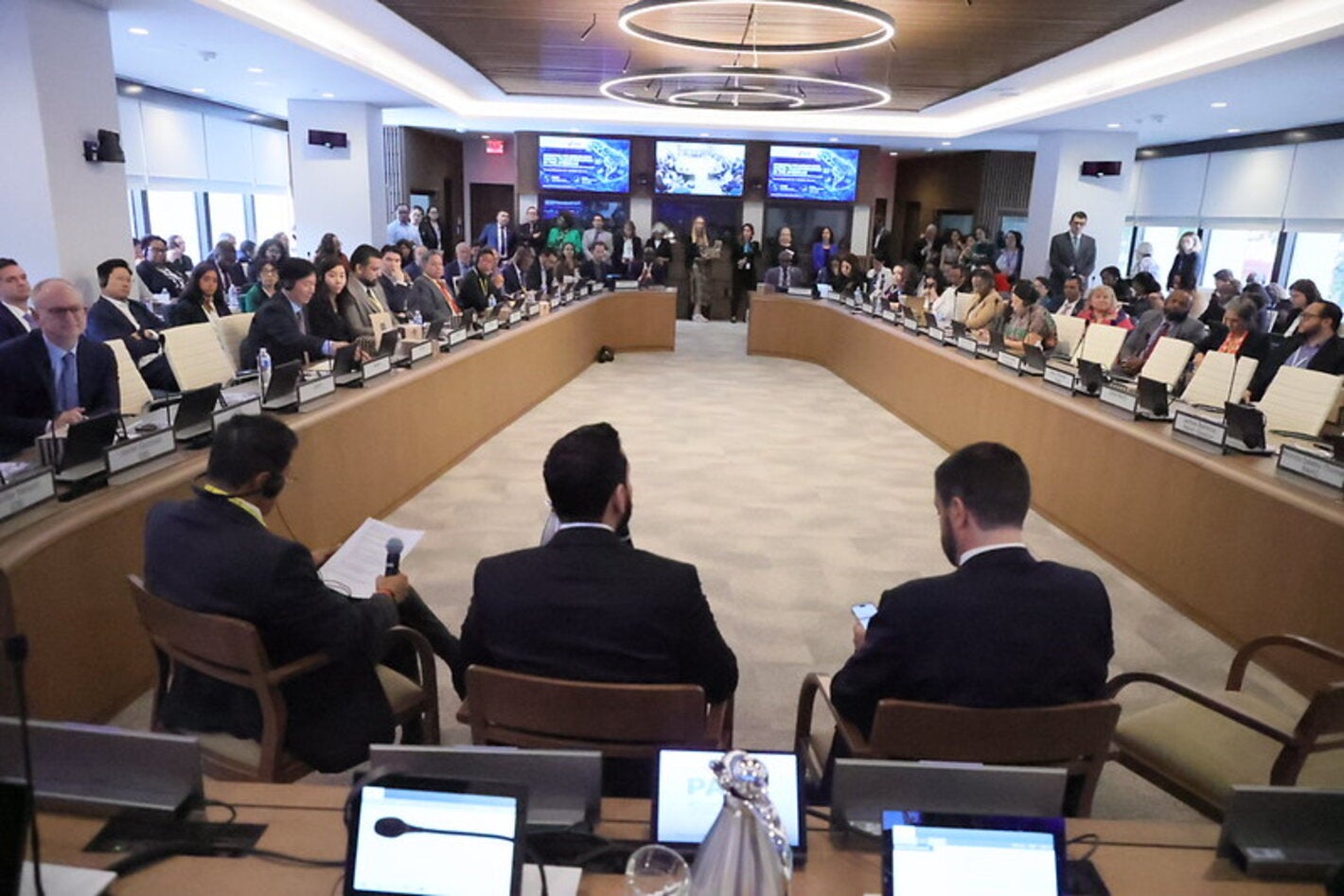
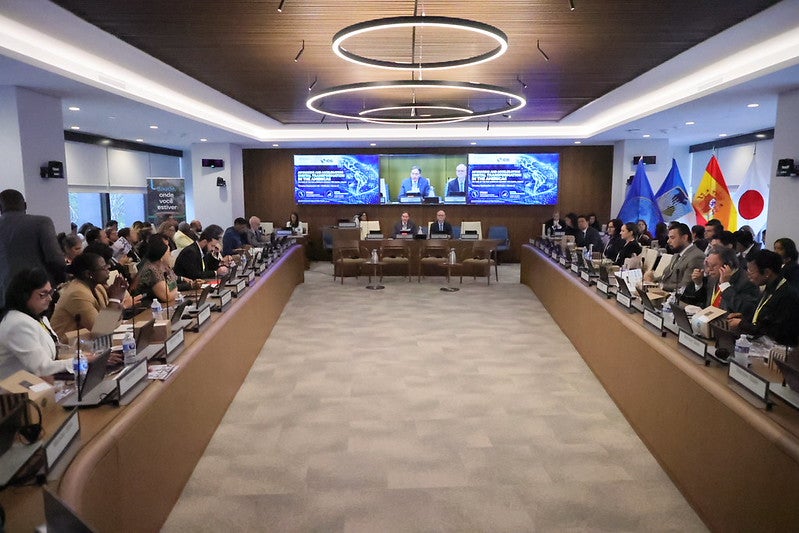
BRIDGETOWN, Barbados, 5 October 2026 (PAHO/WHO) — Coming directly on the heels of a landmark resolution to establish a CARICOM Digital Health Strategy at the 53rd Council for Human and Social Development (COHSOD) – Health meeting, Caribbean health ministers and senior delegates converged in Washington, D.C., during the 63rd Directing Council of the Pan American Health Organization (PAHO) to advance discussions on cross-border health data integration across the hemisphere.
Co-hosted by PAHO and the Inter-American Development Bank (IDB), the high-level briefing session showcased how CARICOM Member States are taking a central role in shaping the Pan-American Highway for Digital Health (PH4H), a flagship regional platform designed to enable secure, trusted, and interoperable health data exchange across borders.
Bridging the Cross-Border Care Gap in the Caribbean
People in the Caribbean regularly cross borders for work, study, tourism, and specialized care, yet their health records usually remain in national or even facility-level systems. The high-level discussions highlighted that PH4H’s core principle - secure, trusted cross-border exchange built on common standards and a shared legal and policy framework - makes true continuity of care possible wherever a person seeks treatment. This directly improves patient safety, eliminates duplicated medical tests and costs, and powers CARICOM’s broader vision for the free movement of citizens.
Dr. Barbosa warmly commended CARICOM and its Member States for their proactive leadership, alongside international partners, including Japan, the Republic of Korea, Spain, Canada, Bloomberg Philanthropies, and Vital Strategies, in driving digital health capacity across the Americas.
"Digital transformation is not simply about the technology; it’s about transforming health systems to better serve people," stated Dr. Jarbas Barbosa, Director of PAHO. "People receiving care outside their home country could access safer and more continuous services, health authorities could exchange information more efficiently to detect emerging threats and coordinate responses during public health emergencies... CARICOM's engagement is particularly important to ensure that Caribbean perspectives and priorities help shape this regional effort."
Alison Drayton, CARICOM Assistant Secretary-General for Human and Social Development at the CARICOM Secretariat, reinforced that as Caribbean citizens move, their care must be able to move with them. “Essential health information, if it doesn't follow, will disrupt continuity of care, complicate referrals, duplicate tests at no small cost, and create risks in emergencies," Drayton stated, adding a crucial reminder that digital health systems and interoperability must be designed to close gaps in healthcare rather than increase inequalities for vulnerable populations across the subregion.
The PH4H emphasizes interoperability, common standards, shared governance, and reusable digital public goods. This approach allows Caribbean nations to pool expertise, share digital platforms and training, and avoid costly duplication. By working together, the region gains economies of scale, a stronger collective voice with technology partners, and health information systems that are resilient, sustainable, and better equipped to support emergency response and public health decision-making.
While agreeing, Ferdinando Regalia, Manager of the Social Sector at the IDB, reiterated the clinical urgency: "Every day, people in our region move between providers, jurisdictions, and countries, but their health information doesn't move with them... What is missing is a trusted way to exchange health information. The PH4H responds to this need."
Caribbean nations rallied behind the principles of PH4H during the briefing, sharing concrete national milestones and advocating for regional synergy.
Dr. Lackram Bodoe, Minister of Health, Trinidad and Tobago outlined national progress in building connected digital medical imaging networks (PACS) and expanding electronic prescriptions across regional health authorities, stressing: "The next phase is not simply about buying more technology - it is about connecting, securing, and sustaining what we already have."
Emphasizing the essential human element of digital health, Minister of Health and Wellness in Barbados, Lisa Cummins highlighted that digital infrastructure, and PH4H tools must be backed by aggressive upskilling of the existing healthcare workforce, as well as medical and nursing university curriculum reforms to prepare clinicians for digital care environments.
Demonstrating strong alignment with the newly mandated CARICOM Digital Health Strategy, Dr Frank Anthony, Minister of Health of Guyana called for regional consensus surrounding Artificial Intelligence (AI) in health, advocating for the integration of ethical AI principles and privacy guardrails directly into the PH4H framework to ensure safety and equitable access.
Next Steps for the Caribbean: 2027 Governance, Workforce & AI Guardrails
To turn strategic consensus into subregional reality following the 53rd COHSOD resolution, health leaders agreed on critical priority areas:
- Regional Governance Framework: Caribbean Member States were urged to engage actively in reviewing the draft PH4H framework which proposed frameworks for shared cybersecurity, data protection, and digital certificate protocols.
- Standardized Digital Certificates: Building on the Americas becoming the first region globally to issue standardized digital yellow fever certificates, CARICOM nations are encouraged to leverage this model for broader cross-border health verification.
- Ethical AI Guardrails: Caribbean delegates called for regional consensus surrounding AI in healthcare, ensuring AI principles are embedded directly into the PH4H and CARICOM frameworks to safeguard data privacy, safety, and health equity.
In closing, Dr. Rhonda Sealey-Thomas, Assistant Director of PAHO, noted that technology could bring quality health services closer to every person. “Together, we can make the Pan-American Highway for Digital Health more than a connected network. We can make it a pathway to stronger health systems, deeper regional cooperation, and better health for every community across the Americas."
Media Contact & Resources:
- Website: https://www.paho.org/en/caribbean-subregional-program-coordination
- Email: spc-crb@paho.org
- Social Media: @PAHOCaribbean (X/Twitter, Facebook, LinkedIn)
About the Pan American Health Organization (PAHO) – Caribbean Subregional Office
The Pan American Health Organization (PAHO) works with the countries of the Americas to improve the health and quality of life of their populations. Founded in 1902, PAHO is the international public health agency for the Americas and serves as the Regional Office for the Americas of the World Health Organization (WHO).
The Office for Caribbean Subregional Program Coordination complements PAHO/WHO’s work at national, regional, and global levels. Located in Bridgetown Barbados, the Office is charged with the responsibility of strategic cooperation with major subregional political integration entities and their institutions to address health policies, strategies, and plans - ultimately contributing to the achievement of key health development objectives.