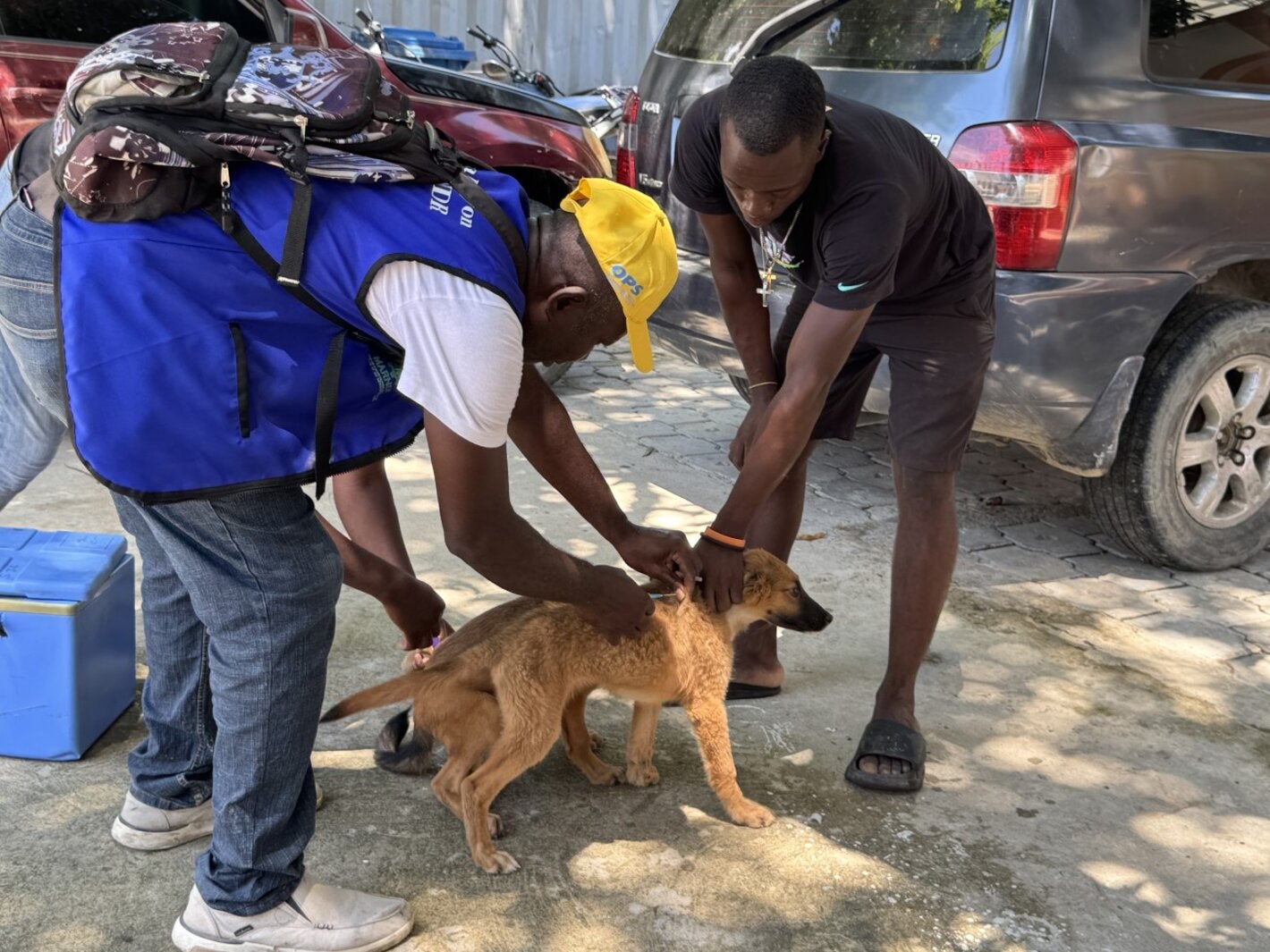
Port-au-Prince, 18 July 2025 (PAHO) – The Pan American Health Organization / World Health Organization (PAHO/WHO), in support of the Ministry of Agriculture, Natural Resources and Rural Development (MARNDR), is currently organising a canine rabies vaccination campaign in in the departments of Artibonite, Centre, Nord-Est, and Nord-Ouest. This activity is part of the Elimination Initiative led by PAHO that aims to eliminate more than 30 diseases and related conditions by 2030, including human rabies transmitted by dogs.
A Preventable Yet Deadly Threat
Rabies remains one of the most deadliest zoonotic diseases, causing an estimated 59,000 deaths annually, mostly in rural areas of Africa and Asia. In Haiti, it continues to pose a serious public health threat.
Surveillance data collected between 2022 and 2024 shows the virus remains present in the country: more than 8,000 suspected cases of animal rabies were investigated, including over 1,100 probable cases and 46 confirmed positives. During that period, 24 human cases were also reported.
Although effective vaccines exist for both humans and animals, major challenges remain in terms of access and availability—especially in remote areas. Vaccinating dogs remains the most effective strategy to break the transmission chain and prevent human cases.

A Targeted Campaign to Break the Transmission Chain
Thanks to technical support from PAHO/WHO and the its Pan American Center for Foot-and-Mouth Disease and Veterinary Public Health (PANAFTOSA), financial support from the U.S. Centers for Disease Control and Prevention (CDC), and coordination by the Directorate of Animal Health (DSA/MARNDR), the 2025 campaign is targeting 16 communes though the deployment of 240 teams across the four departments mentioned. The primary objective is to vaccinate between 140,000 and 160,000 dogs—including stray or community dogs—and to raise awareness among owners about the importance of this preventive measure.
The campaign specifically aims to reduce virus circulation among the canine population by achieving an estimated vaccination coverage of 70 to 80% of targeted dogs. It also seeks to strengthen community awareness on rabies prevention and appropriate responses to bites from suspected rabid animals. In addition, it contributes to building national capacity in canine vaccination through the training of four departmental coordinators, seventeen communal coordinators, and over 480 veterinary and auxiliary agents.


A Step Forward in Eliminating Human Rabies Transmitted by Dogs
Canine rabies remains a public health challenge in Haiti, particularly in a context of a fragile veterinary system and ongoing security constraints. While previous campaigns have helped maintain vigilance in several departments, interruptions caused by the COVID-19 pandemic and national instability have underscored the need to strengthen and sustain efforts over the long term.
“By vaccinating dogs on a large scale, we directly protect human communities—especially children. It’s a simple but vital action that saves lives,” said Dr. Selim Khan, Health Advisor at PAHO/WHO in Haiti.