

Rabies is a zoonosis (disease transmitted to humans by animals) caused by a virus that affects domestic and wild animals, and spreads to people through contact with infected saliva through bites or scratches.
The disease is present on all continents and affects more than 150 countries. Worldwide, rabies is responsible for approximately 60,000 human deaths each year, and in the vast majority of human cases, dogs are the source of transmission.
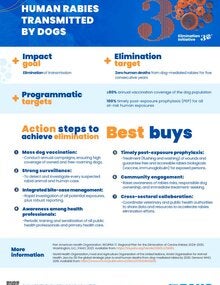
The Americas have achieved a dramatic reduction of approximately 98% in the incidence of dog-mediated human rabies, from around 300 cases in 1983 to 11 human cases transmitted by dogs in 2025 and 2026 (through July). However, in recent years, human rabies transmitted by wildlife has become increasingly important, with the common vampire bat (Desmodus rotundus) being the main source of transmission.

This is one of the +30 diseases and conditions included in the Elimination Initiative and targeted for elimination in the Region of the Americas by 2030.
The region of the Americas has the necessary knowledge and tools for the elimination of rabies transmitted by dogs. Coordinated actions for the regional elimination of human rabies transmitted by dogs began in the Americas in 1983, with the technical cooperation of PAHO, responsible for the coordination of the regional program for the elimination of rabies, as well as the operation of the regional epidemiological surveillance system of rabies.