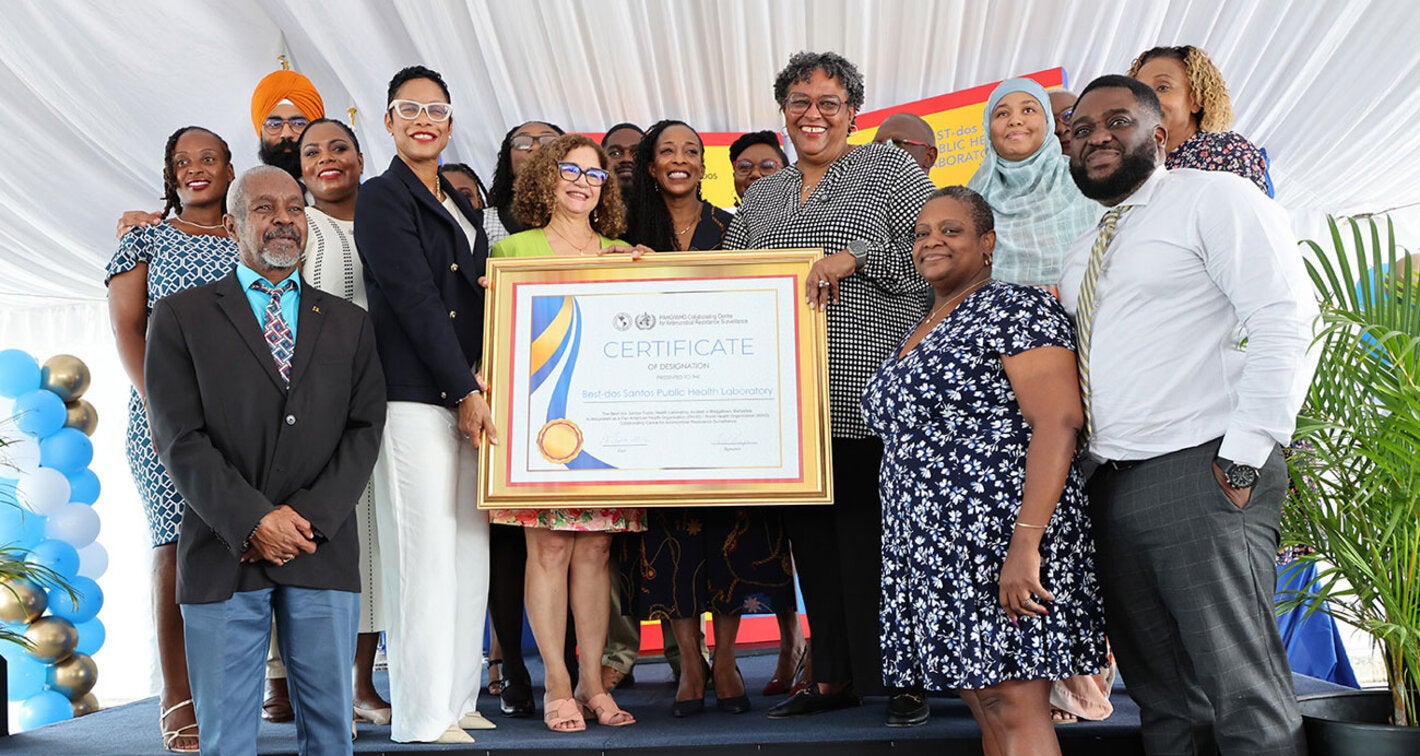
Bridgetown, Barbados, 22 June 2026 (PAHO/WHO) – The Best-dos Santos Public Health Laboratory in Barbados has been designated a Collaborating Centre for Antimicrobial Resistance (AMR) Surveillance by the Pan American Health Organization/World Health Organization (PAHO/WHO), a move that strengthens regional capacity in the Caribbean to detect, monitor and respond to drug-resistant infections.
As a collaborating centre, the laboratory will support countries across the subregion with surveillance, training and technical expertise, helping to improve the detection of resistant pathogens and the quality of data used to guide public health action.
Antimicrobial resistance—when bacteria, viruses and other microorganisms stop responding to treatment—is considered a major global health threat.
Prime Minister Mia Amor Mottley described AMR as a “silent, slow-motion pandemic” and stressed the importance of partnerships to address it. “Without collaboration, we are not able to contain the spread of diseases or expand our scientific knowledge,” she said during the designation ceremony on 17 June.
Strengthening regional capacity
The Best-dos Santos laboratory has played a growing role in national and regional public health surveillance, including microbiology, molecular diagnostics, antimicrobial susceptibility testing and whole genome sequencing.
Through its new designation, the laboratory will act as a reference centre for the Eastern Caribbean, supporting countries to strengthen laboratory systems, improve surveillance networks and build technical capacity.
“Long before today’s designation, this laboratory was already serving as a centre of excellence for the subregion,” said Dr. Amalia Del Riego, PAHO/WHO Representative for Barbados and the Eastern Caribbean Countries. “Colleagues from across the Caribbean have come here to be trained, sharpen their skills, and return to their countries better prepared to strengthen national systems.”
Partnerships behind the designation
The designation reflects years of investment and collaboration with international partners. PAHO/WHO highlighted support from the Government of Argentina, including training in antimicrobial resistance through the Malbrán Institute, as well as contributions from the United States, which helped expand laboratory capacity during the COVID-19 pandemic, particularly through equipment donations and strengthened genome sequencing capabilities.
Minister of Health and Wellness Lisa Cummins said Barbados’ leadership in this area has contributed to global efforts to address AMR, including political commitments at the United Nations and the development of targets for 2030.
A growing global risk
Laboratory Director Dr. Songee Beckles emphasized that antimicrobial resistance is “one of the greatest public health threats of the 21st century” and highlighted the lab’s role in strengthening AMR detection, surveillance, research and response capacities.
Through investments in microbiology, molecular diagnostics, antimicrobial susceptibility testing, quality management systems and regional partnerships, the lab has evolved into a leading Caribbean laboratory, she said.
She added that PAHO and WHO have supported the lab in strengthening surveillance systems and improving the detection of resistant pathogens through training and other support.
The designation builds on the laboratory’s expanding role in global health surveillance. In 2024, it was recognized as a WHO National Influenza Centre, joining the Global Influenza Surveillance and Response System (GISRS).