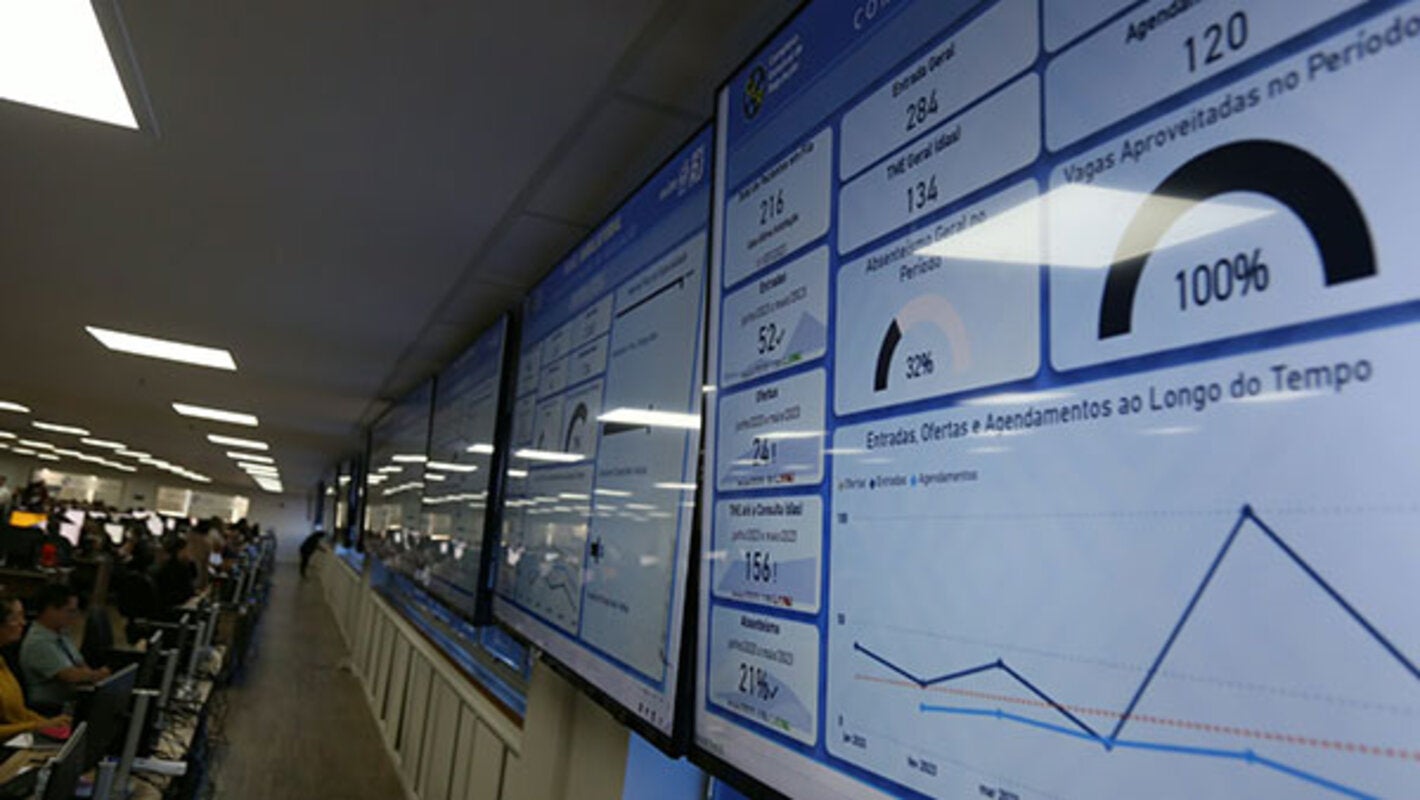
São Paulo, November 26, 2026 (BIREME/PAHO/WHO) – On October 14, 2026, BIREME/PAHO/WHO launched the new Syndromic Surveillance Window of Knowledge, a digital space that brings together and organizes scientific publications, technical documents, and experiences to support health professionals, managers, researchers, and students. Developed in collaboration with the Emergency, Arboviruses, and Health Intelligence Coordination team of the Pan American Health Organization (PAHO/WHO) and organizing members of Syndromic Collaborative, the Window of Knowledge facilitates access to information and evidence related to identifying changes in health patterns, early warning, and response to events of public health concern.
Syndromic surveillance uses information on signs, symptoms, and health records to identify trends and changes that may indicate outbreaks and other public health threats. This approach complements traditional epidemiological surveillance systems and contributes to timely event monitoring, tracking demand for health services, and decision-making.
With international coverage and a particular focus on Brazilian experiences, the new resource brings together foundational and recent publications, available in their original languages. Its thematic organization and VHL search tools allow users to explore the foundations, methodologies, applications, and technologies related to syndromic surveillance, in alignment with the One Health approach, which recognizes the connections among human, animal, and environmental health.
Five thematic areas for organizing and accessing knowledge
The resource is structured around five thematic areas covering different dimensions of syndromic surveillance, from conceptual foundations to system implementation and the use of analytical tools:
- Applications and Public Health Response: brings together studies, reviews, and experiences on the identification and monitoring of respiratory diseases, arboviral diseases, gastrointestinal outbreaks, weather-related events, disasters, and mass gatherings.
- Governance, Policies, and Strategies: presents publications on the coordination and sustainability of surveillance systems, integration of information sources, data sharing and privacy, and epidemic intelligence strategies.
- Definitions, Methods, and System Design: covers conceptual foundations and methodological studies on syndromic definitions, selection of data sources, syndrome groupings, indicators, and system planning.
- System Implementation and Evaluation: brings together studies, evaluations, and technical guidelines on the deployment and operation of syndromic surveillance systems, including data quality, usability, performance, maintenance, and experiences in health services and networks.
- Algorithms, Technologies, and Data Analysis: presents research on anomaly detection, clinical record classification, sentinel networks, and applications of natural language processing, machine learning, and spatial analysis.
In each thematic area, users can find direct links to selected literature and search tools in the Virtual Health Library (VHL), allowing them to consult reference documents and explore scientific publications related to the topic.
Technical resources and practical applications
In addition to the five thematic areas, the Window of Knowledge provides direct access to reference materials and tools to support the development and improvement of syndromic surveillance practices.
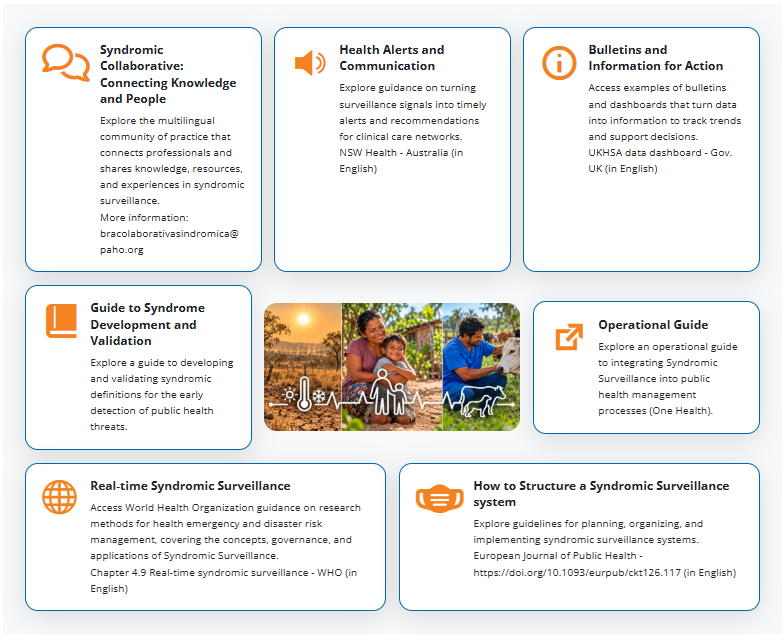
Featured content includes guidance on translating surveillance signals into alerts and recommendations for clinical care networks, examples of bulletins and information dashboards to support decision-making, and guidelines for developing and validating syndromic definitions. The selection also includes documents on establishing surveillance systems, integrating them into public health management processes, and World Health Organization (WHO) guidance on real-time syndromic surveillance.
A dedicated section, entitled “Syndromic Surveillance in Different Contexts,” presents documents illustrating practical applications of this approach in situations of public health concern.
Examples include a guide from the Commission for Environmental Cooperation on monitoring the health impacts of extreme heat, featuring experiences from Canada, Mexico, and the United States; and a case study from the U.S. Centers for Disease Control and Prevention (CDC) on monitoring a mass gathering with more than 30,000 participants, using health service data to track health conditions and inform daily reports.
The selection also includes guidance from the European Centre for Disease Prevention and Control (ECDC) on implementing syndromic surveillance in migrant reception or detention centers and refugee reception settings, as well as documents on health system contingency planning during public health emergencies, including the COVID-19 pandemic.
Launch in the context of Colaborativa Sindrômica
The new Window of Knowledge was made available on October 14, 2026, as part of the launch of Colaborativa Sindrômica, a community of practice established to connect professionals, institutions, and experts, promote the exchange of knowledge and experiences, and strengthen syndromic surveillance capacities in Brazil.
The initiative, promoted by PAHO in collaboration with institutions of Brazil’s Unified Health System (SUS) and other partners, seeks to foster coordination among different stakeholders and the sharing of resources, methodologies, and experiences related to the use of healthcare data for public health surveillance.
In this context, the new resource represents BIREME’s contribution to the organization, management, and dissemination of scientific and technical information, providing Colaborativa Sindrômica and other interested audiences with a structured collection to support access to knowledge and the use of evidence in public health.
Learn more
To learn more about the launch of Colaborativa Sindrômica, read the news article, in Portuguese, "OPAS, instituições do SUS e parceiros lançam Comunidade de Prática para Vigilância Sindrômica - OPAS/OMS | Organização Pan-Americana da Saúde". The new Window of Knowledge is available for consultation through the VHL.