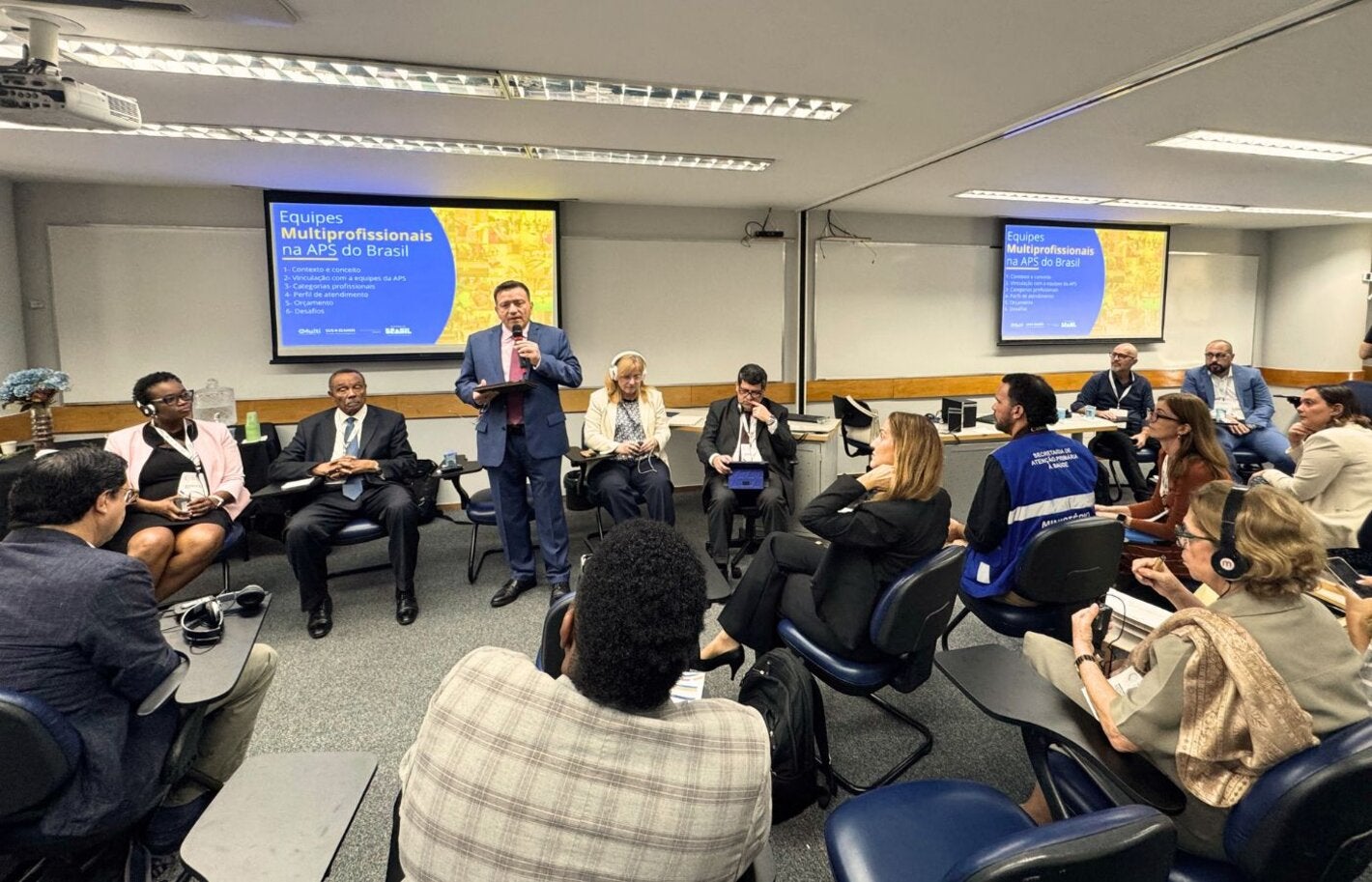
Rio de Janeiro, 27 January 2026 (PAHO)- At the II Regional Forum of the Alliance for Primary Health Care in the Americas, experts from across the Region and beyond underscored the central role of interprofessional teams in strengthening primary health care (PHC) and responding to increasingly complex population health needs.
Opening the panel on “Interprofessional Teams in Primary Health Care”, Benjamin Puertas, Unit Chief for Human Resources for Health at the Pan American Health Organization (PAHO), emphasized that while countries share a common understanding of interprofessional practice, approaches and terminology vary widely. He highlighted that interprofessional teams bring together health workers from different professions and occupations who collaborate, coordinate, and share responsibility to deliver comprehensive, people-centered care—an essential feature of effective primary health care.
The discussion explored how this concept is being implemented across diverse national and local contexts. From Brazil, Dirceu Ditmar Klitzke, Coordinator of Primary Health Care Financing Programming, Ministry of Health of Brazil, presented the country’s long-standing experience with interprofessional family health teams. He described how these teams operate in close coordination with multiprofessional teams and address a broad range of needs, including mental health, child health, rehabilitation, and chronic diseases. He also noted that sustained financing—shared across federal, state, and municipal levels—has been critical, while fostering a collaborative, non–medical-centric work culture remains an ongoing challenge.
Experiences from Paraguay highlighted the evolution of human resources for health governance and the expansion of family health teams over time. Juan Marcelo Estigarribia, Chief of Staff, Ministry of Health of Paraguay, described how the incorporation of new professional profiles, the deployment of digital health information systems, and the recognition of community health workers have strengthened interprofessional practice. At the same time, challenges persist in ensuring comprehensive teams in remote areas, embedding interprofessional education across the health workforce, and improving teamwork within the family health teams.
The panel also addressed contexts marked by fragility and crisis. Gabriel Thimothe, Director General, Ministry of Health of Haiti, outlined how insecurity, violence, and population displacement in Haiti have affected health service delivery. Despite these constraints, community-based strategies—including community health workers and mobile health teams—have helped sustain access to essential services. Strengthening coordination, supervision, and digital support were identified as critical to reducing fragmentation and ensuring continuity of care.
At the subnational level, Augusto Videira, Director of Primary Health Care, Municipal Health Secretary of Salvador, shared the experience of Salvador, a city facing significant demographic and epidemiological transitions. He emphasized that interprofessional teams are essential to respond to chronic conditions, mental health needs, and social determinants of health in a rapidly aging and predominantly Afro-descendant population. Investments in training, residency programs, governance, and digital tools were highlighted as key to consolidating collaborative practice in primary care.
From Guyana, Ertensia Hamilton, Director of Family Health Services, Ministry of Health, described how interprofessional teams are adapted to different levels of care and population needs, supporting innovative initiatives such as task shifting, community health workers career path, school-based screening and home-based care for older adults. These approaches have expanded access to comprehensive services and improved patient satisfaction, though challenges remain related to the distribution of skilled health workers, migration, and cross-sector coordination.
Bringing a global perspective, Melitta Jakab, Director, WHO EURO Specialized Centre on Primary Health Care, highlighted trends in European countries toward multidisciplinary and interprofessional teams as a way to expand the resolutive capacity of primary care. Drawing on experiences from Kyrgyzstan, Kazakhstan, and Spain, she emphasized the importance of population health management and risk stratification to ensure that interprofessional teams focus on individuals and communities with the most complex needs. Enabling factors such as supportive policy frameworks, payment mechanisms, interprofessional education, and organizational development were identified as essential for success.
In closing remarks, Benjamín Puertas underscored the need to further consolidate a culture of collaborative and interprofessional work across health systems. He highlighted the importance of investing in education, training, and continuous professional development; strengthening governance and coordination across sectors and levels of government; and tailoring team composition to local epidemiological and contextual realities. To support this, PAHO developed EqIPS—a tool for organizing and composing interprofessional teams in primary health care. Leveraging digital technologies, data-driven approaches, and innovative financing mechanisms, he noted, will be key to maximizing the impact of interprofessional teams and advancing primary health care in the Americas.