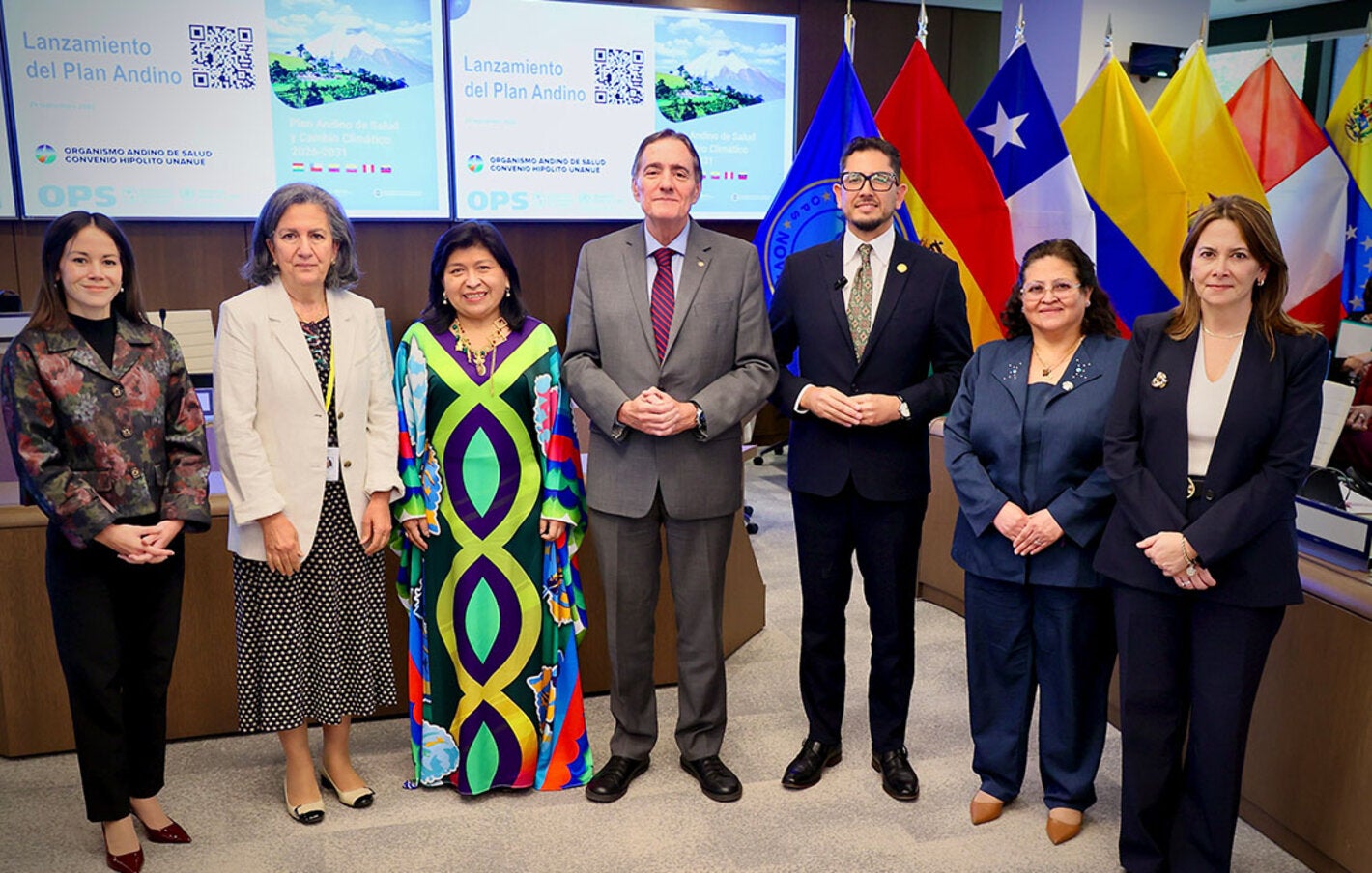
The Andean Health and Climate Change Plan 2026–2031 seeks to strengthen surveillance and early warning systems, promote climate-resilient health services, and deepen regional cooperation to address climate-related health risks.
Washington, D.C., September 30, 2026 (PAHO) – At a side event during the 63rd Directing Council, the Pan American Health Organization (PAHO), the Andean Health Organization–Hipólito Unanue Agreement (ORAS-CONHU), and health authorities from the Andean countries presented the Andean Health and Climate Change Plan 2026–2031 (PASCC), an initiative aimed at strengthening the resilience of health systems and protecting more than 173 million people from the impacts of climate change.
The plan, approved on June 12, 2026, by the health authorities of Bolivia, Chile, Colombia, Ecuador, Peru, and Venezuela during the 40th Extraordinary Meeting of Ministers of Health of the Andean Area (REMSAA) in Lima, establishes a subregional framework for strengthening the capacity of health systems to anticipate climate-related risks, prepare for them, and respond to their impacts.
Climate change poses a growing threat to health in the Andean Region. Rising temperatures, heatwaves, floods, droughts, wildfires, and other extreme events affect the availability of water and food, worsen air quality, and contribute to the spread of climate-sensitive diseases. These impacts also threaten health infrastructure and services.
“PAHO has supported Andean countries through technical cooperation, capacity building, evidence generation, and the development of surveillance systems,” said PAHO Director Dr. Jarbas Barbosa. “The plan will strengthen health-sector leadership in climate action, advance integrated surveillance and early warning systems, and support the transition toward more resilient and sustainable health services,” he added.
“An alert without a team, a protocol, and the resources to respond remains just information. Science can give us time to act; cooperation among the six countries must turn that time into protection for the communities most at risk,” said ORAS-CONHU Executive Secretary Fernando Araos Dattoli.
The PASCC 2026–2031 establishes a common framework for improving adaptation, increasing resilience, and strengthening the capacity of health systems to respond to climate-related risks. It also promotes measures to progressively reduce the environmental footprint of the health sector and strengthen its leadership in climate policies across the subregion.
The strategy is structured around three priority areas: strengthening health-sector leadership in climate change policies; improving surveillance, information, and evidence generation to guide decision-making; and advancing adaptation, resilience, and mitigation measures to reduce the vulnerability of populations and health systems.
Among other actions, the plan calls for expanding regional monitoring, early warning, and response systems for climate-related health events, as well as strengthening information exchange and cooperation among Andean countries.
The PASCC 2026–2031 also incorporates a One Health approach, recognizing the interdependence of human, animal, and environmental health, and places particular emphasis on populations that are more vulnerable to the impacts of climate change.
Building on progress
The new plan builds on work carried out under the Andean Health and Climate Change Plan 2020–2025, developed jointly by the ministries of health of the Andean countries, ORAS-CONHU, and PAHO. An evaluation of the previous plan identified progress in capacity building, regional cooperation, and intersectoral coordination, as well as persistent challenges related to financing, human resources, and the political positioning of the health and climate change agenda.
The PASCC 2026–2031 was developed through a participatory process led by the Andean Committee on Health for Emergency and Disaster Risk Management and Climate Change, under the coordination of the ORAS-CONHU Executive Secretariat and PAHO. PAHO contributed technical evidence, facilitated the exchange of regional experiences, and supported the definition of priorities and lines of action to improve adaptation and increase the resilience of health systems.
The plan also falls within the framework of the Subregional Cooperation Strategy for South America 2026–2031, which guides joint efforts to strengthen resilient health systems, reduce inequalities, and respond in a coordinated manner to climate and environmental risks.
It is aligned with key international commitments on health and climate, including the Sustainable Development Goals (SDGs), the Paris Agreement, the Sendai Framework for Disaster Risk Reduction, the World Health Organization’s Global Action Plan on Climate Change and Health, PAHO’s Policy on Equity and Climate Change, and the Belém Health Action Plan for the Adaptation of the Health Sector to Climate Change.
Participating authorities
The presentation of the Andean Health and Climate Change Plan 2026–2031 included Bolivia’s Minister of Health and Sports, Marcela Flores Zambrana; Chile’s Minister of Health, May Chomalí Garib; Colombia’s Minister of Health and Social Protection, Ana María Vesga Gavira; and Venezuela’s Vice Minister of Comprehensive Health, Nolly Fernández.
The event also featured video messages from Ecuador’s Minister of Public Health, Juan Carlos Aveiga Parra, and Peru’s Minister of Health, Luis Williams Dyer Fernández.