
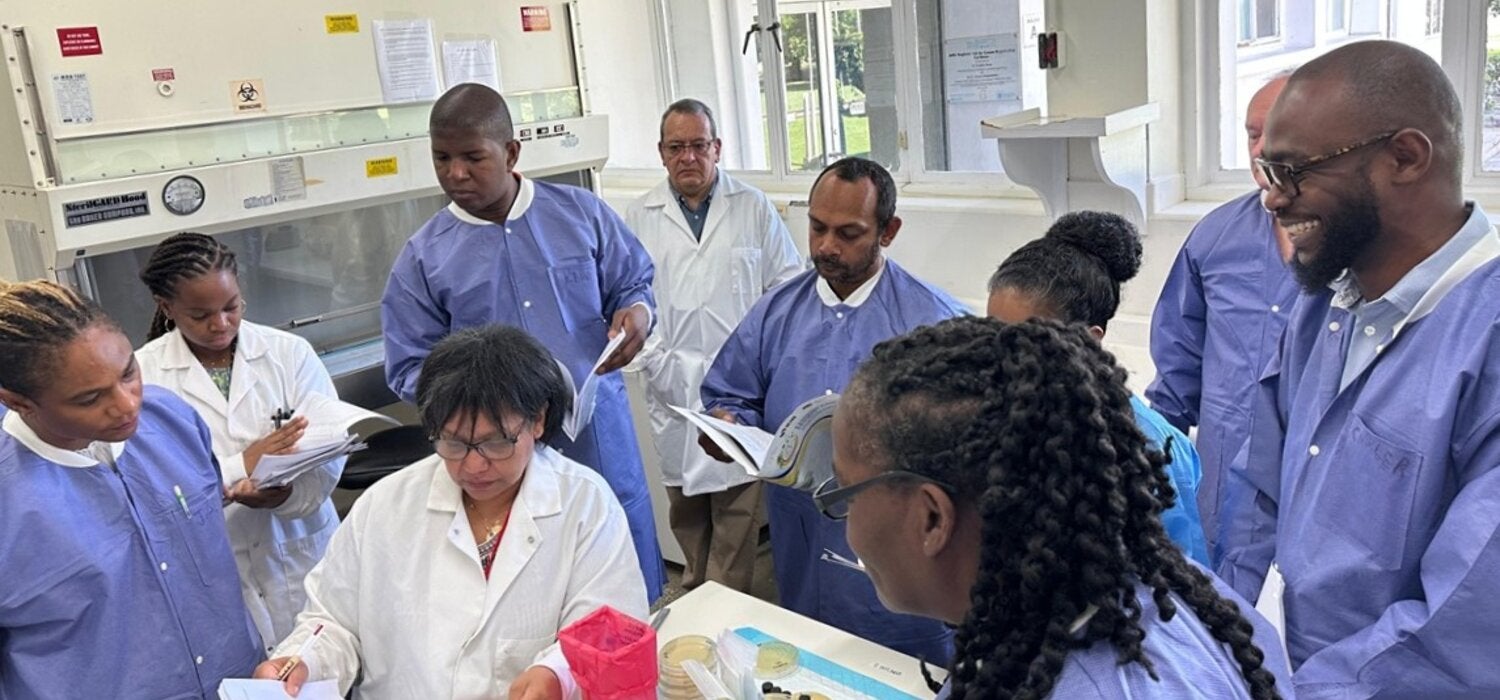
Across the Caribbean, hospitals are encountering a growing threat: infections that resist even the strongest antibiotics. Where a simple treatment once worked, doctors now face bacteria that survive every drug they try. These “superbugs” are no longer rare, and the consequences are becoming harder to ignore. For clinicians and patients, treatment challenges bring real risk. For laboratories, they bring new urgency: How do we detect these resistant organisms quickly? What drugs will work? And will those medicines even reach our countries?
To answer these questions, the Pan American Health Organization (PAHO), through its ReLAVRA+ laboratory surveillance network, has entered a scientific and strategic collaboration with the Global Antibiotic Research & Development Partnership (GARDP). At the centre of this effort is the characterisation of carbapenem-resistant organisms, that is, bacteria that can evade even the strongest antimicrobial drugs normally reserved for critical care.
These pathogens are being analysed using clinical isolates shared with PAHO’s regional laboratory. For Marcelo Galas, Technical Officer on Antimicrobial Resistance Surveillance, AMR Special Program at PAHO/WHO, the work is both scientific and urgent: “We are seeing organisms that no longer respond to first, second, or even third-line antibiotics. What used to be rare is no longer rare.” Early results show the increasing circulation of bacteria that produce enzymes capable of breaking down last-line antibiotics before they can be effective. Some resistance patterns mirror global trends, while others show emerging regional signatures unique to the Caribbean.
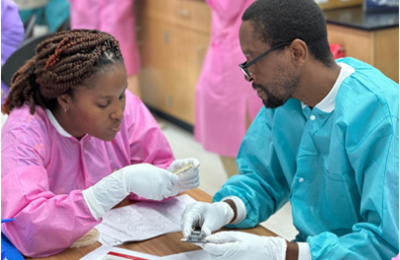
This knowledge has a tremendous impact. When laboratories understand the mechanisms behind resistance, countries are better equipped to choose cost-effective diagnostic tools, update treatment decisions, and advocate for access to life-saving medicines. Scientific evidence becomes a bridge between laboratory benches and hospital wards. It also becomes a lever for equity.
One treatment now in focus is cefiderocol, developed for multidrug-resistant Gram-negative infections. But like many advanced antimicrobials, it is most accessible to countries with large markets or high purchasing power. Without evidence, small states risk being overlooked, even when their patients need these drugs the most.
“Surveillance data supports equity,” says Galas. “When we can show evidence of gaps, we can make a better case for improving access.” That is where this collaboration becomes more than detection - it becomes advocacy. It helps ensure that Caribbean nations are not left behind as new treatments emerge.
The partnership is also guiding countries on the diagnostic front. Carbapenem-resistant organisms require precise laboratory methods to detect them rapidly. With support from PAHO, GARDP, and investments through the Fleming Fund, Caribbean laboratories are adopting modern instruments and improving workflows to reduce delays. A stronger surveillance network means more reliable diagnostics, faster alerts, better treatment guidance, and ultimately, better patient outcomes.
While resistance spreads quietly through food chains, healthcare systems, communities, and borders, the Caribbean is choosing to respond loudly - with data, collaboration, and shared scientific capacity. The partnership between PAHO’s ReLAVRA+ network and GARDP shows how surveillance, laboratory science, and fairness intersect: data guides treatment, treatment access supports equity, and equity strengthens public health.
Through this collaboration, Caribbean laboratories contribute to global AMR solutions, and in turn, benefit from tools, evidence and access to future treatments. In the fight against superbugs, knowledge is power, and this initiative helps ensure that power is shared with the countries that need it most.