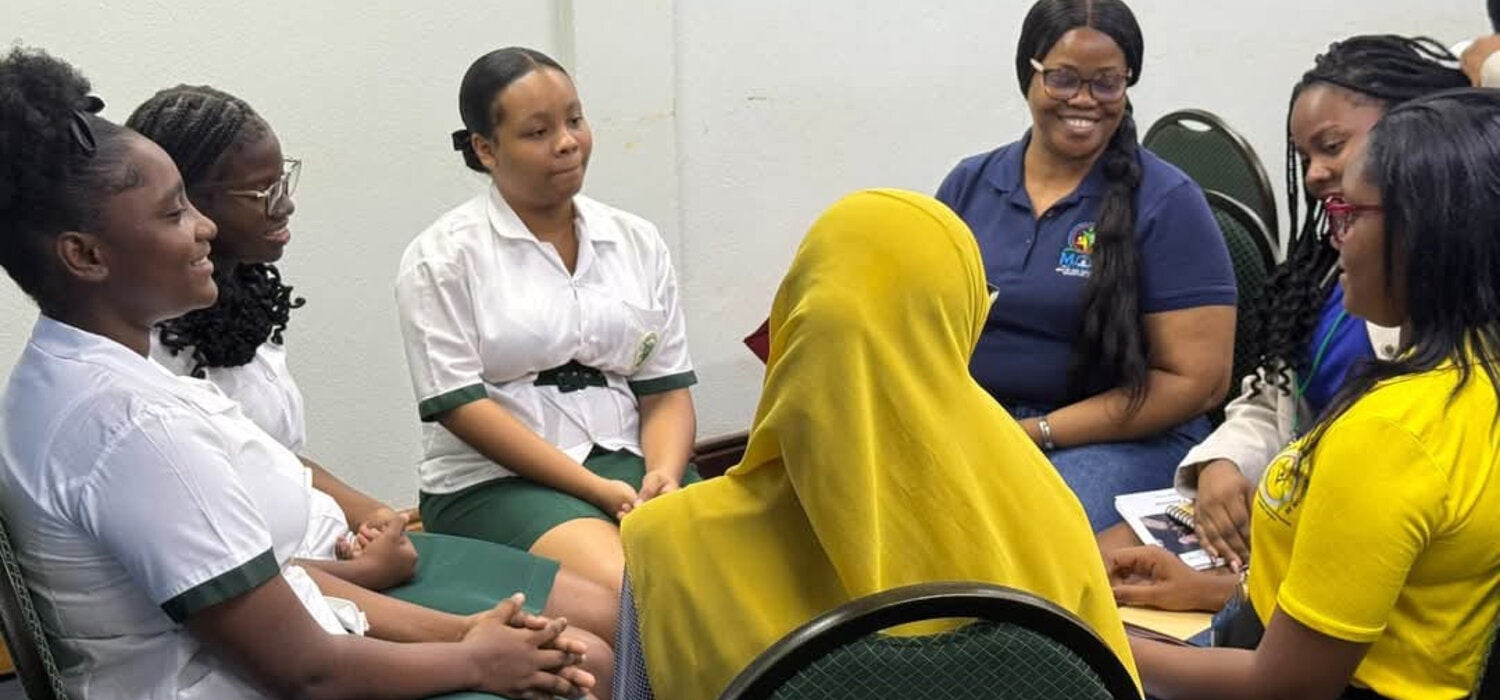
Guyana expands mental health training for teachers and health professionals to help detect and support youth in distress
Guyana expands mental health training for teachers and health professionals to help detect and support youth in distress
October 2025
Facing one of the world’s highest suicide rates, with support from the Pan American Health Organization (PAHO) and UNICEF, Guyana is advancing efforts to better equip teachers and health workers to identify and address mental health issues early—before they reach crisis levels.
“Once upon a time, mental health was seen only as something that affected certain people. There was shame and silence, because nobody wanted to say, ‘I need help’,” explains Dr. Esther Ward, a lecturer at Guyana’s Cyril Potter College of Education (CPCE), who is one of the educators leading a mental health transformation.
Last year, thanks to a PAHO and UNICEF joint program to address mental health and psychosocial conditions in adolescents, Dr. Ward joined the National Mental Health Training Program, which brings together educators, counselors, and health workers to build practical skills in identifying and managing mental distress. She then helped the CPCE build its Health and Family Life Education program to introduce new tools and approaches to strengthen emotional awareness, cultural sensitivity, and early detection of mental health issues among children and adolescents.
“What we needed was more listening,” she says.
Dr. Ward trains teachers, counselors, and administrators to recognize the signs of emotional distress in children.
National challenge and a community approach
High suicide rates in Guyana reflect deep social and economic challenges—including cultural factors—that include limited access to care, substance abuse, and stigma. The government’s National Mental Health and Suicide Plan (2024–2030) calls for more community-based and school-centered programs. PAHO supports Member States like Guyana with mental health and suicide prevention programs to scale up training, expand counseling services, and promote early identification of depression and anxiety among youth.
“We’ve achieved something important—getting others to understand that mental health is not just about ‘my people,’ but for all people,” says Dr. Ward, who also trains teachers, counselors, and administrators to recognize the signs of emotional distress in children, especially those from rural Guyana—where cultural barriers and remoteness often limit access to professional help.
Dr. Esther Ward, a lecturer at Guyana’s Cyril Potter College of Education (CPCE), who is one of the educators leading a mental health transformation.
Last year alone, CPCE trained more than 2,000 teachers, half of them from schools in Guyana’s hinterlands. By next year, the college hopes to reach every teacher in the country. A new bachelor’s degree in health education along with a dedicated module on mental health is in development and set to launch in 2026.
“Many of our students come from Guyana’s hinterland communities where mental health is misunderstood and people end up suffering in silence,” says Dr. Ward. “This course helps teachers become culturally aware and responsive so they can offer real support.”
Guyana’s cultural diversity—spanning Amerindian, Afro-Guyanese, and Indo-Guyanese as well as other ethnicities like Chinese and Portuguese—shapes how people perceive and respond to mental health issues. In some communities, mental anguish may be misunderstood, minimized, or attributed to spiritual causes, creating barriers to seeking help.
“Culture is the total of one’s experience,” Dr. Ward explains. “Professionals who have not been exposed to certain traditions may fail to recognize red flags or know how to respond. Our training promotes culturally aware and responsive teachers—people who understand that a student’s background shapes how they communicate and cope.”
The courses enhances cultural awareness for Guyana’s teachers, which helps them build trust and empathy to ensure that students—especially those far from urban centers—feel understood and supported. One of the most powerful lessons emerging from CPCE’s mental health curriculum is the value of confidentiality and trust.
Beyond Guyana
PAHO launched Improving the Mental Health of Children and Adolescents in Primary Care, an online course aimed at improving the identification and care of mental health conditions in children and adolescents. Designed for primary health care workers, the course responds to the need for early detection and intervention of mental health problems that often begin in childhood.
This year’s World Mental Health Day—October 10—emphasizes children's mental health as a fundamental human right and underscores its role in sustainable social and economic development. Children and adolescents represent 35% of the population in the Region of the Americas. Their mental health needs are often overlooked. In fact, depression and anxiety are among the leading causes of years with disabilities for those aged 15 to 24. Suicide is the third most common cause of death, in the same group.
Hosted on PAHO’s Virtual Campus for Public Health, the course is expected to strengthen the capacity of health services to respond effectively and in a timely manner to the needs of this population. The self-paced program offers 10 modules covering anxiety, depression, trauma, substance use, developmental disorders, ADHD, autism, and suicide prevention.
The course combines theory and practice through interactive videos, case studies, and practical tools to help participants recognize warning signs and take appropriate action in primary care and school settings. PAHO developed the course to bridge the gap between the growing demand for mental health services and the limited availability of specialized care. The early signs of mental health conditions often appear at ages when intervention is possible and can lead to positive outcomes.
“When the teachers know these cues, they understand different perspectives and can safely say, ‘this person is having a breakdown’ or that ‘this person is suffering a mental health condition’,” says Dr. Ward.