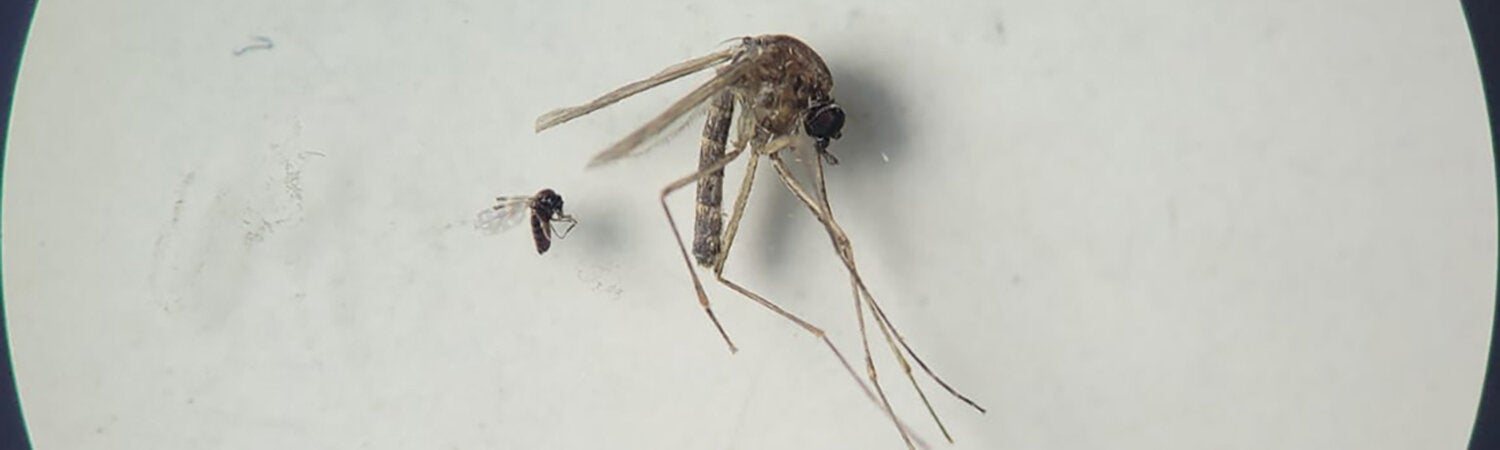
Oropouche virus disease (OROV) is a febrile infection caused by an arbovirus of the genus Orthobunyavirus, belonging to the family Peribunyaviridae. First identified in 1955 in Trinidad and Tobago, OROV has caused cases and outbreaks in several South American countries, including Brazil, Colombia, Ecuador, French Guiana, Panama, Peru and Venezuela. Outbreaks have been most frequent in the Amazon Basin region, where the most known vector, the midge (Culicoides paraensis), maintains a sylvatic cycle involving hosts such as sloths and non-human primates.
Symptoms of Oropouche fever include sudden fever, severe headache, extreme weakness (prostration), joint and muscle pain. In some cases, photophobia, dizziness, persistent nausea or vomiting, and low back pain may occur. Fever usually lasts up to five days. Although serious complications are rare, the disease can progress to aseptic meningitis, which usually manifests in the second week of illness, prolonging recovery by weeks. Up to 60% of cases are reported to have relapses of symptoms in the weeks following recovery.
The increased spread of OROV is linked to a variety of environmental and human factors. Climate change has intensified rainfall and temperatures, while deforestation and urbanization have altered the natural habitats of vectors and hosts, favoring interaction between them and increasing the risk of transmission.
To control the spread of OROV, vector prevention and control measures are recommended. This includes strengthening entomological surveillance, reducing midge populations, and educating the population on personal protection measures. Specific recommendations include using fine-mesh mosquito nets on doors and windows, clothing that covers arms and legs, repellents with DEET or icaridin, and fine-mesh nets over beds or sleeping areas.
Since late 2023, outbreaks of Oropouche virus disease have been reported in several countries in South America and the Caribbean, including areas with no previous history of this disease. Go to the cases and deaths dashboard (in Spanish).
According to a PAHO Public Health Risk Assessment (August 2024) in Brazil, one fetal death and one miscarriage have been reported in the state of Pernambuco , as well as four cases of newborns with microcephaly possibly linked to OROV. A similar outbreak occurred in Manaus between 1980 and 1981, with nine infected pregnant women, two of whom suffered miscarriages.
Confirmation of Oropouche disease is done by molecular and serological testing in laboratories with adequate capacity; there is no rapid test available.
There is no specific treatment or vaccine for Oropouche. Management includes rest, hydration, and the use of medications to control fever and pain, as well as monitoring for possible complications.
Four genotypes of Oropouche virus have been identified. Infection with any of these genotypes should induce antibody production, providing protection against future reinfection.
Oropouche virus is a re-emerging virus in the Americas, transmitted to people mainly through infected midges and some species of mosquitoes. Oropouche has been observed to be emerging outside the Amazon Basin, in previously unaffected areas.
In addition, as of September 2024, two deaths in infected persons have been reported so far in Bahia, Brazil. Infection during pregnancy has been linked to fetal death and possible birth defects. Neurological cases (Guillain Barre syndrome) possibly associated with OROV infection are also under study.
Transmission
OROV is transmitted mainly through the bite of the midge Culicoides paraensis, which inhabits wooded areas and near bodies of water, and certain mosquitoes such as Culex quinquefasciatus. Viral circulation is suspected to include both sylvatic and urban cycles. In the jungle cycle, primates, sloths and possibly some birds act as vertebrate hosts. In the urban cycle, humans are the amplifying host. Vertical (mother-to-child) transmission has been documented recently and is still under investigation.
Symptoms
Symptoms are similar to those of dengue and begin four to eight days after the infecting bite. Signs include sudden fever, severe headache, extreme weakness (prostration), joint and muscle aches, chills, nausea, diarrhea, and persistent vomiting. Approximately 60% of cases experience relapses of symptoms weeks after recovery. Although most recover within a week, some patients have a prolonged convalescence. Serious complications, such as aseptic meningitis, are rare, but may occur in the second week of illness.
Treatment and vaccine
There is currently no specific treatment or vaccine against Oropouche virus. Management of the disease is supportive and focuses on symptom relief, such as rest, hydration and the use of fever and pain medications, as well as monitoring the patient for possible complications, such as arterial hypotension, intense sweating leading to rapid dehydration and especially nervous system manifestations, such as meningitis, meningoencephalitis and Guillain-Barré syndrome. In case of severe manifestations, cases should be hospitalized.
Recommendations
- Vector control: Strengthen entomological surveillance, reduce mosquito and gnat populations, and educate the population on personal protective measures.
- Preventive measures for travelers: Travelers to affected areas should take precautions against insect bites, using repellents with DEET or icaridin, protective clothing and mosquito nets.
- Recommendations for pregnant women: According to the U.S. Centers for Disease Control and Prevention (CDC), pregnant women are advised to reconsider non-essential travel to areas with a Level 2 Travel Health Advisory for Oropouche virus due to the risk of mother-to-child transmission.
Case Definition for Oropouche
Person who presents with acute onset fever (or history of fever) of up to 5 days duration associated with intense headache and two or more of the following manifestations:
- Myalgia or arthralgia
- Chills
- Photophobia
- Dizziness
- Retroocular pain
- Nausea, vomiting or diarrhea (diarrhea is defined as three or more episodes in 24 hours and change in stool consistency)
- Any nervous system manifestation (diplopia, paresthesia, meningitis, encephalitis, meningoencephalitis)
*It is important to note that up to 60% of Oropouche cases may experience a relapse of symptoms between 1 and 10 days after clinical improvement. In cases where Oropouche was not initially suspected, these patients should be reclassified as suspected cases. Given the clinical similarities between Oropouche and dengue, it is essential to conduct a thorough differential diagnosis, ensure close follow-up and monitoring, and assess for warning signs that may indicate dengue rather than Oropouche.
Headache is typically severe and often localized to the posterior (parieto-occipital) region. It commonly persists even after the fever subsides. A severe headache is defined as a pain score of 7 on a 1-to-10 scale. Myalgia and arthralgia are generally diffuse. Unlike chikungunya, arthralgia in Oropouche does not present with inflammatory signs. Patients frequently report neck pain and lower back pain.
Any suspected case that also presents at least one of the following criteria:
- Lives in or has traveled to an area of confirmed transmission of Oropouche cases.
- Has an epidemiological link with a confirmed case of Oropouche.
- Has a positive IgM ELISA test for Oropouche.
Any suspected case that also presents any of the following criteria:
- Has a positive result for the detection of OROV, viral RNA (RT-PCR), or for viral antigens.
- Presents an antibody seroconversion or an increase in antibody titer of at least 4 times in paired samples taken more than 7-10 days apart (and a convalescent sample taken more than 14 days after the onset of symptoms) (25).
- Post-mortem determination of viral RNA by RT-PCR or demonstration of antibodies or antigens by immunohistochemical or other available tests in deceased patients with suspected OROV infection.
- In cases of patients with suspected OROV encephalitis, the result of a positive IgM test in cerebrospinal fluid (CSF) is considered positive.
Case Definition for Vertical Transmission of Oropouche Infection
A. Pregnant women suspected to have Oropouche virus infection +
a. Pregnant women with signs and symptoms consistent with Oropouche infection with exposure in an area with potential circulation (travel or local exposure).
- Recommend to follow the diagnostic testing algorithm.
OR
b. Pregnant women with fetuses with findings of concern on prenatal images.
- Evidence of Central Nervous System defects (such as microcephaly, hydrocephaly) or hydrops.
- Recommend IgM testing of serum (knowing that it is not currently available everywhere)
- Consider RT-PCR testing of amniotic fluid (if appropriate)
B. Fetal or stillbirths suspected to have Oropouche virus infection +
a. Fetal demise/stillbirth in pregnant women with signs and symptoms consistent with Oropouche virus infection.
b. Fetal demise/stillbirth with findings of concerns as evidence of central nervous system defects (such as microcephaly, ventriculomegaly, hydrocephaly) or other associated symptoms (arthrogryposis, macular atrophy), or hydrops.
Recommend testing:
- Fetal tissue, placenta, cord blood, CSF, serum or urine by RT-PCR
- Maternal serum for IgM, urine, and amniotic fluid for viral RNA by RT-PCR
C. Live born infants suspected to have Oropouche virus infection +
a. Livebirths of mothers with laboratory evidence of Oropouche virus infection in pregnancy.
- Recommend RT-PCR on serum and urine, and IgM testing on serum.
OR
b. Livebirths with central nervous system defects such as microcephaly, ventriculomegaly, hydrocephaly or other associated symptoms (arthrogryposis, macular atrophy) or hydrops up to one year of age.
Recommendations
- Clinician suspicion should be heightened for infants with cortical atrophy with minimal to no cortical calcifications and cystic lesions
- Recommend RT-PCR on serum and urine, and IgM testing on serum
- Consider RT-PCR and IgM on CSF (if available)
- Maternal serum should be tested by IgM for serologic evidence of infection if not already testing
- Other infections should be considered and tested for
Additional considerations
Research studies should be conducted of pregnant women with potential exposure to Oropouche virus to better define spectrum of congenital infections.