
Participation
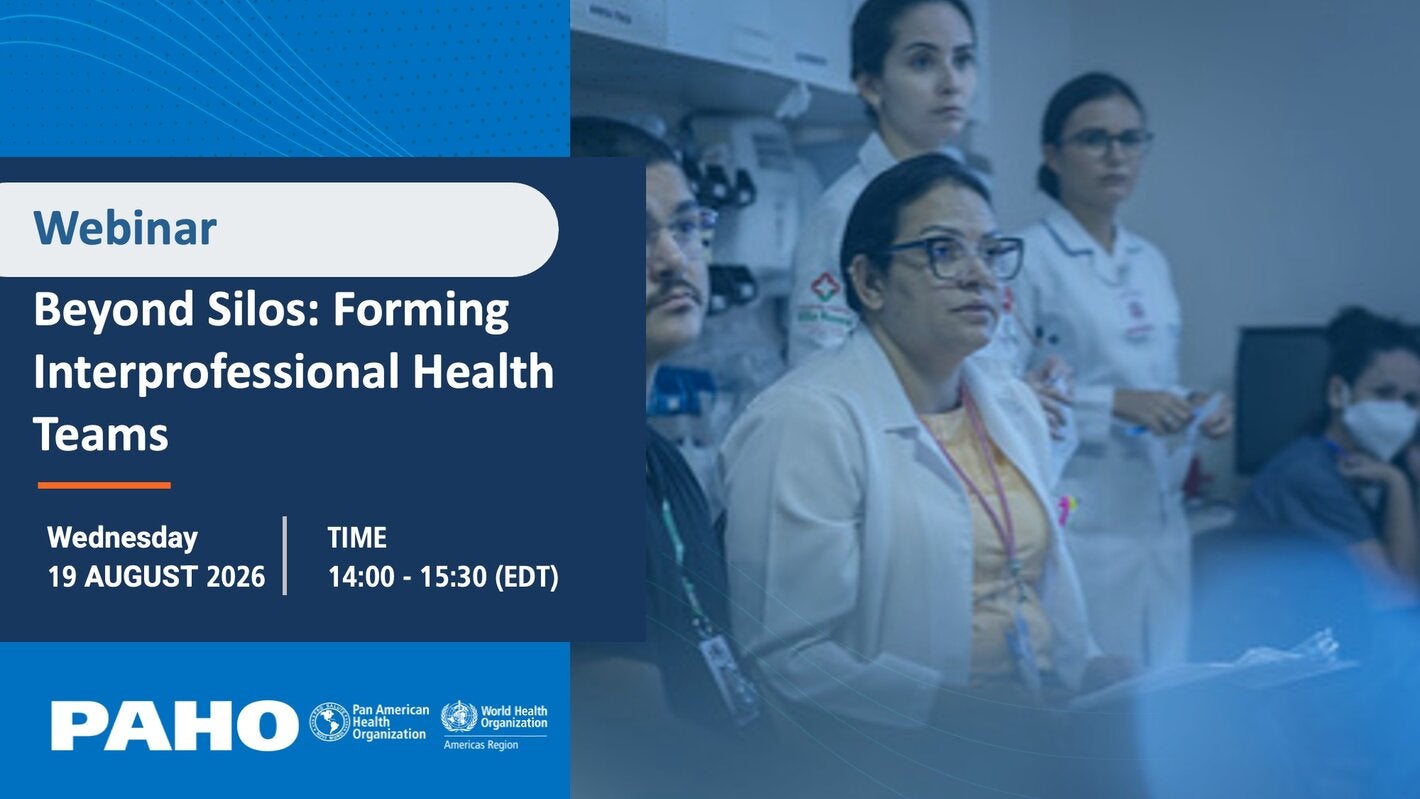
- DATE: Wednesday, 19 August 2026
- TIME: 14:00–15:30 (EDT)
- OTHER TIME ZONES: Buenos Aires, Brasilia (15:00–16:30), Mexico City (12:00–13:30), Bogotá, Kingston, Lima, Panama City (13:00–14:30).
- PLATFORM: ZOOM (with registration)
- LANGUAGE: Simultaneous interpretation will be available in English, Spanish, and Portuguese.
Background and rationale
Strengthening health systems in the Americas, based on Primary Health Care (PHC), requires a workforce capable of performing effectively within Integrated Health Services Networks (IHSN). The fragmentation of services is one of the main obstacles to the equity and efficiency of the Region’s health systems. Addressing this structural challenge requires shared responsibility between the education sector and the health sector to train professionals who, in addition to possessing technical excellence, are prepared for collaborative practice that guarantees continuity of care throughout the network.
In this context, PAHO’s Policy on the Health Workforce 2030: Strengthening Human Resources for Health to Achieve Resilient Health Systems (Document CD60/6, approved by the Member States in 2023) establishes clear strategic lines to strengthen the sector’s governance and regulatory mechanisms. This policy promotes the development of interprofessional teams, enhanced capacity building, and decent working conditions that protect the physical and mental integrity of health personnel, in full alignment with the PHC-based models that guide the Region toward achieving universal health coverage (UHC) and the Sustainable Development Goals (SDGs).
In line with this normative framework, PAHO’s Human Resources for Health Unit (HSS/HR) has led a strategic agenda aimed at the institutionalization of Interprofessional Education (IPE) as a driver of change in the Region of the Americas. Through sustained technical cooperation and the promotion of collaborative networks, the Unit fosters the transition from fragmented training models toward the establishment of interprofessional teams capable of responding to the complexity of today’s health services. This effort has helped raise the visibility of the importance of collaborative practice for patient safety and lay the foundations for workforce governance that prioritizes education–service integration and coordinated performance at all levels of care.
Purpose
This webinar will bring together PAHO and regional experts to examine strategic options aimed at advancing the institutionalization of Interprofessional Education in the Americas. The event is conceived as a high-level technical space to address educational fragmentation and and strengthen the Interprofessional Health Education Network, mobilizing leaders, educators, and managers around a common agenda that positions IPE as a strategic tool for strengthening IHSN.
The relevance of this initiative rests on four strategic dimensions:
- Continuity of the training pathway: Promote the integration of IPE across undergraduate, postgraduate, and continuing education, ensuring that health professionals develop a collaborative identity aligned with PHC values from the beginning of their training.
- Shared responsibility in transforming models: Advance a vision in which the education sector trains profiles oriented toward network-based work, while the health sector evolves toward management models that encourage interprofessional collaboration and dismantle the structural barriers that fragment care.
- Engagement with decision-makers for policy convergence: Foster dialogue with decision-makers to align education and health policies, ensuring that professionals find work environments that promote comprehensive, coordinated care.
- Sustainability and efficiency of health networks: Unify criteria between training and services under the PHC approach to optimize team performance within IHSN, with a direct impact on solving complex problems, patient safety, and reducing service fragmentation.
This event is organized by the Department of Health Systems and Services (HSS) of the Pan American Health Organization (PAHO/WHO); and the PAHO/WHO Collaborating Center for the Transformation of Health Sciences Education, Universidad Nacional del Litoral (CC ARG-79).
Objectives
- Examine the current state of IPE institutionalization in the Region of the Americas, including progress, synergies, and persistent barriers.
- Analyze the contribution of interprofessional collaborative practice to quality of care and patient safety, drawing on documented experiences from countries of the Region.
- Examine how PAHO’s Policy on the Health Workforce 2030 provides a normative and strategic framework for the operationalization of IPE at the regional level.
- Identify emerging priorities and concrete opportunities for educational innovation within the framework of IPE.
- Generate regional commitments aimed at consolidating the Interprofessional Health Education Network in the Americas as a sustainable mechanism for collaboration, exchange of experiences, and capacity building in IPE.
Agenda
Topic
Welcome and technical instructions
Yohana Díaz de Valle, Advisor, Professional Education, Human Resources for Health Unit, PAHO/WHO
Opening remarks.
Benjamín Puertas, Unit Chief, Human Resources for Health, PAHO/WHO
Panel 1: The tension that moves us. Can the education system and the health system stop training in parallel?
(1) Voice of the education sector: “we train for the future, but the health system is not ready to receive them”.
José Rodrigues Freire Filho, University of São Paulo (USP), Brazil.
(2) Voice of the health sector: “we need teams that already work together, but we are getting professionals in silos”.
Josip Espinosa, National Sub-directorate of Primary Care, Caja de Seguro Social, Panama.
(3) Voice of those who are being trained today: what do the student really receive?
Naomi Bolastig, Master of Occupational Therapy Student, University of Toronto, Canada
Technical Dialogue: Interprofessional Education, from Classroom to Practice
(1) IPE across the different levels of education: How can IPE articulate undergraduate, graduate, and continuing education to respond to the current challenges of health systems?
Larisa Carrera, PAHO/WHO Collaborating Centre, Universidad Nacional del Litoral
(2) Capacity building with an interprofessional perspective through the VCPH: How can we support the development of competencies in interprofessional teams at the regional scale?
Gabriel Listovsky, Chief of the Special Program PAHO Virtual Campus for Public Health
Open plenary dialogue
What are we willing to stop doing to go beyond silos?
All panelists
Moderation: Yohana Díaz de Valle, Advisor, Professional Education, Human Resources for Health Unit, PAHO/WHO; and Sebastián Oleas, International Consultant, Human Resources for Health Unit, PAHO/WHO
Closing remarks
Giovanni Escalante. Representative, of the PAHO/WHO Office in Chile