
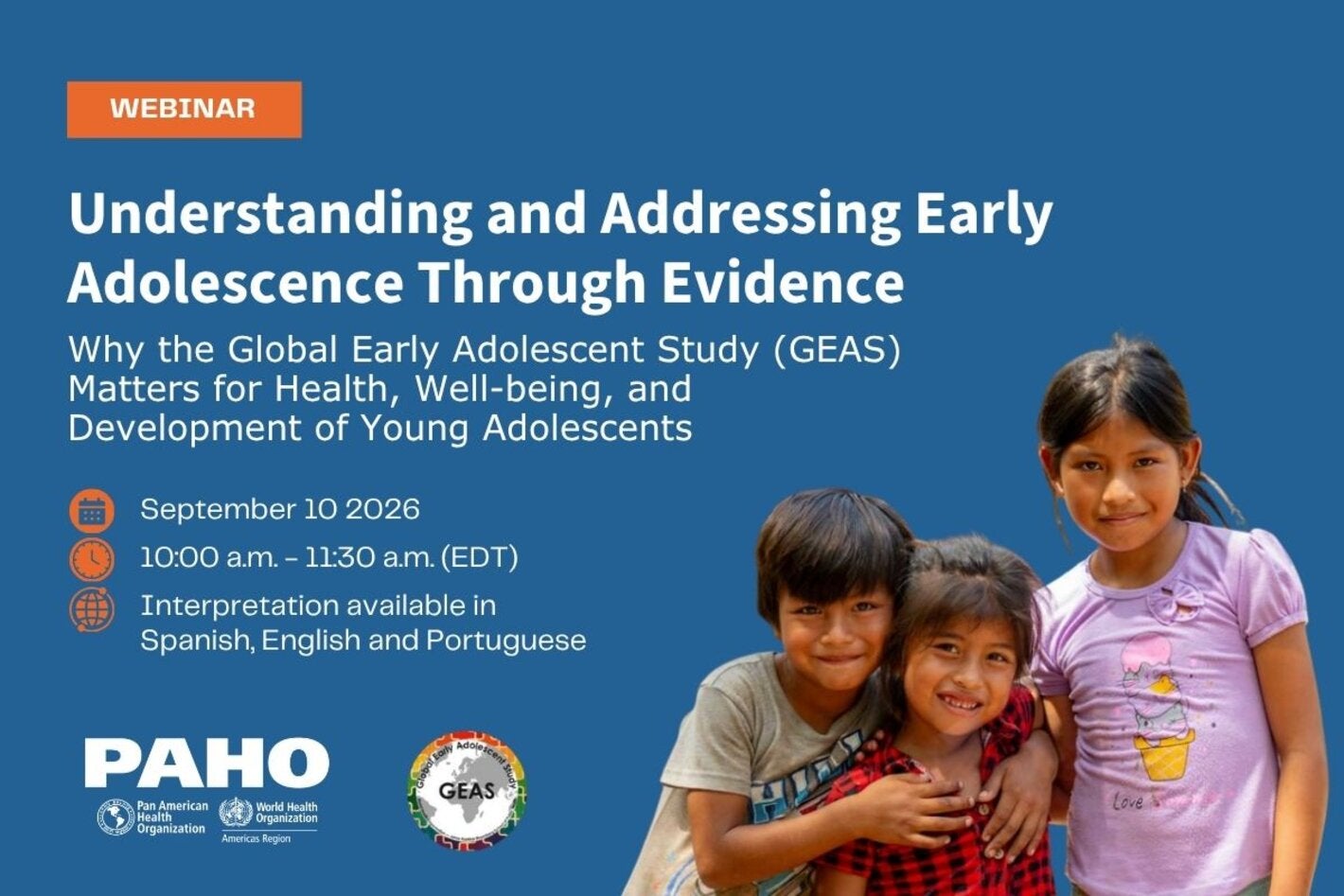
Join us on Thursday, September 10, at 10:00 a.m. (Washington, D.C. time) for the webinar on "Understanding and Addressing Early Adolescence Through Evidence".
Background
Despite its importance, early adolescence remains one of the least studied periods of the life course. Policymakers and program planners often lack robust evidence on the experiences, aspirations, social influences, and developmental trajectories of younger adolescents, particularly in low- and middle-income countries.
The Global Early Adolescent Study (GEAS) is a longitudinal research initiative conducted in 10 countries and 12 sites, including three in Latin America and the Caribbean, in a collaborative effort between the Johns Hopkins Bloomberg School of Public Health, academic institutions, and program implementors.
The study seeks to generate a better understanding on: 1) how gender socialization occurs in early adolescence; 2) how gender norms and attitudes shape adolescent development and well-being; 3) how these evolving norms and attitudes shape health trajectories as individuals transition through adolescence into adulthood; and 4) appropriate measures and methods for research on these issues for this age group. It has also been used to evaluate gender-transformative interventions in several sites, granting insight into how programs work differently by context, gender, and target health outcome.
The first decade of global investment in adolescent health has highlighted the need for stronger evidence on the experiences and needs of younger adolescents. Traditional health indicators alone do not adequately capture the social and developmental factors that influence adolescent outcomes.
This webinar aims to strengthen the design of interventions that respond to the realities of young adolescents through sharing of the lessons learned from the the Global Early Adolescent Study. It will highlight global lessons learned as well as experiences from Chile, Jamaica, and Brasil.
How to participate
DATE: Thursday, September 10, 2026
TIME: 10:00 - 11:30 a.m. (EDT)
LANGUAGES: Interpretation will be available in English, Portuguese and Spanish.
Objectives
- Present the rationale, design, and evolution of the Global Early Adolescent Study.
- Highlight key global and regional finding and lessons learned related to early adolescent development, gender norms, social environments, and well-being.
- Discuss how GEAS evidence can help strengthen the regional response to early adolescence
- Promote dialogue among researchers, policymakers, practitioners, and youth advocates on priorities for adolescent health research and action in LAC.
Target audience
- Ministry of Health officials
- Adolescent health focal points
- Researchers and academic institutions
- Public health professionals
- Education sector representatives
- Youth-serving organizations
- Development partners
- United Nations agencies
- Civil society organizations
- Youth and adolescent representatives
Agenda
10:00 a.m. - 10:05 a.m.
Logistics and objectives
Dr. Sonja Caffe, Senior Advisor on Adolescent Health, Life Course, Women's and Children's Health Unit (HL), PAHO/WHO
10:05 a.m. - 10:15 a.m.
Opening Remarks
Dr. James Fitzgerald, Director, Health Systems and Services Department (HSS), PAHO/WHO Dr. Kristin Mmari, Co-principal Investigator GEAS
10:15 a.m. - 10:25 a.m.
Presentation - Introduction to the Global Early Adolescent Study (GSEAS) and Major Findings
Dr. Kristin Mmari
10:25 a.m. - 10:55 a.m.
Panel discussion with LAC implementation sites
• Moderator: Dr. Daniel Antiporta, International Advisor, PAHO-Ecuador
• Dr. Matilde Maddaleno Herrera Facultad de Ciencias Medicas, Universidad de Santiago
• Dr. Abigail Harrison University of the West Indies, Mona
• Dr. Cristiane da Silva Cabral School of Public Health, University of Sao Paulo
10:55 a.m. - 11:15 a.m.
Panel discussion: Implications for policies & programs
Dr. Kristin Mmari, GEAS Dr. Aysa Saleh Regional Gender Advisor, PAHO/WHO Dr. Maria del Carmen Calle President IAAH Ms. Cilandell Glen Adolescent Health Coordinator, Guyana Mackdiel Romero Youth Leader Mexico, PAHO Youth for Health Group (PYHG member),Ministry of Health Brazil
11:15 a.m. - 11:25 a.m.
Audience Q&A and discussion
All
11:25 a.m. - 11:30 a.m.
Closing Remarks
Dr. Sonja Caffe, Senior Advisor on Adolescent Health, Life Course, Women's and Children's Health Unit (HL), PAHO/WHO