
Watch the recording
Innovative Format: The “Digital Health Lab LIVE”
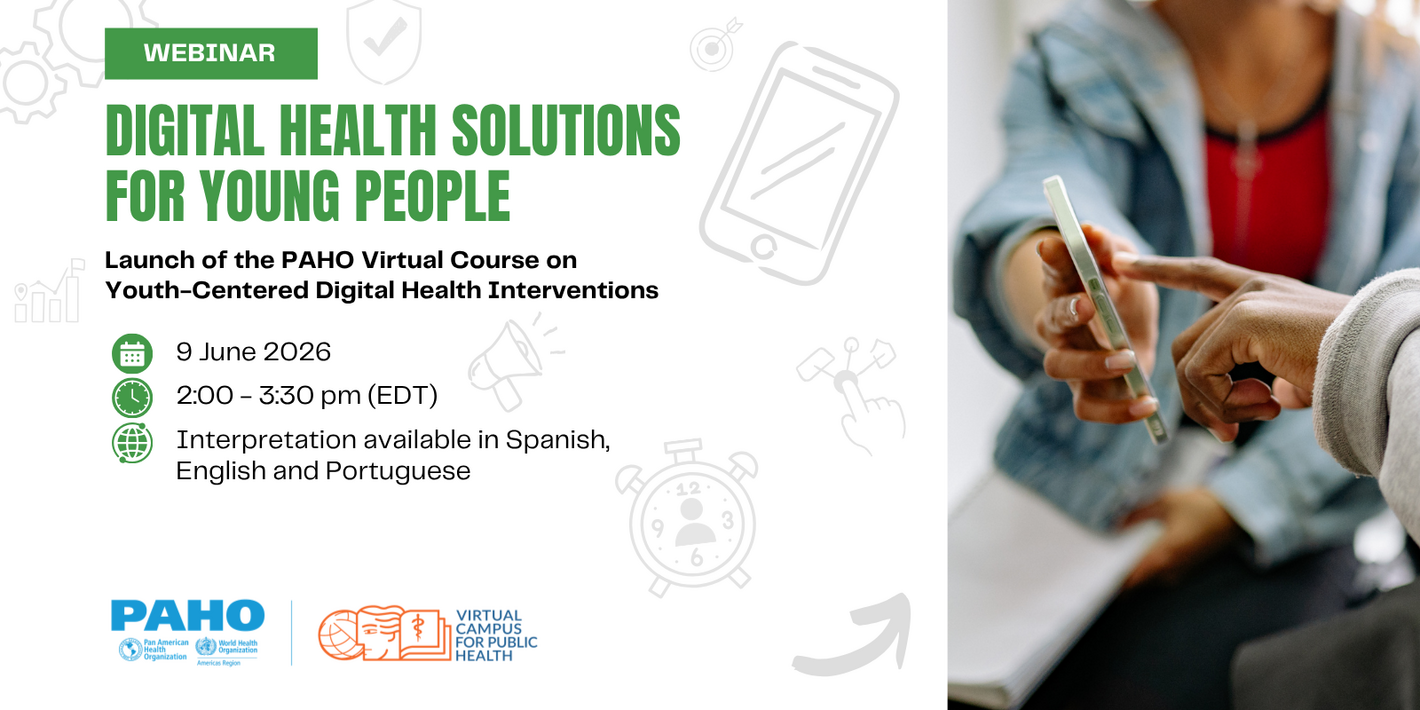
The aim will be to avoid the “traditional” webinar format of sequential presentations, but to implement a youth-co-hosted, interactive launch event designed to mirror the participatory spirit of the course itself. As the course emphasizes that young people should be co-creators, the launch event must embody that principle as well. The entire event will be co-hosted by two young leaders from the PAHO Youth for Health Group (PYHG). They will share the stage and the narrative authority from the opening to the close, including the introduction of speakers and facilitation of discussion and Q&A.
Objectives
- Officially launch the PAHO Virtual Course “Youth-Centered Digital Health Interventions” and increase the visibility across the Region.
- Inspire enrollment and engagement by showcasing real digital health innovations created by and with young people in the Region.
- Demonstrate the value and practical application of the WHO Youth-Centered Digital Health Interventions Framework in the Americas context.
- Amplify youth voices and leadership in the development of digital health innovations through active youth engagement in the webinar and beyond.
Background
Digital technologies have become a critical determinant of health and wellbeing for young people, shaping how they access information, services, and social support. In Latin America and the Caribbean (LAC), digital platforms, particularly mobile internet and social media, play an increasingly important role in the facilitation of young people’s access to health information and services, as well as the establishment and maintenance of peer connections.
At the same time, digital engagement carries risks, including exposure to misinformation, cyberbullying, harmful content, and excessive screen time, all of which can negatively affect mental health and risk behaviors. While acknowledging the risks and taking action to mitigate them, it is also important to recognize that digital technologies offer transformative opportunities to reach young people with health information and services through the platforms they already use. Yet, despite the rapid technological growth, digital health interventions targeting youth have often lacked clear frameworks, quality standards, and—critically—the meaningful participation of young people themselves in their design and delivery.
Recognizing this gap, WHO, alongside other global partners, developed the Youth-Centered Digital Health Interventions Framework in 2020. This landmark guidance outlines a collaborative and staged approach to planning, developing, and implementing digital health solutions with and for young people. The guidance aims to strengthen the quality and results of digital interventions for the health of young people, and is intended for digital health intervention designers, program managers, developers, implementers, researchers, funders and young people. Newcomers to digital health can use it as a start-to-finish primer on how to develop youth-centered digital health interventions collaboratively and responsibly.
To make this guidance more accessible to stakeholders in the Region and beyond, PAHO developed a virtual course that is currently available in the PAHO Virtual Campus in English and Spanish.
About the Virtual Course
The “Youth-Centered Digital Health Interventions” course is a free, self-paced learning experience hosted on the PAHO Virtual Campus of Public Health. It equips professionals and youth leaders with the knowledge, tools, and resources to improve the planning, development, and implementation of digital health solutions for young people.
Agenda
- Dr. Jarbas Barbosa, Director, PAHO
- Danielle Mullings and Rehman Hassan, PYHG
- Marcelo D’Agostino, Unit Chief, Information Systems and Digital Health, Department of Evidence and Intelligence for Action in Health, PAHO
- Adriana Gomez, Executive Director, Teensmart International
- Anthony Berrocal Cerdas, Digital Health and Interoperability Specialist, Ministry of Health of Costa Rica
- Mackdiel Romero and Kaj Archer, PYHG
- Moderator: Oscar San Roman, International Consultant Adolescent Health, PAHO/WHO
- Dr. Sonja Caffe, Senior Advisor, Adolescent Health, HSS/HL
- Gabriel Listovsky, Special Program Chief, Virtual Campus for Public Health, PAHO